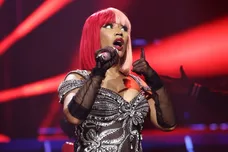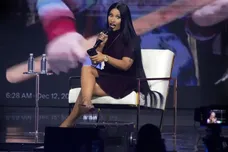
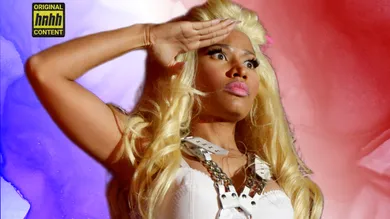


Collectively, when Nicki Minaj walked onstage at Turning Point USA’s AmericaFest, there weren't many who were shocked. Gone was the flamboyance and visual defiance. In its place was a streamlined look that matched the crowd. She sat beside Erika Kirk, widow of far-right activist Charlie Kirk, and co-signed talking points that have become somewhat gospel to conservatives.
It was the kind of rhetoric that echoes through Fox News segments and Republican campaign ads. Now, it was coming from the mouth of one of Hip Hop’s most recognizable and once fiercely celebrated stars. To some, the moment felt like betrayal, but to most, it seemed to confirm what they already knew.
Read More: Nicki Minaj Leaves Fans In Disbelief After Joining Erika Kirk At TPUSA’s America Fest
Minaj isn't one to use coded language. She has praised Donald Trump and J.D. Vance, called the Democratic Party a threat to Black America, attacked Black women online repeatedly without being provoked, and invoked moral panic as if she’d been rehearsing it. For longtime fans—many of whom are LGBTQIA+, femme, or chronically online—it was a gut punch. The world is used to Minaj trolling, but this was in alignment with ideologies that have caused an outcry both nationally and globally.
Yet, for those paying attention, this didn’t come out of nowhere. Minaj has spent years composing a public identity rooted in power. Her current embrace of MAGA is not a heel turn. It’s a continuation of an expression of values she’s shown before to protect power and attack dissent. Then, it becomes a display of loyalty even when it costs others.
The question now isn’t “What happened to Nicki?” It’s “Why didn’t more of us believe her the first time?”
Read More: Nicki Minaj Says She Doesn’t Care If Her Fans Don’t Support Donald Trump
The Pattern Of Protection: Power Over Principle
Loyalty, in Hip Hop, is treated like a code, but when devotion means shielding harm, silencing victims, or punishing critics, it becomes a strategy for preserving power.
Over the years, Minaj has made that strategy visible. When her husband, Kenneth Petty, was convicted of attempted rape and later charged for failing to register as a sex offender, Minaj unleashed on naysayers. She questioned the victim’s story, framed legal consequences as personal attacks, and, according to accusations in court filings, was tied to attempts at intimidation.
Then, in 2017, after her brother Jelani Maraj was convicted of repeatedly sexually assaulting an 11-year-old child, she submitted a letter asking for leniency, calling him "the most patient, gentle, genuine, giving selfless man I know." Maraj was sentenced to 25 years in prison.
Read More: DL Hughley Jokes Nicki Minaj Should Be Worried About Chris Hanson, Not Gavin Newsom
She has also often called in her cavalry of Barbz to go after those who investigate or question her affiliations. None of this is random. Protect those close to you and attack those who challenge you. Reframe accountability as hate. Recast criticism as betrayal. It’s the same logic that animates the far-right political space she’s now stepped into, where loyalty is prized, and harm is minimized. More importantly, a failure to fall in line is punished.
A History Of Twitter Rage & Politico Signaling
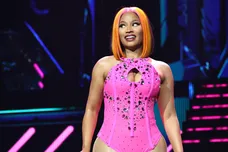
The version of Nicki Minaj that first reached the mainstream was bizarre and covered in pink. She rapped in accents, had colorful wigs, and made cartoonish facial expressions that her fans loved to imitate. Minaj called herself Barbie, the pop culture peak of femininity and fantasy.
For years, fans treated her as an avatar of empowerment. The Barbie persona felt like permission to take up space, to be bold and loud and unserious in a world that asks Black women to shrink. Moreover, Minaj used social media like a live microphone. She broadcast grievances and political signals in the same breaths she used to defend herself against industry criticism. Her Twitter/X timeline was the center of her online meltdowns, serving as a record of how her worldview evolved and which political narratives she boosted.
Read More: Nicki Minaj Goes On Unprompted Rant About Trans Kids & Gavin Newsom
As early as 2010, when her star was still rising, she referenced Donald Trump in discussing standards for strong women. At that point, it wasn’t overtly political, more observation than endorsement. Still, it placed her language in proximity to power at a moment when Trump himself was a reality TV star, not yet a politician.
In 2012, she dropped a line on Lil Wayne's track "Mercy" seemingly endorsing Mitt Romney's bid for president. “I’m a Republican voting for Mitt Romney, you lazy b*tches are f*cking up the economy," she rapped. Then, in 2015, while speaking to Billboard, she was again tangled in mixed signals about Trump. It quietly signaled a willingness to engage with ideas on both sides rather than to anchor herself to one camp.
Read More: Nicki Minaj Calls JD Vance An "Assassin" In Front Of Charlie Kirk's Widow Erika
Years later, at the 2020 Pollstar Live conference, she explicitly rejected the idea of joining a “Donald Trump bandwagon." At the time, the images of family separation at the border hit her personally. She spoke about crossing into the U.S. as a child and the horror that policy stirred in her. Regardless, even in distancing herself from Trump’s policies, she wrapped her comment in humor, saying she found him “funny as hell” on Celebrity Apprentice. One part of her message opposed a policy harming children. Another part leaned into the man who advanced it.
In came 2021, when she tweeted an unverified anecdote about COVID‑19 vaccines that quickly became one of the most widely circulated examples of celebrity misinformation during the pandemic. Her refusal to accept expert guidance early on became part of a broader pattern. It positioned her against elite institutions and scientific authority, and aligned her with rhetoric that would later be politicized on the right.
Read More: JD Vance Channels Nicki Minaj To Tell Americans They "Don't Have To Apologize For Being White"
Over the next few years, her online behavior showed consistent logics. Minaj operated on the principle of blame first, nuance last, and hostility toward perceived enemies. On X, she aggressively attacked artists like SZA and industry executives like Jay‑Z and Roc Nation leadership, calling into question their integrity and accusing them of plotting against her career, even as history and sales figures positioned her as one of the most successful and long‑lived women in Hip Hop. There were also her rifts with Remy Ma, Cardi B, Lil Kim, Latto, Mariah Carey, and Loni Love.
We can't ignore her unleashing on Megan Thee Stallion, aligning with Tory Lanez, and penning a questionable diss track while calling the Houston rapper, who was shot in 2020, a liar. Lanez was named as the shooter by Megan and was found guilty of assault with a firearm, illegal gun possession, and negligent discharge of a gun in connection with the incident. He has maintained his innocence while behind bars.
Read More: Nicki Minaj Divides Fans By Praising Donald Trump
By 2025, she crossed from social media commentary into full political alignment, reposting a White House video on X touting policy victories, and publicly defending Trump on issues like persecution of Christians abroad, specifically in Nigeria. When LGBTQ+ fans questioned her support, she reframed their concerns as self‑absorption, suggesting that her own experiences with political harassment were more urgent than theirs.
Read More: Nicki Minaj Faces Backlash For Sharing Donald Trump's Supposed Achievements
Queer Currency, Cashed Out
From its onset, queerness surrounded the Nicki Minaj brand. It showed up in her fashion, her dedicated Barbz fanbase, and in cultural references. Her visuals borrowed from drag and ballroom, and her persona, especially in the early years, was drenched in exaggerated performance. Minaj was known for her inflated voices and doll-like aesthetics that long permeated, or were staples in, the LGBTQIA+ community. She even appeared as a judge on RuPaul's Drag Race, sitting alongside queer drag queens and encouraging them on their journey.
The Barbz understood it immediately. Many were gay, queer, trans, nonbinary, femme, or marginalized, and they saw something of themselves in the theatrical armor she wore. Even today, a quick visit to any social media platform will show that they still defend her fiercely, regardless of any controversy. The Barbz made Minaj feel larger than the industry that never quite knew what to do with her.
Read More: Nicki Minaj Stirs Controversy By Supporting Donald Trump’s Granddaughter Kai
As her platform grew, the signals pivoted. Early on in her career, Minaj discussed being perceived as bisexual, a title she didn't shy away from as she reportedly initially identified as queer. However, during a 2012 interview with Rolling Stone, the rapper admitted she said that for attention. While that shook up her Barbz back then, it wasn't a revelation that caused outrage. Then, when she dropped a verse for Doja Cat's "Say So," Minaj claimed she used to be bisexual, but now she's "hetero."
In more recent years, the gay icon posturing dulled. That tension exploded at the Turning Point USA stage. By parroting anti-trans talking points online and beside Erika Kirk, Minaj aligned herself with a political machine that has made cruelty its brand. This wasn’t nuance or political confusion. She sat beside the wife of the late Charlie Kirk, who, just last year at a college campus debate event, told students that he would never consider Minaj a good example for "18-year-old Black girls." Still, Nicki appeared at an event hosted by his wife to weaponize far-right narratives.
The MAGAfication Is the Point
The right doesn’t need Nicki to legislate; they need her to distract. With Candace Owens, who has long been on the MAGA bandwagon, reportedly defecting to become a moderate, there is a vacancy waiting to be filled. Moreover, it’s no coincidence this political alignment comes at a time when she’s under pressure. Legal costs are piling up. Her husband is legally restricted in his movement as a registered sex offender. Her home is reportedly at risk.
Read More: Nicki Minaj Celebrates Donald Trump Using "Beez In The Trap" In Latest TikTok Post
It’s easy to mock this moment or call it a fall-off. Yet, the consequences of this alignment aren’t abstract. When celebrities pivot into politics, we can't simply say they're publicly sharing their opinions when they've built a brand off of mobilizing their followers. Someone like Nicki Minaj brings numbers and narratives. Here, she carries decades of cultural credibility into a room that intends to use it to advance policies that harm the very people who helped build her career.
The signs were always there. Some just chose not to see them. Now that the mask has slipped, or been ripped off, there’s no excuse for pretending this is confusion or a misunderstanding. This isn't chess versus checkers or someone infiltrating the opposition. This is about what Nicki Minaj really believes behind closed doors, and who she's willing to stand alongside.