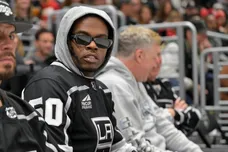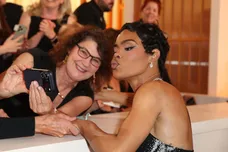
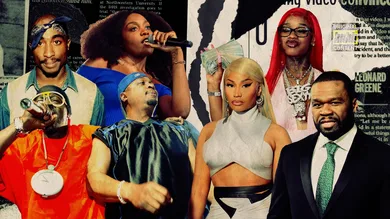


Weeks ago, some of Hip Hop and its most recognizable adjacent artists gathered at Mar-a-Lago. Sexyy Red, 50 Cent, Robin Thicke, Amber Rose, and more attended a wedding celebration for an advisor to President Donald Trump, appearing comfortably within the orbit of a political figure whose policies remain deeply controversial in Black and immigrant communities. Earlier, Nicki Minaj publicly called Trump her favorite president and was photographed holding his hand.
During that time, a different set of images circulated. Federal immigration enforcement operations in Minneapolis left U.S. citizens dead. Civil rights investigations opened, and residents filled the streets in protest. The Jeffrey Epstein files resurfaced conversations about power, exploitation, and the protection of the wealthy and politically connected, including Trump’s name in long-disputed documents. Both realities existed simultaneously.
Read More: Nicki Minaj Will Speak During Donald Trump's Crypto Forum At Mar-a-Lago
Some artists have used award stages and interviews to speak directly about immigration enforcement, incarceration, and violence at the hands of the state. Others have chosen alignment with political power. At the same time, a familiar refrain resurfaces whenever rappers address policy, and it usually lands as 'keep politics out of music.' Separate the art from the artist. Stay in your lane. In Hip Hop, that separation has never been clean.
The culture was born from over-policing and economic abandonment. It did not emerge as neutral entertainment. It arose because the communities that built it were shaped by legislation, housing policy, the expansion of the criminal justice system, and federal neglect. Early songs were political records. They translated policy into lived consequences.
That makes this moment, in history and in music, more than just celebrity optics. As several mainstream artists publicly align with political leadership whose policies directly affect the communities that created Hip Hop, another narrative quietly gains traction that the genre itself is not inherently political. Its protest roots are being framed as incidental rather than foundational. Rappers should be entertainers first and citizens second.
Hip Hop has always been political because the conditions that produced it were political. Attempts to detach the culture from that truth do not neutralize it. They rewrite it.
Hip Hop Was Born Political
In the 1970s, the Bronx was burning. Redlining hollowed neighborhoods, and public schools were crumbling. It was a time when policing intensified, and media coverage reduced entire communities to statistics. Young Black and Latino kids built a culture out of turntables, block parties, and discarded sound systems because no one else was coming. That act alone was political.
When Grandmaster Flash and the Furious Five released “The Message” in 1982, it was not framed as activism. They were reporting on the very neighborhoods they lived in. “Broken glass everywhere” was not a metaphor but a description. The record forced middle America to hear what it had chosen to ignore.
Read More: Uncle Luke Confirms He’s Running For Congress In Florida
Soon, Public Enemy was addressing police violence and a distortion of Black history in white spaces. N.W.A. did not write a polite editorial when they recorded “F*** tha Police.” They documented a relationship between law enforcement and Black communities that many Americans insisted did not exist. None of this was partisan because it was a lived reality on wax.
Federal crime bills expanded incarceration and mandatory minimums, restructuring entire neighborhoods in the 1990s. Artists continued to narrate what policy papers refused to humanize. Tupac Shakur wrote about poverty and systemic neglect with the urgency of someone inside it. Dead Prez named the prison-industrial complex directly. Lauryn Hill framed miseducation as spiritual violence. The culture did not become political when someone recorded a protest anthem. It was political the moment marginalized youth decided their reality deserved amplification.
Read More: Pharrell Faces Backlash After Explaining His Hatred For Politics
When Hip Hop Became Mainstream
The '90s saw Hip Hop move from neighborhood jams and regional radio to international boardrooms. What began in the Bronx had become a billion-dollar industry. Corporations that once dismissed Rap as noise now structured entire marketing divisions around it. Fashion houses, liquor brands, tech companies, and political campaigns all learned the same lesson that Hip Hop moved culture. With that influence came scrutiny, and with scrutiny came pressure.
As artists signed larger deals and labels consolidated under corporate umbrellas, political speech began to carry financial consequences. Songs that talked politics were often categorized as “conscious” Rap, a term that subtly suggested niche relevance. Artists such as Mos Def and The Coup continued to question state authority and militarism, but those conversations rarely dominated commercial radio. Political analysis remained part of the culture, though often pushed to the margins.
Read More: A$AP Rocky Wants To Run For Mayor Of New York City
Then came the uprisings in Ferguson and Baltimore. When footage of police killings circulated, Hip Hop responded immediately. Kendrick Lamar’s “Alright” moved from a powerful track to a Black Lives Matter protest chant, echoing through streets filled with tear gas. J. Cole traveled to Ferguson in 2014 following the Mike Brown being shot and killed by police. Beyoncé’s Super Bowl performance drew visual parallels to the Black Panther Party, prompting political backlash that revealed how fragile the tolerance for Black political symbolism remained.
Commentary moved from the content of the protest to the messenger's appropriateness. Public discourse questioned whether entertainers should comment on policy at all. The expectation was clear that they were to perform culture, not critique power.
Read More: 50 Cent Jokes That Kanye West & Nicki Minaj Inspired Him To Avoid Politics
The Modern Resistance Lineage
Political engagement in Hip Hop did not disappear when the genre became corporate. It adapted and recalibrated, finding new language for old systems. As cellphone footage made police violence unavoidable, artists didn't wait for press briefings to validate what communities already knew.
YG and Nipsey Hussle released “FDT” during the 2016 election cycle. The title left little room for ambiguity. Radio stations debated whether to censor it. The Secret Service reportedly contacted YG’s label regarding the record. That reaction stressed the point that Hip Hop’s defiance was not symbolic. It was audible enough to draw federal attention.
Read More: Sexyy Red Performs At Donald Trump Advisor's Wedding, Nicki Minaj Attends
Noname has consistently challenged capitalism, policing, and the commodification of Black suffering, even when that stance complicated her relationship with mainstream Rap audiences. Her book club initiative moved political education offline and into community practice. That extension of art into civic engagement reflects Hip Hop’s original function as informal schooling.
Rapsody constructs lineage directly into her work, naming Black women whose histories are often sanitized or omitted. Meek Mill’s public battle with the criminal justice system shifted into advocacy once his case exposed procedural irregularities. His involvement in reform efforts complicated perceptions of celebrity activism.
Read More: Nicki Minaj Labels Herself Donald Trump’s “Number One Fan"
Moreover, women in Rap have been especially direct in recent years. Cardi B has publicly criticized immigration policy and federal leadership through social media and interviews, translating frustration into plain language for millions of followers. Megan Thee Stallion authored a national op-ed defending Black women, situating personal trauma within systemic misogynoir. Doechii used award show visibility to condemn governmental overreach and call for collective resistance.
These artists do not share the same ideology or the same strategy. They recognize that ICE raids, racist policing practices, housing instability, violence against women, and incarceration policies directly affect the communities that built this genre. Resistance in Hip Hop has never required unanimity, but it does require witness.
The Proximity To Power
Further, Hip Hop has always had a complicated relationship with power. The culture emerged from systemic neglect, yet its success has required negotiating with institutions that once criminalized it. That tension is not new. What feels different now is how explicit the alignment has become. In recent years, several high-profile artists have moved beyond challenging power to standing alongside it, and they don't care how it affects the very fans and communities that helped build their fame.
Some alignments seem transactional. Lil Wayne met publicly with Donald Trump in 2020 to discuss the proposed “Platinum Plan” for Black America. Weeks later, he received a presidential pardon on federal gun charges. Kodak Black also received clemency in the final hours of that administration and has since spoken favorably about the president who granted it. Clemency often complicates allegiance. The optics, however, remain political.
Read More: The MAGAfication Of Nicki Minaj
Other engagements present themselves as a strategy. Ice Cube developed the “Contract With Black America” and acknowledged conversations with both Democratic and Republican campaigns during the 2020 election cycle. He framed his position as policy-driven rather than partisan. Critics argued that timing matters.
Then there is economic alignment. 50 Cent publicly stated he preferred Trump’s tax policies over proposed increases under Democratic leadership. Nicki Minaj has become Trump's biggest fan, posting about his greatness and appearing at far-right events. Sexyy Red has expressed support in interviews and online commentary. Fivio Foreign and Annuel AA attended a Trump campaign rally. Sheff G and Sleepy Hallow have also appeared at campaign events. These moments are not coded.
Read More: Lil Wayne & His Trump Lyrics: A Love Letter To Power
There is also a smaller but growing subculture of explicitly Conservative Rap. Artists such as Forgiato Blow and Bryson Gray build careers around pro-Trump messaging and anti-progressive rhetoric. This movement positions itself as countercultural within Hip Hop, proving that the genre is not a monolith but carries political weight.
Silence, Fear, & The Cost Of Speaking
The modern music industry is not only about records. There are sponsorships, brand alignments, streaming partnerships, global touring markets, and corporate companies whose interests extend far beyond culture. A public political stance can threaten contracts. It can trigger organized backlash campaigns and narrow booking opportunities in certain regions. Artists are aware of this.
To critique immigration enforcement or presidential leadership is to risk being labeled divisive. To remain silent is to remain marketable. That is the quiet equation many public figures navigate. A single political statement can produce days of trending outrage and harassment. Algorithms reward conflict but rarely nuance. Labels and management teams often advise caution, not because they disagree with the sentiment, but because they anticipate financial fallout.
Read More: NBA YoungBoy Shocks Fans By Defending Donald Trump On New Song, "XXX"
Yet, silence is not apolitical. In moments of active policy harm, absence reads as distance. This is primarily because Hip Hop’s origins were not neutral. Pharrell faced an outcry when he publicly stated that he doesn't "do politics," as a Black man from the South. The culture exists because mainstream institutions refused to document the realities of marginalized neighborhoods. To decline to speak now, when similar dynamics persist, represents an exit from that foundation. Fear is understandable, and backlash is real, but so is the lineage.
Read More: Cardi B Trolls U.S. Homeland Security Amid Partial Government Shutdown
Hip hop does not have to endorse a party to remain political, but never did. It was political when young people across New York City's boroughs described neighborhoods abandoned by officials. It was political when West Coast artists documented over-policing long before national media acknowledged it. Then, it was political when Southern rappers narrated poverty in regions dismissed as culturally disposable. The politics lived in the act of naming what others ignored.
That history matters now.
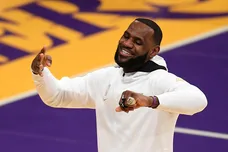
When athletes speak about state violence, they are told to stay in their lane. LeBron James was told to “shut up and dribble” after criticizing presidential rhetoric. Colin Kaepernick was effectively pushed out of the NFL after kneeling during the national anthem to protest police brutality. Musicians have heard the same refrain. The Chicks were frozen out of the industry after criticizing the Iraq War. Beyoncé has consistently faced pushback for highlighting Black culture in her music and imagery. Rappers are told to just rap. Stick to music and leave policy alone, because no one wants to hear your opinion.
The culture has always documented what power does to people. Whether that documentation continues without dilution is not a question for politicians. It is a question for the artists holding the microphone.