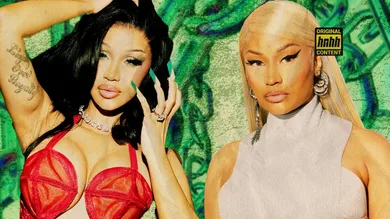


The back-and-forth between Cardi B and Nicki Minaj may be trending again, but none of this is new. The timing of the tension struck just in time for the celebration of Cardi's No. 1 charting sophomore album, Am I the Drama? These two have been at each other's necks for years, but every time one woman seems to come out on top, the conversation shifts to who’s next to knock her down.
That pattern didn’t start with Cardi and Nicki. It didn’t even start with Kim and Foxy. This particular corner of Hip Hop has always made room for women, but rarely at the same time. Then, when it does, the industry tightens the space, not to highlight their differences, but to force them into competition. It's presented as there is only room for one queen. A singular crown with a lonely throne. One woman at a time.
Read More: Mount Rushmore: The Women Of Rap
Throughout Hip Hop history, there have been plenty of beefs between women in Rap that have jolted the culture. We've gathered a few notable rifts that have etched themselves in Hip Hop lore, but our list is certainly not exhaustive. This is a record of how often the culture demands conflict from women to prove they belong.
Many of these tensions were rooted in bars, while others in business, and some were just straight up personal beefs. Several were settled, others never had the chance. Yet, all of them sit inside a legacy that deserves more context than clickbait and more honesty than hashtags. It hangs in the balance of gossip and history.
1. Roxanne Shanté Vs. The Real Roxanne
Read More: Ladies First: Roxanne Shanté Talks Preserving Hip Hop With Rock The Bells Festival & Giving The OGs Their Flowers
In 1984, 14-year-old Roxanne Shanté recorded “Roxanne’s Revenge,” a response to UTFO’s “Roxanne, Roxanne.” Her version flipped the song’s premise and dragged the group by name, turning her into an instant presence on New York radio. Soon, the track caught fire, and so did the industry’s interest. UTFO responded by manufacturing a new character, The Real Roxanne, and launching her as Shanté’s rival. The back-and-forth grew into a marketing storm known as the Roxanne Wars, spawning over 100 response tracks and defining the era’s obsession with battle.
However, the tension wasn’t real but structured. The Real Roxanne wasn’t an emcee who had been disrespected and chose to clap back. She was a label response to a young Black girl who got too loud without permission. It was a blueprint for how the industry would continue to pit women against each other under the guise of "competition."
2. MC Lyte Vs. Antoinette
Speaking of competition, the early days of Hip Hop didn't necessarily need drama. Two women could go head-to-head on the mic without calling it a feud. Still, if you were paying attention in the late ‘80s, you caught the discord.
Antoinette’s “I Got an Attitude” was confident and direct, but word around the boroughs was that her sound borrowed heavily from Audio Two, best known for “Top Billin’” and closely tied to MC Lyte. Lyte allegedly did Audio Two a favor and answered with “10% Dis,” and it wasn’t vague. She called Antoinette out in plain language, questioning her style and her legitimacy. The track hit hard, but it stayed on wax.
What followed was a handful of returns. Antoinette dropped "Lights Out, Party’s Over," but it never turned theatrical. Just two femcees using the tools they had in their voices and pen games. For all the talk of women in Rap being too emotional, this was structured sparring.
3. Foxy Brown
Queen Latifah
Read More: The Top 50 Best Female Rap Albums Of All-Time
The first jab came tucked inside a soundtrack. On “Name Callin’,” a solo cut from the Set It Off album, Queen Latifah came hard. She didn't name names, but the energy was pointed as she took aim at artists with little substance behind the mic who were more focused on image. The track dropped in 1996 and by that point, Foxy Brown was everywhere. The New York femcee had Platinum records and a style soaked in sex and confidence. People connected the dots and believed the Queen was referring to the Ill Na Na.
Foxy didn’t ignore it. She clapped back by questioning Latifah’s sexuality, and painted her critique as bitterness masked as respectability. In 1998, she dropped her own response with a diss record also titled “10% Dis”—recycling the name of MC Lyte’s earlier classic, but this time aimed at Latifah. Foxy leaned into accusations and character shots, dismissing Latifah as outdated. They never responded to each other again.
Lil' Kim
Both came up in the mid-’90s, co-signed by major players in Hip Hop like Biggie and Jay-Z. They also both arrived fully formed in fur coats, raunchy bars, and no interest in being quiet. From the outside, they looked like mirrors, but Foxy Brown and Lil Kim were treated like rivals before they had time to become anything else.
There was talk of a joint album and reportedly, promotional photos even surfaced. However, nothing dropped, but what did come were subliminals and interview shade. Then there were the direct shots on diss tracks. By the early 2000s, their entourages were physically clashing outside Hot 97. In 2001, a shootout outside the station left one man wounded and Kim facing perjury charges for lying about who was there. She eventually served a year in federal prison.
4. Nicki Minaj
Lil Kim
Accusations of Nicki Minaj copying Lil Kim's image without credit were rampant by the time Pink Friday dropped. Wigs, mixtape covers, and photoshoots mirrored Kim's style, but it wasn't widely acknowledged by Minaj. Although Nicki rarely named Kim directly, on “Roman’s Revenge" she rapped, “So f*ck I look like gettin’ back to a has-been?” Kim returned fire with “Black Friday,” calling Nicki an industry puppet and mocking her as a clone.
Neither backed down. They traded insults through records and interviews, with Kim lamenting that Minaj didn't want any other woman in Rap at the top except for herself. This all turned what could’ve been a handoff between eras into a standoff that shaped the next decade of femcees. The silence between them still speaks volumes.
Remy Ma
Read More: Remy Ma Shares Nicki Minaj Pic "#B4TheButtJob" And Deletes It
Tension between Nicki and Remy had been building quietly, but it broke open in 2017 with “ShETHER.” Over seven minutes, Remy unloaded bar-for-bar shots, accusing Nicki of ghostwriting, industry manipulation, and sleeping her way to the top. The track borrowed its beat and title from Nas’s "Ether" and was a calculated hit that quickly went viral.
Nicki waited, then responded with “No Frauds,” a radio-friendly track featuring Drake and Lil Wayne. Critics said it lacked the urgency of Remy’s diss, but Nicki never flinched. Her bars were focused on chart stats and allies, while Remy kept the pressure on with follow-ups like “Another One.” The tit-for-tat eventually cooled, but the moment marked one of the few times someone stood toe-to-toe with Nicki and got the last loud word, at least in the eyes of the streets.
Cardi B
Read More: Nicki Minaj Makes Bold Promise About Cardi B's Scathing Comments
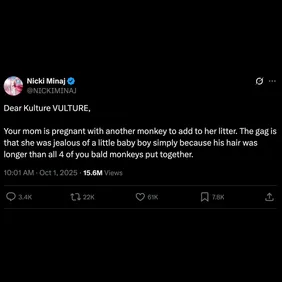
There were rumors of some ills behind the scenes, but when Cardi B’s “Bodak Yellow” hit No. 1 in 2017, Nicki didn’t congratulate her publicly amid talks of competition. People noticed, and soon, more surfaced. Cardi played it cool in interviews, saying there was no issue. However, the questions kept coming, and the energy shifted every time they shared a room. There was also the gossip surrounding "Motorsport," where both artists were featured. Yet, the rollout felt off. Their verses were reportedly changed. Cardi later admitted they didn’t shoot the video together. It was clear they weren’t aligned.
Then, things got louder in 2018. At New York Fashion Week, they clashed physically, with Cardi leaving with a knot on her head and her shoe thrown at Nicki. Online, the feud spun out through IG captions, leaked footage, and longwinded rants. They've tried to keep distance, but the static never fully died. Subtweets and lyrical jabs have kept their names tethered, even without direct shots.
Read More: Nicki Minaj Debunks "Motor Sport" Conspiracy Theories About Cardi B
This latest round came after Cardi’s sophomore album, Am I the Drama?, debuted at No. 1. Soon after, Nicki jumped online to tease a single dropping in 2026, six months later. Fans read it as shade before the two women were back to trading insults on Twitter with no reconciliation in sight.
Megan Thee Stallion
Read More: Nicki Minaj & Megan Thee Stallion Beef: A Timeline
At first, it all looked like support. Nicki Minaj joined Megan Thee Stallion in 2019 on Instagram Live to tease their collaboration “Hot Girl Summer,” laughing together and showing what mutual shine could look like between women at the top. However, things quickly took a turn for the worse. Later, Megan teamed up with Cardi B for “WAP” in 2020, resulting in Nicki unfollowing her. Megan stopped mentioning Nicki in interviews, and Nicki’s fans, already known for policing loyalty, escalated the tension online.
Four years later, the silence broke. After Megan dropped “Hiss,” a bar about “hoes mad at Megan’s Law” was widely interpreted as a reference to Nicki Minaj’s husband, Kenneth Petty, a registered sex offender. Not long after, Nicki responded with “Big Foot” following a lengthy Twitter rant and livestream. The diss track mocked Megan’s height, trauma, and late mother. Minaj also framed Megan naming Tory Lanez as the man who shot her in 2020 as a lie.
Read More: Nicki Minaj’s Public Reckoning Names SZA, But Wounds Run Deeper
The title "Big Foot" itself was a jab, playing off internet mockery of Megan’s physicality. Minaj followed up by posting taunting tweets and memes. This missed friendship turned into a digital assault, with Nicki using the mic and social media as weapons.
Latto
Read More: Nicki Minaj Shades Megan Thee Stallion, Latto On "Red Ruby Da Sleeze"
This beef didn't unfold on wax but online. In 2022, Nicki publicly criticized the Grammys for moving “Super Freaky Girl” out of the Rap category, arguing that if her song wasn’t considered Rap, then neither should Latto’s “Big Energy.” The Queen of da Souf rapper responded on Twitter, pushing back against the comparison. The exchange spiraled quickly. Screenshots, voice notes, and accusations spilled out, including Latto calling Nicki a “40-year-old bully,” and Nicki calling Latto a “Karen.”
What made the moment wasn’t just the words. Latto had previously cited Nicki as a major influence, even uploading a video of a poster size version of Minaj's tweet praising the Atlanta star. The fallout wasn’t about bars or charts but power, and who gets to critique the machine without alienating the next wave. The tweets eventually stopped, but the aftermath still reverberates.
Khia Vs. Trina
Read More: Trina Addresses Beef With Khia: "The Level Of Disrespect Is Beyond"
Khia’s debut single, “My Neck, My Back,” hit in 2002 and was quickly compared to Trina’s sexually explicit style. From there, Khia did most of the talking. Over the years, she repeatedly dissed Trina by accusing her of ghostwriters, degrading her physical appearance, and calling her out online. She dropped lines like “Trina can’t rap” and once called herself “the baddest” long after Trina had already claimed the title. Trina rarely responded, choosing to dismiss the drama.
Trina finally addressed the feud by dismissing Khia and saying she’d never battle someone beneath her. That only reignited Khia’s commentary. However, despite the longevity of the jabs, this was never a lyrical war. Trina refused to engage when she felt as if she was simply being baited into an unnecessary fight. It just became Khia taking aim whenever the spotlight found her, and Trina swatting the tension away. Still, it remains one of the longest-running, one-sided rivalries in Hip Hop.
Notable Mentions
Read More: Cardi B Opens Up About Beefing With Other Female Rappers Ahead Of "Am I The Drama?"
Not all conflicts made it to the booth, but many still surfaced through social media posts, interviews, or subliminal shots. CupcakKe’s 2021 diss tracks called out Megan Thee Stallion, Cardi B, City Girls, and Doja Cat. Sukihana fired back briefly on Twitter, but the exchange ended there. Azealia Banks, true to form, took aim at Rico Nasty and also lashed out at Doja Cat multiple times, accusing her of being inauthentic without reply.
These weren’t major feuds but flare-ups or attempts to bait reactions. Still, they reflect the same conditions that fuel bigger beefs in an ecosystem that watches women in Rap beef more closely than it supports them. Not every slight is manufactured, and not every clash is rooted in industry mechanics. Some of this is ego shaped by the game, but fully owned by the people playing it. Some are driven by envy and others by insecurity. A few are calculated grabs for clicks. And sometimes, it’s just one artist not liking another’s success. Whatever the motive, the outcome is the same, where friction becomes the headline, and the music often ends up secondary.