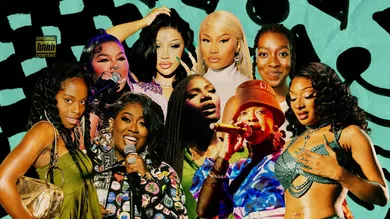


Ranking the best female rap albums of all time is no easy task. Overall, there are hundreds of talented women who have made a name for themselves in the world of hip-hop. Moreover, many of these women are responsible for creating entire movements within the culture. The originators helped lay the foundation for the artists we have today. While the artists of today are forging a path for the women of tomorrow.
Throughout the last 40 years, women have given us some of hip-hop's most iconic and classic records. From the late 80s until today, the innovation has been fun to watch, and even more satisfying to document. Narrowing this list down to 50 albums was a tall task. After all, significant albums had to be left out. Consequently, this is HotNewHipHop's most ambitious list to date, and we know our readers will be having some epic debates about these placements.
With that being said, please enjoy HotNewHipHop's Top 50 best female rap albums of all time.
50. JJ Fad - Supersonic The Album
We are starting out our Greatest Women Rap Albums of All Time list with a pretty important record in terms of production. That would be Rialto, California’s electro and West Coast trio, J.J. Fad. Baby-D, MC J.B., and Sassy C worked in great unison with legends of the region in Dr. Dre, DJ Yella, and Arabian Prince. Of course, they all went onto form one of the most vital groups the genre has ever seen in N.W.A. If you are a first time listener of Supersonic, but are fans of the classics from its aforementioned beat smiths, then you’ll surely enjoy this nonstop dance party of an album. It’s title and intro track gets all the shine for being a commercial smash and the first song from a female rap group to earn a GRAMMY nod. But the grooves and vibes are carried throughout the rest of the focused tracklist.
- Zachary Horvath
49. Salt-N-Pepa - Blacks' Magic
By the time Cheryl James and Sandra Denton dropped their third album Blacks’ Magic in 1990, the group hadn’t fully formed out all the crossover hits they would go on to boast today. But they had a lot of the repertoire already, and this album showed Salt-N-Pepa evolve their artistry with earthier drum patterns, more fleshed-out song concepts, more soulful melodies, and an overall nostalgic aesthetic that even the cover art reflects. While there are still plenty of noisy and more funky pop appeals that root this record in hip-hop’s ‘80s era, the duo’s chemistry with a wider production roster still shines through. As one of the earliest perfectionists of trading bars off and creating magic from it, this combination of perspectives and humor really resonates. Sure, the hits may dominate James and Denton’s legacy, but projects like Blacks’ Magic show that the vision went far beyond any one formula.
- Gabriel Bras Nevares
48. Heather B - Taken Mine
Heather B was the pioneer of the reality rap album long before Cardi B and Joseline Hernandez. As one of the original reality TV stars on MTV's The Real World, she gave viewers a sneak peek of her rap skills on the show. This groundbreaking moment marked the first time that reality TV, rap music, and organic publicity came together to create a successful product. Following a traditional rap style like Queen Latifah, Heather’s debut album picked up where Real World left off by delivering more content that stops being polite and starts getting real. The album featured authentic, straightforward lyricism rooted in street realism and social commentary. Notable singles such as “All Glocks Down” and “If Headz Only Knew” stood out. Her debut helped establish the idea that women in hip-hop are not a monolith, paving the way for diverse voices to flourish on their own terms.
- Bryson "Boom" Paul
47. Rico Nasty - Anger Management
Back in 2019, Rico Nasty teamed up with Kenny Beats for Anger Management, an album that has become a mission statement for Rico’s entire sound and career. Overall, this is one of those projects that smacks you in the face with the opening track, and it doesn’t stop until the proverbial end credits roll.
From the very first track, “Cold,” we get Rico’s infectious energy, along with some thunderous production that complements the artist’s vibe to perfection. Meanwhile, Rico’s flows throughout the project feel like precursors to projects like Playboi Carti’s Whole Lotta Red. In many respects, Rico is partially responsible for the rage rap sound we hear today. This makes Anger Management an influential album that deserves recognition on this list. Sure, Rico has a plethora of dope albums. However, Anger Management is the album that fans will forever gravitate towards.
- Alexander Cole
46. Queen Latifa - Nature Of A Sista'
Sure, Queen Latifah’s 1989 iconic debut, All Hail the Queen, announced her presence on the scene. Yet, her sophomore album in 1991, Nature of a Sista, walked a different path. It was an ambitious blend of Jazz, Reggae, New Jack Swing, and Hip Hop over a foundation of Black femininity. Latifah rapped with conviction on tracks like “Latifah’s Had It Up to Here,” where she defended her sovereignty. The smooth “How Do I Love Thee” showed that women could be sensual and not only submissive. Moreover, “Nuff of the Ruff Stuff” cut through relationship games with a confidence rarely claimed by women in Rap.
Despite Nature of a Sista’s current status as a classic album, at the time of its release, it didn’t garner huge numbers. Its softer tones and genre-wandering confused some listeners and led to Tommy Boy Records parting ways with Latifah. However, that creative risk didn’t cost Latifah her legacy. Instead, it deepened the sonic lineage she’d already begun. She invited Black women into the booth on their own terms, blending femininity with lyrical authority. Nature of a Sista belongs on the list because Queen Latifah proved that innovation, not safety, is what makes a classic.
- Erika Marie
45. Trina - Diamond Princess
Trina’s Diamond Princess is undoubtedly one of the most pivotal albums in women’s hip-hop. She had out grown as her moniker as the “Baddest Bitch” and expanded the influence as the Diamond Princess of female rap. Taking the genre beyond its traditional strongholds on the East and West Coasts. Following her explosive debut, Da Baddest Bitch, this album established Trina as more than just a breakout star; she emerged as a cultural powerhouse, reshaping Miami’s role in the hip-hop scene. With bold tracks like “No Panties” and “Told Y’all,” Trina embraced her sexuality while asserting her dominance, independence, and financial savvy. She flipped the script on gender dynamics, demonstrating that women could wield sensuality as a form of empowerment rather than exploitation. Diamond Princess became the definitive blueprint for unapologetic, glamorous, and authoritative female rap, inspiring icons like Nicki Minaj, Cardi B, and Megan Thee Stallion. By blending explicit lyricism with Southern swagger, Trina didn’t just carve out her space in the culture—she redefined it, proving that Miami women could lead the charge in hip-hop’s evolution.
- Bryson "Boom" Paul
44. Doja Cat - Scarlet
Doja Cat set out with an explicit mission in 2023: To reassert her status as a rapper. After releasing a slew of incredibly successful pop songs, such as “Kiss Me More” and “Say So,” she felt her hip-hop chops were being forgotten. "Don't ever fckin disrespect me as a rapper. After the last song I dropped, you will respect my pen and that's fckin that,” she wrote on Twitter in 2021, after BET faced backlash for nominating her for the award of Best Female Hip Hop Artist. Two years later, she finally proved the critics wrong with Scarlet. She kicked its promotion off in a dark and confident direction with the lead single, "Paint the Town Red." It was a massive success. When the album finally arrived, she earned another top-10 single with "Agora Hills.” Even if Doja Cat returns to a more “pop-driven” direction with her next album, Vie, Scarlet will remain an iconic installment in her discography.
- Cole Blake
43. Yo-Yo - Make Way For The Motherlode
“Don’t play with my Yo Yo” is a phrase that spans over three decades and continues to be sampled in women’s hip-hop today. Make Way for the Motherlode not only catapulted Yo-Yo into the spotlight during hip-hop’s formative years, but it also sent a powerful message to women pursuing music: you don’t have to rely on sweet serenades when you can deliver impactful raps. This groundbreaking debut album faced daunting odds. Released at the pinnacle of West Coast Gangsta Rap, it entered a landscape where the success of female rap artists was largely uncharted, and few precedents for thriving albums by women existed. Yet, against all expectations, Yo-Yo emerged as a formidable force in the genre, proving that determination and talent can shatter barriers. If Yo Yo had not succeeded, would we have icons like Lady of Rage, Kamiyah, or Doggy’s Angels?
- Bryson "Boom" Paul
42. Megan Thee Stallion - Tina Snow
When Tina Snow dropped back in 2018, it was clear that Megan Thee Stallion was destined for superstardom. Of course, the album centers around the artist’s alter ego, whom we unfortunately don’t see a lot these days. Regardless, the project contains some of Meg’s most iconic and creative tracks. “Good At” and “Big Ole Freak” are two stand-outs on the project that showcase Megan’s ability to rap and be melodic over production that contains R&B twists and turns.
Compared to the rest of her work, Tina Snow feels like the “essential” Megan Thee Stallion record. Her newer work lacks the personality and bite of her earlier projects, and fans can’t help but reminisce about those Tina Snow days. That said, it should come as no surprise that this is the Meg album that makes it onto our list.
- Alexander Cole
41. Doechii - Alligator Bites Never Heal
The self-proclaimed “Swamp Princess,” Tampa, Florida’s Doechii, became just the third woman (second as a solo act) to win Best Rap Album at the GRAMMYs this year. She did it with this mixtape, a project that’s grown in immense popularity since its release in August 2024. The TDE signee documents her past, especially the grislier and more taxing times. There’s the all-encompassing “DENIAL IS A RIVER,” which sees Doechii revisit her addictions and tumultuous relationships with humor and honesty. Then, there’s “DEATH ROLL,” a terrific metaphor for her constant worries that have her head spinning a million miles a minute. While it is a mixtape in the way that it's curated, its thematic and topical focuses give it an album sheen. To think she hasn’t reached her full potential is astounding and she’s already given femcees a lot in terms of exposure and extra empowerment to challenge the overwhelming number of male artists in the genre.
- Zachary Horvath
40. M.I.A - Kala
Released in 2007, M.I.A.’s Kala arrived as a collision of global sounds and personal history, cementing her as one of the most politically and culturally urgent voices of her generation. Born of the Tamil diaspora, M.I.A. channeled the trauma and displacement of the genocide against Tamils in Sri Lanka into a record that feels both urgent and expansive, a window into the lived experience of exile and survival. The album’s production is kaleidoscopic—merging DIY electronics, hip-hop, dancehall, Afrobeat, and South Asian samples into a sound that defied genre conventions. Tracks like “Paper Planes” and “Jimmy” juxtapose catchy hooks with pointed social commentary, while her homegrown, guerrilla-style approach to recording and editing reinforces the record’s raw authenticity. Beyond its sonic inventiveness, Kala expanded the possibilities of global pop with flyness in a way that we’ve seen today with artists like Travis Scott and Lil Uzi Vert, among others. Two decades later, it stands as a bold testament to M.I.A.’s ability to marry political urgency, cultural specificity, and experimental ingenuity.
- Aron A.
39. Little Simz - Grey Area
Little Simz had dropped two well-liked but not overwhelmingly notable albums prior to the 2019 release of her third album, Grey Area. Grey Area is her coming out party. The lyricism is highly direct. She has no aversions to planting her flag from the very beginning, calling herself “Jay-Z on a bad day” less than 16 bars into the opening track, “Offence.”
Over funky and jazzy production from former friend/collaborator Inflo, Simz discusses the first half of her 20s, heartbreaks, and her mental health. But don’t take her transparency as a show of “weakness.” She has almost as many bars about being the best rapper alive as she does about reckoning with the difficulties of early adulthood. Simz has since grown into one of the most consistently acclaimed rappers of her generation, and Grey Area was the starting point in an immensely impressive career trajectory.
- Devin Morton
38. Azealia Banks - Broke with Expensive Taste
Nowadays, Azealia Banks is more recognizable for the controversy attached to her public persona than the great music she made. Broke With Expensive Taste was her debut (and to date, lone) album after so many delays that it almost started to feel mythological. Banks refused to color within the lines, and much of the album still sounds as fresh now as it did in 2014.
“212” and “Luxury” have both become Blog Era classics, with Azealia Banks’ uniquely confident delivery and vocal inflections effectively complementing production cues inspired by both NYC’s famed ballroom culture and UK garage. Without Banks, fans don’t get Doja Cat or Doechii as we know them today, whose propensities for embracing the eclectic and unwillingness to stick to a rigid view of what hip-hop should be brought them to unexpected heights. Broke With Expensive Taste was a transformational release that resulted in Banks’ successors being free to be themselves in their music.
- Devin Morton
37. Noname - Room 25
Room 25, released in 2018, is Noname’s complex but inviting debut album. It’s an expertly written coming-of-age narrative that also offers some poignant social commentary. With her subdued delivery that almost always borders on spoken-word-esque, Noname navigates her personal identity and place in the world while unflinchingly discussing external issues that affect her community.
The album's lush, live jazz (and neo soul-tinged) instrumentation provides a perfect backdrop for Noname's intricate lyricism. Tracks like "Self" and "Blaxploitation" blend humor with biting critiques of colonialism and anti-Black stereotypes. Her collaborators also shine on Room 25. "Montego Bae" featuring Ravyn Lenae is a warm love song that feels like a day on the beach. "Ace" sees Noname join forces with close friends Saba and Smino for three minutes of rapid-fire bars. The album concludes with "no name," a mission statement explaining her stage name and urging listeners to seize life and its opportunities. Room 25 is a remarkable album and a deservedly celebrated entry in modern hip-hop history.
- Devin Morton
36. Little Kim - The Notorious K.I.M
Lil Kim dropped her sophomore album The Notorious K.I.M. in 2000, and it was quick to make a splash. The project debuted at No. 4 on the Billboard 200 albums chart, selling an impressive 229K copies in its first week. This made it the best-selling female rap album of the year and marked the femcee’s highest peak at that point in her career. The Notorious K.I.M. is jam-packed with the same kind of sexual bravado listeners got acquainted with on Hard Core. This time around, however, Lil Kim explored deeper, more complex themes of loss, betrayal, survival, and more. It stands out in her discography as the moment she began to find her own voice without the guidance of her late mentor The Notorious B.I.G., cementing her role as one of the most provocative and iconic femcees in recent history.
- Caroline Fisher
35. Boss - Born Gangstaz
The music industry is a cutthroat business, a lot of you know that. Unfortunately, despite a hot start for Detroit native Bo$$ in the early 90s, she wasn’t able to continue that momentum past one studio album with Def Jam. But even though that was the case, don’t let that cloud you from the excellence that’s on Born Gangstaz. Authoritative, confident, and intimidating are the adjectives we’d use to describe the performances and bumping beats on this 17-song collection. Bo$$ put her connections via a DJ Quik co-sign to good use here. Erick Sermon, AMG, and Jam Master Jay produced bulk of the records, including its standouts like “Comin’ to Getcha,” “Mai Sista Izza B*tch,” among others. Amid the record’s release Bo$$’s street cred was infamously put into question by certain critics. In a lot of folks’ opinions, including ours, she made those reviewers look silly with one of the strongest and meanest records of the decade.
- Zachary Horvath
34. Tairrie B - The Power of a Woman
Tairrie B may not be a household name, but her place in hip-hop history is critical to the evolution of the genre. Signing on under the mentorship of NWA legend Eazy E in the late 1980s, Tairrie became one of the earliest prominent white female rappers. She dropped her debut effort, Power of a Woman, at the start of 1990, kicking off a revolutionary decade for women in hip-hop.
The album features collaborations with Eazy as well as Dr. Dre and The D.O.C. Tairrie showcases her storytelling talents on songs like, “Vinne Tha’ Moocha,” but also her ability to make a catchy hit such as, “Murder She Wrote.”
Unfortunately, Power of a Woman remained as Tairrie B’s only studio album until she returned with a late career resurgence by dropping Vintage Curses in 2015. She followed that effort up with Feminenergy in 2020.
- Cole Blake
33. La Chat - Murder She Spoke
One of the queens of Memphis made her claim to the throne as early as Three 6 Mafia’s Mystic Stylez’s title track back in 1995, a claim she maintained even more strongly six years later. Murder She Spoke is one of the most extensive but also consistently enjoyable tracklists on this entire ranking, and much of its success comes from its simplicity. Chastity Daniels carried the torch for Hypnotize Minds with her dominant flow control, ever-engaging vocal performance, and a blunt bravado that is indelibly liberating. It’s also a solid introduction to this scene as a whole, with homages like “Slob On My Cat” and classics like “Yea I Rob” still influencing trap-adjacent hits to this day. It’s an underrated gem in this era, and one that sticks to its guns perhaps more compellingly than almost all of its contemporaries. No frills, no pretense, and no room for low energy.
- Gabriel Bras Nevares
32. Rapsody - The Idea of Beautiful
Today, Rapsody stands out as a formidable rap star, celebrated for her incredible lyrical abilities and unique presence that pays homage to the tradition of women in hip-hop. However, back in 2012, she was an emerging artist ready to challenge barriers and stereotypes with her debut album, The Idea of Beautiful. While sex appeal has often been a cornerstone of women's hip-hop since the 1990s, Rapsody demonstrated that powerful lyrics can achieve success and earn accolades without relying on sexual imagery or revealing clothing. Her undeniable tracks like “Motivation,” “Rich,” and “Believe Me” showcase the diverse interpretations of beauty within women’s hip-hop. The album addresses themes such as self-worth, resilience, and societal pressures with honesty, establishing a blueprint for female MCs to assert their authority without compromise. Collaborating with renowned producers not only highlights her talent but also paves the way for future female rappers who aim to navigate the industry on their own terms. This album solidified Rapsody’s reputation as a formidable emcee in hip-hop, a status that had not been truly attainable for female rappers until now. Many in the rap community believe that Rapsody possesses the ability to "end careers," solely due to her limitless lyrical prowess and her fierce delivery when challenged.
- Bryson "Boom" Paul
31. Eve - Let There Be Eve
Let There Be Eve established Eve as a major force in hip-hop when it dropped in the late ’90s. As a woman in a male-dominated crew, the challenge was proving she could hold her own—and as the First Lady of the Ruff Ryders, she did just that. Her streetwise toughness met wit and charisma that still feels magnetic decades later. Dark, hard-hitting production from Swizz Beatz and Ruff Ryders affiliates provided the perfect backdrop, letting her bars land with precision and authority. On “What Ya Want,” Eve’s flow is effortless and punchlines sharp, immediately announcing her presence. “Gotta Man” shows her playful, flirtatious side while retaining dominance, and “Love Is Blind” tackles domestic abuse, giving voice to survivors with empathy and grit. Even amidst star producers and collaborators, Eve’s debut remains a testament to her complexity as an artist, crafting a debut that feels both unflinchingly fierce and intimately vulnerable simultaneously.
- Aron A.
30. Remy Ma - There's Something About Remy
In 2006, Remy Ma delivered her debut studio album, There's Something About Remy: Based on a True Story. Arriving on the sixth anniversary of her mentor Big Pun’s death, it showcased her versatility, striking a solid balance between straightforward, unapologetic tracks and radio-friendly bangers. Remy’s debut also boasts an impressive list of features from the likes of Ne-Yo, Fat Joe, Keyshia Cole, and more. She enlisted a variety of hip-hop heavyweights to produce the album, too, including Swizz Beatz, The Alchemist, Scott Storch, and Cool & Dre, among others. The project solidified the Terror Squad artist’s place as a best-in-class lyricist, while her fierce delivery set her apart from competitors. It peaked at No. 33 on the Billboard 200 albums chart, while singles like “Whuteva” and “Conceited” managed to make more of a splash.
- Caroline Fisher
29. The Conscious Daughters - Ear to the Street
Although The Conscious Daughters found commercial success the following year with the “Somethin’ To Ride To (Fonky Expedition)” single, it was 1993’s album Ear To The Street that defined their place in early West Coast conscious hip-hop. That single appears on the tracklist, but to chalk it up to a few resonant hits is dismissive. Carla “CMG” Green and Karryl “Special One” Smith came from radical roots in Oakland, something that the head of their label Scarface Records also reflected. Of course, this shows up in the street struggle, vivid narratives, and gritty outlook in the lyrical content, although the overall presentation is still quite groovy when it comes to the instrumentals. But there’s still a lot of aggression and confidence on here that prevents this from becoming too straightforward, especially when G-funk influences pull through on cuts like “We Roll Deep.” A landmark record, and a grounded one nonetheless.
- Gabriel Bras Nevares
28. Missy Elliott - Under Construction
How do you keep the party going with so much chaos around you? That’s what many critics resonated with when Under Construction came out in 2002, Missy Elliott’s most brash but also retrospective album at the time. Times were dark, but the death-distraught and near-helpless context behind this record is invisible when you listen to it. Funk and groove have always been a part of the Missy repertoire, but there’s something about this particular approach that sounds even gritter, livelier, and more bombastic. It does age this record a little, but this was also when Missy really perfected her perspective flips on rap romance and felt unencumbered by expectations of gender roles. Such is the case for this whole ranking, but few raw efforts come across as lightning in a bottle in the same way that Under Construction does. It cost much fine-tuning, but you feel it all the same.
- Gabriel Bras Nevares
27. Rah Digga - Dirty Harriet
Rah Digga doesn’t get enough credit for her largely unrivaled crossover appeal, with her abilities contributing to early 2000s pop rap development as much as they did to the movements of lyrical defense that began around that time. 2000’s Dirty Harriet embodies that versatility with booming deliveries and boisterous bars. While there are great features like Busta Rhymes and Pharoahe Monch on here that flesh out their tracks, Rashia Fisher never lets go of the wheel, and she is always the most captivating presence on any given track. Dusty and menacing beats overwhelm on here, and they never fail to energize mean-mugging even when cuts like “What’s Up Wit’ That” rely on soaring strings. There’s a lot of flexing and boastfulness on here, but Dirty Harriet never gives you reason to doubt. It’s one of the early 2000s’ most vivid and immediate hip-hop records period, and deserves even more praise.
- Gabriel Bras Nevares
26. Foxy Brown - Broken Silence
Five years after the release of her iconic debut album, Ill Na Na, Foxy Brown resolidified her place among rap’s elite in 2001 with the release of Broken Silence. By this stage in her career, Foxy started showcasing a more mature perspective. “This'll finally explain all the pain I've been through / And in no way shape or form am I provoking violence / Please try to understand my ‘Broken Silence,’” she raps to introduce the album. She makes good on the promise of introspection by addressing her family drama a few tracks later on “The Letter.”
Even with the candor, the whole project is still loaded with Foxy’s unparalleled charisma. Take her work with Kelis on the sexually explicit single, “Candy,” for instance. This time around, she also began taking more influence from reggae and dancehall, such as on the lead single, Oh Yeah.”
- Cole Blake
25. Rapsody - Eve
Rapsody’s 2019 third studio album, Eve, is an incredibly heartfelt tribute to some of history’s most impactful Black women. Names like Michelle Obama, Nina Simone, Serena Williams, and Maya Angelou are among those who have respect paid to them on this album. Rapsody also gets into themes of self growth and confidence, as well as resilience, doing so over production that takes inspiration from several Black musical traditions, including soul, gospel, and funk.
Tracks like “Aaliyah” offer Rapsody’s perspective on non-traditional presentations of femininity, while “Ibtihaj” (featuring D’Angelo and GZA) directly shouts out some of her predecessors. “Afeni,” named after Tupac Shakur’s mother, feels like an unofficial sequel to “Keep Ya Head Up,” even sampling his words. Queen Latifah delivers a symbolic torch passing on “Hatshepsut,” in a verse that is also a reminder of Latifah’s own legendary status in hip-hop. In different hands, Eve may have fallen short of its ambitious goals. In Rapsody’s hands, it’s an excellent show of admiration.
- Devin Morton
24. Lil Kim - La Bella Mafia
La Bella Mafia was a pivotal moment for Lil' Kim and for women in hip hop. She demonstrated that she could achieve success without the guidance of Notorious B.I.G. and Diddy. This album solidified Kim's status as an icon, showcasing her signature blend of aggressive sex appeal. Tracks like "Magic Stick," "The Jump Off," "Thug Luv," and "Can You Hear Me Now?" highlighted her dominance in the industry while proving that women in rap can be both ultra-sexy and street-smart without adhering to male-dominated norms. She rules in the bedroom, at the club, and on the street corner, inspiring a generation of future emcees to do the same. While artists like EVE, Rah Digga, and Trina were also making waves, La Bella Mafia not only reinforced Lil' Kim's legacy but also paved the way for future artists such as Nicki Minaj, Cardi B, and Megan Thee Stallion. These artists have built careers centered on boldness, confidence, and unfiltered expression.
- Bryson "Boom" Paul
23. Sa Roc - The Sharecroppers Daughter
Sa Roc’s 2020 album The Sharecropper’s Daughter is arguably one of the most important albums of the decade so far. Overall, it is an album that speaks on a plethora of heavy topics, such as generational trauma and systemic oppression. Sa Roc uses these themes to tell personal stories that are heart-wrenching yet real. It’s an album that showcases just how personal art can be, while also being all-encompassing.
Her mastery of language and flows can be found over beautiful production from Sol Messiah. Overall, the songs here contain a wide range of sounds, with melodic hooks carrying each song forward. Sa Roc’s performances on the album are inspired, with slow and fast moments creating a cinematic pacing to the project. Black Thought, Styles P, and Saul Williams are some of the standout guests on the album, although Sa Rock remains the star of her own narrative. The Sharecropper’s Daughter is a beautiful album, and it is one that will leave a lasting impression on you.
- Alexander Cole
22. Salt-N-Pepa - Very Necessary
The fourth album from the trio of Salt-N-Pepa deserves a lot of credit for giving the conscious hip-hop artists of today the courage to speak their minds about whatever they’re passionate about. For the Queens-based group, that was sex and love. More importantly the duality of both concepts. Don’t let the clubbier tracks such as “Whatta Man,” “Shoop,” or “No One Does It Better,” distract you from that fact either. Cheryl “Salt” James, Sandra “Pepa” Denton, and DJ Spinderella make it clear that they aren’t hesitant to get down to the nitty gritty and call things how they see it. For instance, they drop a big ‘ol f*ck you to the double standards that men and women face on “None Of Your Business.” “I treat a man like he treats me / The difference between a hooker and a ho ain't nothing but a fee,” Salt raps. Helping set this album apart though is the digestible approach. Some of the catchiest hip-hop tunes of this era land on Very Necessary.
- Zachary Horvath
21. Cardi B - Invasion of Privacy
Later this year, as long as everything goes according to plan, Cardi B will finally be following up on her 2018 debut, Invasion of Privacy. This seven-year long wait has contributed a lot to how hip-hop listeners view the South Bronx songwriter. Of course, you can also point to her activity on social media or how this record pulled off quite the upset at the 2019 GRAMMYs. That year, the odds were certainly stacked against her with Mac Miller’s Swimming, Travis Scott’s ASTROWORLD, Pusha T’s DAYTONA, and Nipsey Hussle’s Victory Lap. But beat them she did, and she made history, too, becoming the first female solo artist to nab a Best Rap Album win. Fast forward six years after that victory and it's honestly hard to say that it is a controversial one. Sure, you can argue that she hasn’t done that much since, but IOP stood alone for a couple of years as the ONLY rap LP ever to have every song reach platinum status. There’s simply too many hits and the cultural presence remains strong over a half decade plus since it came out.
- Zachary Horvath
20. Nicki Minaj - Pink Friday
In 2010, Nicki Minaj unveiled her debut studio album, Pink Friday. Having already made a name for herself thanks to multiple mixtapes and high-profile collaborations with Lil Wayne, Drake, and more, her project debuted at No. 2 on the Billboard 200. It later peaked at No. 1 and became the first female rap album in seven years to be certified platinum by the RIAA. It’s since been certified triple platinum, marking the Trinidadian hitmaker’s pivot into the mainstream. It showcases her versatility, providing listeners with plenty of accessible and radio-friendly tracks while maintaining the sensibilities that OG fans grew to love her for. She tapped peers like Eminem, Kanye West, and Rihanna to join her on the LP, which houses some of her more memorable hits like “Moment 4 Life,” “Roman’s Revenge,” and “Fly,” among others, further cementing her as one of the most prominent female rappers of her generation.
- Caroline Fisher
19. The Lady of Rage - Necessary Roughness
From Virginia to New York to Los Angeles, there is no denying that the Lady of Rage is one of rap’s most influential women. From her days with the L.A. Posse to her work on The Chronic and Doggystyle, she quickly made an impact on listeners. Her aggressive delivery and technical rhymes made her an immediate fan favorite. When 1997 rolled around, she was ready to give fans her big debut, and that is exactly what she did with Necessary Roughness.
With this project, the Lady of Rage was able to build upon her feature success by crafting memorable songs with lots of character. Easy Mo Bee and DJ Premier provided exceptional production for the album, while Lady of Rage was even able to garner a feature from Snoop Dogg. In many ways, Necessary Roughness is one of the more underrated projects from that time. It came at an odd time for Death Row Records, and unfortunately, Lady of Rage didn’t get the respect she deserved. But for true hip-hop fans, she remains a legend of the West Coast.
- Alexander Cole
18. Queen Latifah - All Hail the Queen
At 19, Queen Latifah entered Hip Hop already crowned with the release of All Hail the Queen in ‘89. Her debut fused several genres, a constant throughout her catalogue, crafting a Golden Age Hip Hop sound that made her both fearless femcee and cultural stateswoman. A standout track, “Ladies First,” her anthem with fellow icon Monie Love, carved out space for women in Rap as more than sidekicks. It became a declaration of Black womanhood on the mic.
Further, across the commercially successful and critically celebrated album, Latifah balanced politics and play. “Wrath of My Madness” established her lyrical firepower, while “Mama Gave Birth to the Soul Children,” with De La Soul, placed her inside the Native Tongues family tree. She embodied authority and inclusivity, often framing herself as royalty, but always speaking to the collective power of her community. The “Ladies First” video extended that message, intercutting performances with images of Black women leaders and activists, connecting a Hip Hop moment to a global story.
- Erika Marie
17. Noname - Telefone
It took almost four years for Noname to craft and release Telefone, following her well-regarded appearances on mixtapes from fellow Chicago-based MCs Chance the Rapper and Mick Jenkins. Finally dropping in 2016, it is a product of the other end of Chicago’s hip-hop scene, essentially the exact opposite of the drill sound that dominated the city’s output in the first half of the 2010s. Like Room 25 after it, the jazzy live instrumentals help accentuate the dense lyricism that she puts forth in her typically reserved tone.
Noname discusses Black women's pain and the struggles of growing up in Chicago. She delivers pointed discussions of grief (“Shadow Man” with Saba and Smino), inner-city violence (“Casket Pretty”), and even abortion (“Bye Bye Baby”). She also goes into detail about why it took so long to create Telefone, discussing the anxiety that came with wanting to make a project her family could also be proud of. Her late grandmother is a recurring reference point in that regard, a woman that Noname clearly reveres deeply. She more than succeeded at producing a memorable debut, quickly establishing herself as one of hip-hop’s most dynamic (and elusive) contemporary artists.
- Devin Morton
16. Jean Grae - Jeanius
You won’t find many MCs who rap clearer, fiercer, and more directly than Jean Grae, and you won’t find many more resonant cult classics than her 2008 9th Wonder collab, Jeanius. Ever since its 2004 leak, hardcore hip-hop fans admired her lyrical dexterity, tongue-in-cheek sense of humor, and ability to show resilience without coming off as patronizing. Guests like Phonte flesh out the gorgeous and often wondrous production from 9th, who cooked up some of his most lush and heavenly instrumentals for this full-length. Its melodic sensibilities also go to great lengths to make it a compelling barrage, as the listener doesn’t stay in one mode for too long.
Most importantly, Jean Grae’s critical acclaim and celebration over the last 20-plus years goes far beyond her place in the underground or her ranking among hip-hop’s best-ever femcees. The context around its release shows a wider interest in more soulful yet crisp sounds in the mid-2000s, and few artists embody the purity of that movement with more heart or gratitude. While Grae takes no prisoners alongside Talib Kwelli on “That’s What’s Up Now,” other cuts like “Desperada” show the vulnerability and values beneath that venom. She earns both sides with grace.
- Gabriel Bras Nevares
15. Missy Elliott - Miss E... So Addictive
By the time Missy dropped her third album Miss E So Addictive in 2001, she had already cemented her place in the pantheon of hip-hop’s greats, regardless of gender. Things could only go up from there, and she and Timbaland – plus many special guests – definitely reflected that in her catchiest, most versatile, and most intoxicating album to date. If you need proof of the universal songwriting and influential sonic palette this record boasts, consider how “Get Ur Freak On” became a classic melody in the realm of reggaetón. Still, even that far-reaching contribution doesn’t fully sum up this album’s idiosyncrasy.
Rather, it’s in how Missy Elliott paved the way for pretty much every strain of commercial hip-hop moving forward, even in small ways whose impact might feel vibe-dependent. There’s just so much talent bursting out of this record, and a clear sign of hip-hop’s crossover appeal – and expectation – moving forward. Sure, this is not the first LP to really shoot for a pop-friendly sound, but the immediacy of these songs plus the Virginia native’s powerful performances put it in a class all its own. At risk of withering away, artists had to catch up to Missy’s star power and range.
- Gabriel Bras Nevares
14. Gangsta Boo - Enquiring Minds
We wouldn't have artists like GloRilla or even male powerhouses such as Denzel Curry to some extent if it weren’t for Gangsta Boo and her involvement with the Three 6 Mafia. The “Yeah Glo!” songwriter effectively said the same following her heartbreaking passing on New Year’s Day, 2023. “She always supported me & the girls way back before we blew up. A REAL LEGEND there will never be another Gangsta Boo." Truer words cannot be said about her and it's a shame that she’s no longer with us. She was backing the rising stars of Southern hip-hop leading up to her death, showing she was more than willing to help usher in this new crop of talent. But we will always have her art and one the best braggadocious female rap albums ever, Enquiring Minds. Her 1998 classic debut saw her successfully boast and talk her sh*t with her male counterparts and group mates in Juicy, DJ Paul, among others. Speaking of those two, they brought that same lo-fi, hardcore, and horrorcore soundscapes for their girl Boo, adding to the replay-ability factor of songs like “Where Dem Dollas At,” “Don’t Stand So Close,” and “Kill, Kill, Kill, Murder, Murder, Murder,” for example.
- Zachary Horvath
13. Little Simz - Sometimes I Might be Introvert
Little Simz may have remained quiet during the somewhat lackluster UK vs. US hip-hop debate, but if anyone could reinforce London’s rightful place as a hub for elite lyricists, it’s her. Nowhere is this more evident than on her album Sometimes I Might Be Introvert, a masterstroke of ambitious creativity, surrealism, and unflinching honesty. The project blends elements of jazz, soul, grime, and orchestral composition to craft a sound that is as cinematic as it is intricate, with Simz’s lyrical precision at the forefront. Tracks like "Introvert" set the tone for the entire album, where Simz raps with razor-sharp clarity about navigating the tensions of fame, identity, and her relationship with the world. The stark, haunting beat—woven with strings and pulsating rhythms—mirrors her internal conflict, giving the song a cinematic quality. Meanwhile, "Woman", an empowering anthem for self-love and agency, further exemplifies her lyrical dexterity. With a silky yet punchy beat, she weaves personal vulnerability into universal themes of strength and self-worth, a stern reminder of her undeniable command over both language and storytelling. A bold declaration, Sometimes I Might Be Introvert transcends borders and oceans as a modern standard of what a rap album should aspire to be.
- Aron A.
12. MC Lyte - Lyte As a Rock
In 1988, MC Lyte unleashed her debut studio album, Lyte As A Rock. Despite being just 17 years old, the Brooklyn rapper’s undeniable lyrical prowess was apparent and quickly captured the attention of both critics and hip-hop fans. Widely recognized as the first full-length album ever released by a solo female rapper, Lyte As A Rock sees MC Lyte demand respect while grappling with heavy themes. She delves into topics of substance abuse, toxic relationships, and more on tracks like "I Cram to Understand U (Sam)" and “Paper Thin.” The project spent 16 weeks on Billboard’s Top Black Albums chart after it was released, debuting at No. 63 and eventually peaking at No. 50. It’s since been called one of the most influential and important rap albums of all time, laying the groundwork for generations to come and proving that women in the industry could hold their own among their male counterparts.
- Caroline Fisher
11. Eve - Scorpion
Eve's career got off to such a promising start in the late 90s and early 2000s. From becoming the “First Lady” after joining the Ruff Ryders to her second album, Scorpion, the rough but soft Pennsylvania spitter had serious crossover appeal. That was evident on said record with songs like the Dr. Dre and Scott Storch-produced “Let Me Blow Ya Mind” with Gwen Stefani. Of course, you can’t forget about “Who’s That Girl?,” the in-your-face but also melodically smooth braggadocios cut flexing her hustle and singing chops. Those bouncy anthems embodied what Eve was all about. “My goal is to be known as a strong independent woman who stands up for what she believes in, who stands for something other than taking your money or having you pay my bills,” she told XXL around the release of the commercially successful LP. Overall, the rhythms, sticky choruses, and Eve’s presence are why this record still holds up nearly 25 years later.
- Zachary Horvath
10. Queen Latifah - Black Reign
By the time Black Reign arrived in 1993, Queen Latifah had already proven herself a commanding artist in culture. This album deepened her influence as she sharpened her mix of political takes, womanhood, and sonic range. It was also the first album by a solo woman rapper to go Gold, solidifying her place in hip hop history.
The record’s massive centerpiece, “U.N.I.T.Y.,” became a generational anthem. With its unforgettable hook, “Who you callin’ a b*tch?” Latifah confronted misogyny and domestic violence head-on. The song earned her a Grammy, but more importantly, it became a rallying cry for women demanding respect both inside and outside Hip Hop.
Elsewhere on the album, Latifah widened her scope. Tracks like “Just Another Day…” painted vivid pictures of “living in ‘hood,” as she sang on the hook, rooted in pride. “Weekend Love” revealed her versatility, weaving in Reggae and R&B. Throughout Black Reign, she maintained her voice as a cultural critic and defender of her community, capable of calling out injustice while celebrating joy and survival.
Black Reign was more than a commercial milestone. It helped redefine the role of Women in rap. Latifah didn’t have to conform to the male-dominated narratives of the time. Instead, she expanded what Hip Hop could sound like and who it could speak for. Thirty years later, its messages of respect and solidarity still resonate.
- Erika Marie
9. Trina - Da Baddest Bitch
By the time Da Baddest Bitch dropped in 2000, Trina was already a heavy hitter in Miami’s underground, but this debut made the rap world sit up and take notice. Southern rap had long been doing its thing—Miami bass, Memphis grit, Atlanta flavor—but no one had quite made space for a woman to dominate with the kind of authority Trina brought. Sex wasn’t something she rapped about but wielded with dominance, and her sexuality, as unapologetic as it was, felt like a radical declaration of empowerment.
Musically, the album leaned hard into Miami bass–influenced beats and booming 808s, letting Trina’s rapid-fire flows and fearless attitude take center stage. “Pull Over” is pure swagger, a club-ready hit that’s playful, menacing, and entirely hers. The title track, “Da Baddest Bitch,” is a masterclass in unapologetic dominance. She’s confident, confrontational, and unafraid to make her sexuality a statement of power. On “69 Ways,” she mixes humor, eroticism, and technical skill, proving her persona could be provocative and precise at the same time. “Get It” shows her relentless energy, her ability to ride a beat and assert herself with streetwise braggadocio. Beyond just making waves in 2000, Da Baddest Bitch set the standard for Southern female rappers–and rappers in general–showing that sex, skill, and storytelling could coexist.
- Aron A.
8. Bahamadia - Kollage
1996’s Kollage is a “cult” classic for a reason. Some of its praiseworthy achievements form part of a larger whole, whether it’s the Soulquarian-adjacent, neo-soul-esque production from The Roots, DJ Premier, Guru, and more or Philly’s definitive stamp on hip-hop. It makes for a contained but still expansive community of soundscapes to explore, where rhymes and beats feel as breezy and ephemeral as wind chimes and sparkly keys. But where Bahamadia impresses the most as an MC and artist is just how much material she pulls out of the art form of rapping itself. Cuts like “WordPlay” need no more than a title to emphasize their message, as the bar schemes and word choices rightfully do all the talking.
Yet “Innovation” and “Spontaneity” go to even greater lengths to give life to more abstract and intangible ideas and creative whims. The former is a bit more explicit in this goal, but the latter is able to communicate that mission more in feeling than in poetry. Kollage often balances between these foundational and futuristic elements, and does so skillfully while playing with that same duality in more soulful and long-standing genres as well. For many of hip-hop’s legendary LPs, so much of the appeal can be in the vivid descriptions, thoughtful conclusions, and blazing moments of catharsis. But Bahamadia clearly loves the process just as much as she loves the results on this record. She defends that symbiotic relationship passionately and with love, which made for a timeless body of work.
- Gabriel Bras Nevares
7. Nicki Minaj - The Pinkprint
In 2014, Nicki Minaj released her third studio album, The Pinkprint. The 17-track project saw the multi-faceted performer make a highly requested return to her hip-hop roots following years of experimentation with dance, electronic, and pop music. It debuted at No. 2 on the Billboard 200 albums chart, later getting certified double platinum by the RIAA and even nominated for Best Rap Album at the 58th Grammy Awards in 2016. It boasts a plethora of high-profile features from the likes of Nicki’s Young Money labelmates Lil Wayne and Drake, Beyonce, Ariana Grande, Chris Brown, and more. This not only broadened the commercial appeal of the album but also allowed her to highlight her undeniable range as an artist. The album marks yet another display of her versatility by offering listeners a blend of in-your-face, radio-ready bangers like “Anaconda” and “Feeling Myself,” along with more reflective cuts like “All Things Go” and “Pills N Potions.” It’s widely recognized by her fans as one of her most personal albums yet, as she delves into heavy themes of loss, guilt, heartbreak, and more. It showcases her emotional depth, serving as a reminder of her powerful songwriting and dynamic delivery skills.
- Caroline Fisher
6. Foxy Brown - Ill Na Na
Almost any project released by Foxy Brown can warrant recognition among the most impressive rap albums of all time, but her 1996 effort, Ill Na Na, might be the best. As a teenager, Foxy’s precocious talent on the mic helped her land appearances on singles by LL Cool J and JAY-Z and even sparked a record label bidding war for her debut studio album. Def Jam eventually inked a deal with her and she was off to the races with Ill Na Na.
Foxy’s young age doesn’t hold her back on the album. Always bragadocious, she’s unintimidated by the challenge of breaking into a male-dominated genre. She even welcomes some of the biggest names in hip-hop onto the project, going toe-to-toe with Blackstreet, Havoc, Method Man, Kid Capri, and JAY-Z, who all appear as guests. Her collaboration with JAY-Z even results in one of the strongest tracks of her career in “I’ll Be.”
Her sharp pen is always present, however. She showcases that lyrical prowess on tracks like “(Holy Matrimoney) Letter to the Firm” and “Get Me Home” as well. Foxy raps with the experience of a seasoned veteran. She was an immediate star, and nearly 30 years later, Ill Na Na remains one of the best albums in hip-hop history.
- Cole Blake
5. Rapsody - Laila's Wisdom
It feels odd to think of a time in which Rapsody was underestimated. Sadly, there’s still misogyny to combat, but it’s thanks to records like 2017’s Laila’s Wisdom that she’s been a leading voice in hip-hop for over a decade. This is the newest album in the top five, and it goes to show that entry into the GOAT conversation can be earned by simple quality. For as much rich depth and familial remembrance as this full-length dives into, there’s a lot of charisma and dynamic emotion (the action, not the feeling) behind this tracklist’s densest and direct moments. “U Used 2 Love Me” and “Nobody” are just two examples where the technical prowess of the pen and the production weigh just as heavily as the concept behind Laila’s Wisdom.
That’s because there’s a careful craft to each track on this album that includes enough lyrical specificity to distinguish its related themes from each other. It all leads to a dramatic reflection on mortality and life cycles, and one of the most beautiful instrumentals on this whole list in “Jesus Coming.” While Laila’s Wisdom rhymes with many previous hip-hop stories, its earthy presentation and its finely combed explorations of existential fears went on to influence many more. It’s a very tender record, and perhaps the most complete and understanding character portrait on this ranking. There’s a throughline of reciprocity and duality on here that leaves a lot of space for empathy, which we need more and more of every day.
- Gabriel Bras Nevares
4. Da Brat - Funkdafied
Da Brat’s 1994 debut album Funkdafied is everything you would want from a 90s West Coast album. Every song is filled with funk-infused production that immediately makes you want to drive down the coastline with your windows down. Meanwhile, the hooks are catchy and anthemic, making every single song sound just as important as the last one. Of course, the star of the show is Da Brat herself, who doesn’t waste any time showcasing her raw talent and energy. Her raps are full of attitude, and it’s clear that she came into this project looking to show she was a leader of the West Coast movement. It’s hard to imagine an album more consistent than Funkdafied. At just nine songs, there are simply no misses here. Instead, Da Brat gives fans a classic record that is filled with West Coast bangers. An album that will forever be remembered for what it contributed to one of hip-hop’s most beloved eras.
Unfortunately, the critical reception for this project, at the time, was unnecessarily harsh. Some felt as though she was stealing from other West Coast artists. However, this is simply not true. Instead, Da Brat helped forge the West Coast sound and expand upon it. She remains one of the best women MCs in the history of the West Coast, and Funkdafied continued to be revered by her peers and the artists who have come after her.
- Alexander Cole
3. Missy Elliott - Supa Dupa Fly
Missy Elliott’s debut landed like a blast of color against the grey sameness of late-’90s rap. Supa Dupa Fly didn’t sound like anything else due to its futuristic beats from Timbaland, paired with Missy’s quick shifts in tone and playful swagger, redrew the boundaries of Hip Hop. She could be seductive and sharp in a single verse, shifting with ease.
The album also gave us “The Rain (Supa Dupa Fly),” a track that turned the simple line, “Beep beep, who got the keys to the Jeep?” into an anthem. This was thanks to a music video that remains one of the most iconic visuals in Hip Hop history. Wrapped in inflated patent leather, Missy turned herself into a larger-than-life figure, rewriting what women in Hip Hop could look and sound like.
Supa Dupa Fly proved that experimentation could go mainstream. It opened space for artists who refused to choose between rapping and singing, and between avant-garde sound and radio play. The record’s influence rippled through Aaliyah, Tweet, Ciara, and into today’s generation of women who bend genre and image without apology. For Missy, this was a debut and a declaration that Hip Hop’s future was hers to design.
- Erika Marie
2. Lil Kim - Hard Core
When Hard Core dropped in 1996–executive produced by Diddy and The Notorious B.I.G–Lil’ Kim detonated a cultural statement that shook the patriarchal chauvinism still pervasive in hip-hop. Emerging from the shadows of Junior M.A.F.I.A., her simplicity, grit, and sheer charisma became revolutionary, equally seductive and violent—a declaration that she could claim space with the same brazen authority as her male counterparts. That reclamation of space and sexuality set the stage for a generation of women in hip-hop, flipping a narrative long weaponized against them.
It’s evident in the first bar of “Big Momma Thang,” where she spits, “I used to be scared of the dick/ Now I throw lips to the shit/ Handle it like a real bitch.” While the shock value of the song’s sexual audacity was jarring for some, it crystallized Kim’s persona: a fusion of street credibility and high-glamour swagger, turning narratives of desire, power, and survival into cinematic, urgent anthems. On “Queen Bitch,” her flow is sharp, delivery venomous, and the sparse beat lets her dominance shine—every bar a claim to power. “No Time” rides a soulful, sample-heavy beat, balancing menace and swagger while blending street grit with mainstream appeal.
Across these tracks, Hard Core’s lean but commanding production amplifies Kim’s audacity, making her voice and persona the driving force. The aggression, charisma, and seductive precision of the album made it a blueprint—sonically, lyrically, and culturally—for women to dominate hip-hop, and cemented its place as one of the genre’s definitive female masterpieces.
- Aron A.
1. Lauryn Hill - The Miseducation of Lauryn Hill
The Miseducation of Lauryn Hill landed in 1998 as a cultural jolt. Hill stretched Hip Hop’s frame, threading rhymes through Soul-fused R&B, Gospel, and Reggae roots. The record sounded like testimony set to melody, pulling from tradition while creating its own future.
The impact was immediate. Five Grammys. Tens of millions of listeners. A moment when a woman’s voice carried the entire weight of a genre and refused to shrink. Songs like “Doo Wop (That Thing)” and “Lost Ones” dominated charts and redefined what authority could sound like in Hip Hop. Hill proved a woman could claim the center of the culture without compromise, leaving a model that artists from Nicki Minaj to Rapsody still reach for.
The album also etched out space for themes rarely treated with such honesty in mainstream Hip Hop. Hill wrote openly about love, betrayal, motherhood, and faith, balancing intimacy with confrontation. Miseducation invited listeners into the contradictions of Black womanhood and demanded that those layers be heard as part of the story of Hip Hop itself.
- Erika Marie