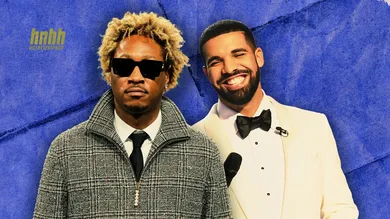


There hasn’t been a shortage of reflections on the two-year anniversary of Drake and Kendrick Lamar’s beef. You’d think people got over it. They didn’t. Instead, Drake fans are obsessing over his getback against the Compton luminary as ICEMAN approaches. And somehow, people have forgotten the two individuals actually responsible for Drake’s most damaging cultural loss: Future and Metro Boomin.
Despite being the catalysts of Drake’s recent string of headaches, rumors are that Future will appear on ICEMAN. Rumors that Drake and Future patched things up have circulated for over a year now. But after Future appeared in NOCTA and Charlamagne hinted the collaboration does, in fact, exist, we have to ask: why does Drake seemingly have more interest in repairing things with Future than almost anyone else involved in the feud?
We Don’t Trust You’s success hinged on “Like That,” which spearheaded a month of tension that culminated in the release of “Not Like Us.” And between two albums, including the follow-up We Still Don’t Trust You, Future and Metro centered both albums around anti-Drake energy, assisted by those who shared equal amounts of disdain toward the Boy.
Metro Boomin, who 21 Savage suggested may have patched things up with Drake, faced his lyrical wrath on “Push Ups” with a one-liner that still feels as quotable today as it did then. Since he isn’t a rapper, Metro resorted to making the infamous “BBL Drizzy” beat—an instrumental that had the summer of 2024 in a chokehold to the point where even Drake rapped on it himself. But Future actually benefited from this feud as much as anybody else and somehow came out far more unscathed than he should’ve, considering his involvement. Maybe that’s because Future occupies a different space in Drake’s career than the others ever did.
Drake and Future’s relationship over the years has gone through its fair share of ups and downs that date back to the latter’s breakout single, “Tony Montana.” Drake jumped on the remix, then failed to show up to the video shoot, opting to attend a King Of The Dot battle in Toronto. Then, there were the supposed misquoted comments in a Billboard interview that led to reports of Future’s removal from Drake’s Would You Like A Tour? tour.
Yet whatever tension existed always managed to subside in pursuit of the bigger picture. That extends to their respective catalogs, too. “Started From The Bottom” became a ubiquitous anthem, thanks to a misunderstanding in the studio. As Future once explained, Drake ran with it after hearing him cue the engineer to “start it from the bottom.” Drake later sent Future a bottle, but the Atlanta rapper jokingly said in an interview that he needed publishing, and rightfully so. Then, fast forward to Views. One of Drake’s most cherished songs, “Feel No Ways,” allegedly pulled its chorus from a leaked Future song titled “This Sunday.” That particular song landed on We Still Don’t Trust You.
All of that to say is that there has been tension between the two parties dating way before 2024. Their relationship has oscillated between resentment and dependency. A cynic might even wonder whether the fallout was ever built to last.
But the reality is the relationship is mutually beneficial, and that has been shown over time. Drake’s pop reach aided Future in winning his first Grammy as the lead artist with “Wait For U.” You can probably even argue that Drake helped maximize Future’s commercial dominance over the years, whether it’s as the sole feature on DS2 or their collaborative project, What A Time To Be Alive. Having Drake’s name associated with yours on Spotify is bound to boost streams and land on the radio.
On the other hand, Drake’s evolution across the 2010s depended on his association with Atlanta. And to understand Drake’s evolution in the 2010s is to understand Atlanta’s influence on mainstream rap. Future represented the darker, melodic, codeine-soaked atmosphere that Drake increasingly absorbed into his own music. They became two sides of the same melodic rap coin. Future’s presence also helped bring Drake closer to the streets, even as Drake increasingly popified those influences for a global audience. That validation mattered. They helped propel Drake into the stratosphere while maintaining the perception that his music still carried street appeal. Of course, Drake’s music still rang out in clubs regardless, but having someone like Future in his corner certainly didn’t hurt his reputation, either.
So, even when the relationship fractured publicly, the music industry still treated Drake and Future like inevitable collaborators rather than permanent enemies. That’s what ultimately separated their relationship from the others. Drake can survive without Rick Ross; he can survive without A$AP Rocky. He can certainly survive without DJ Khaled. Hell, he can even survive without LeBron James. But Future still represents a cultural current that Drake has benefited from as much as Future has for over a decade.
With that in mind, it didn’t seem entirely out of the ordinary that Future and Drake had quietly kissed and made up behind the scenes. Those rumors emerged in late 2024, while earlier this year, Future was caught sporting NOCTA. And with the speculation that he will now appear on ICEMAN, a project that might entirely revolve around Drake’s revenge, it should make us wonder if there’s even animosity toward the whole rap civil war to begin with. If Drake is willing to reconcile with the person who helped launch the most damaging moment of his career, then the lingering tension with others starts to feel increasingly performative.
The reality is that no one really knows what kicked off their beef. It seems more likely that Future might have sided with Metro Boomin because of behind-the-scenes tension rather than the two falling out over a woman or even Future feeling some type of way about Drake and 21 Savage’s collaborative project, Her Loss. But if true, it would make the most significant rap beef of our generation deeply personal yet oddly small-scale.
The music industry is ultimately a transactional business. You scratch my back, I scratch yours. With Future, it’s not necessarily the loyalty that’s needed; it’s the cultural significance he shares with Drake. As peers, they shaped an era with each other, and neither of them benefits from permanent separation. That serves as a lose-lose, not just for them, but for us, the consumers who, at the very least, share some curiosity about how their creative partnership evolves. So reconciliation here feels far less emotional than it is inevitable.
So, for all the discourse about having to “pick a side,” hip-hop’s biggest relationships have always been dictated by utility. And whether Drake likes it or not, there are very few artists whose presence still validates his connections to rap’s center and the streets quite like Future.