

Sometimes, it feels like Ye’s latter catalog is hit with revisionist history every few years. Like, someone revisits a recent Kanye album and tries to convince the rest of us that it wasn’t that bad.
Kanye’s existence has been smeared by his own actions — controversial politics that included a presidential run, Nazi praise, and the contradiction of publicly trying to win Kim back while simultaneously downplaying her role in his life. We could go on. But for a career rooted in artistic excellence that later veered into public spectacle, an imbalance emerged in the 2010s when his ambitions became larger than life–far more expansive than anything before. Ye was committed to bringing the YEEZY brand to the world, first through shoes and clothing, then architecture, art, sports, education, religion, and design. And in many ways, he pursued all of it while doubt lingered around him. When no one believed he could be a rapper, he became one of the biggest pop stars in the world. When critics dismissed his fashion aspirations, he set trends the industry followed. He repeatedly resurrected himself from scrutiny, reminding the world of his brilliance, only to burn everything down and attempt to rebuild it again.
The Pattern Of Self-Destruction
In the vein of David Bowie, Prince, and Michael Jackson, every album Kanye released from the start of his career through The Life Of Pablo, which marked its 10-year anniversary on February 14th, 2026, was marked by reinvention: aesthetic resets, wardrobe shifts, sonic architecture, and new philosophies entering the pop culture canon. Many of these transformations arrived alongside controversy, some marking his most radical moments. The Taylor Swift interruption. The George Bush comment. These incidents became catalysts for backlash and eventual forgiveness, while also sharpening his critiques of political and cultural systems. After storming the stage at the 2009 VMAs, he returned as the maximalist architect behind My Beautiful Dark Twisted Fantasy, an album still heralded as one of the greatest of the modern era. Controversy became part of the brand. With every outrage cycle came a body of work undeniable enough to restore his footing.
These episodes made him more polarizing, yet it often felt like he was saying what others were thinking, regardless of consequence. The apologies that followed rarely seemed rooted in remorse as much as strategic recalibration. In many ways, they reflected Ye’s desire to enter the bourgeois elite — to implement change through influence and proximity to power. His hunger for wealth and recognition was always intact, but it wasn’t yet hardened by the cynicism that followed billionaire status. By the time he compared himself to Putin or Walt Disney, he realized he could survive controversy. That realization made him dangerously desensitized to backlash.
The Right-Wing Turn & Redemption Attempt
Even as he continued selling out arenas and touring globally, his recent anti-Semitic era appeared to reach a breaking point — or at least that’s what he’s signaling. Ye issued a public apology to Black and Jewish communities for the offensive statements he’s made in recent years. Whether it’s sincere remains unclear. It’s difficult not to see it as damage control after self-inflicted isolation. No one asked him to platform extremists or create music that echoed far-right rhetoric. And while he has attributed much of this to mental health struggles, it doesn’t feel like the first time he has leaned on that explanation for harm caused. For years, the chaos was paired with music strong enough to justify the turbulence. The art often outpaced the controversy until it couldn’t. At one point, he was indispensable. No matter how inflammatory his words, his musical contributions felt invaluable to the landscape.
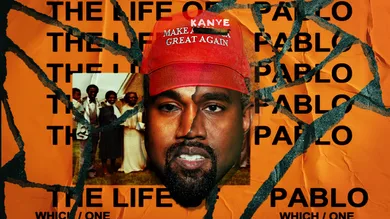
You could argue that Ye or the Wyoming sessions were the last time he captured lightning in a bottle, but even those moments felt like attempts to recreate the chaos and glory that made The Life Of Pablo such a whirlwind rollout and standout entry in his catalog. That album marked the first time he seemed comfortable inhabiting contradiction. It’s likely why it feels like the clearest point to acknowledge that the version of Ye many grew attached to, volatile yet self-aware, effectively ended there.
The Old Kanye In His Final Form–Watch The HotNewHipHop Video Essay Below
The Life Of Pablo was the final, complete form of the “Old Kanye” — not simply because of what followed, from far-right alignment to the tour breakdown after Kim Kardashian’s robbery. Sonically, it didn’t retreat to the soul samples of The College Dropout or the maximalism of My Beautiful Dark Twisted Fantasy. Instead, it represented the last time Kanye balanced ego, innovation, vulnerability, spectacle, and cultural leadership. After Pablo, the ambition that once fueled his artistry began consuming it. Kardashian-level fame elevated the brand but inflated the ego. The creative precision that once made him the MVP behind The Blueprint expanded into an infrastructure he oversaw — much like everything under the YEEZY umbrella in the decade that followed.
That infrastructure became central to his identity and emblematic of the power he attained. Marrying into the Kardashians symbolized proximity to white celebrity culture and institutional validation. By the time he hosted Yeezy Season 3 at Madison Square Garden, with the Kardashian family arriving in coordinated fur, he had silenced those who doubted his fashion credibility. He became a one-man conglomerate at the peak of a pyramid he built over the years.
The Life Of Pablo 10 Years Later…
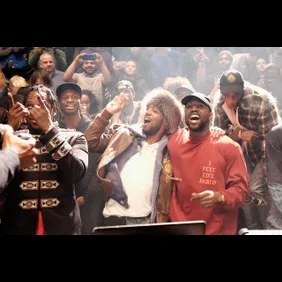
In that sense, The Life Of Pablo represents more than an album. It was the culmination of a broader vision — the Old Kanye in final form. Compared to earlier projects, it wasn’t revolutionary in sound as much as in attitude. It marked victory after a streak of creative triumphs. During an era when artists like Chance The Rapper maintained spirituality without dogma, Ye embraced religion while calling Pablo a gospel album with a lot of cussing, a framing even Kirk Franklin approached cautiously. Reinvention became secondary. For the first time, Kanye drew primarily from himself, and many collaborators reflected his influence. Each track reconciled a prior era: the conviction of “Jesus Walks” echoed in “Ultralight Beam”; the industrial edge of Yeezus resurfaced in “Feedback”; early lyrical hunger appeared in “No More Parties in L.A.” alongside Kendrick Lamar; and the pop ambition of Graduation felt present on “ Fade.”
At the same time, ego and self-awareness coexisted. “Real Friends” delivered self-critique. “Saint Pablo” captured paranoia and financial anxiety. “Famous” weaponized provocation as performance art. Even “I Love Kanye” played with public grievances. It was one of the last moments when spectacle enhanced the music rather than overshadowed it.
His industry pull remained strong. He wasn’t radioactive yet; appearing on a Kanye album was still an honor, not a liability. Vic Mensa and Chance emerged as part of his Chicago lineage beyond drill’s rise. Sia and Frank Ocean contributed without hesitation. Even Max B called in with his blessing after Ye’s spat with Wiz Khalifa. Rihanna and Chris Brown appeared on the same tracklist — rare given their history — while Drake earned writing credits on “Father Stretch My Hands” and “30 Hours.” Even Ty Dolla $ign’s presence foreshadowed future collaborations.
What Does The Bully Era Entail?
But the cracks appeared soon after. Pablo documented a fairy tale realized — access to rooms he once rapped about being barred from. The ego that was once criticized became validated. Fame didn’t dilute his vision, but the scale of it validated delusion. That validation pushed him into dangerous territory: embracing Donald Trump, minimizing George Floyd’s murder, praising Hitler, calling slavery a choice, and then weaponizing his influence in politics. The ambition that once propelled innovation began fueling self-destruction. Everything started resembling an attempt to recreate the Pablo moment. The Donda rollout mirrored its predecessor—stadium lock-ins, last-minute revisions, public previews—framed as redemption. Yet controversy reentered the picture through polarizing guest appearances and choices that seemed engineered to provoke rather than inspire.
So what does repair look like? It begins with the recent apology published in The Wall Street Journal ahead of Pablo’s 10-year anniversary. The emerging Bully era feels positioned as another attempt at recalibration. His new deal with Gamma followed public contrition and reported meetings aimed at making amends. Skepticism is warranted. Still, if there’s evidence of commitment, it may lie in distancing himself from some of the extremist circles he previously entertained.
The suspicion surrounding this era is understandable. The Old Kanye many hoped would return effectively concluded with The Life Of Pablo. Expecting repentance as proof of artistic revival may not be the right metric.
The Old Kanye was never defined by morality; ego was always part of the equation. What defined him was disruption, transforming unlikely influences into something distinctly his. Early previews of Bully suggest a renewed focus. The songwriting feels tighter. The sonic risks feel intentional rather than reactionary. It doesn’t sound like he’s chasing trends but resetting his creativity. More than anything, listeners have needed a project where the music speaks louder than the spectacle. Bully may not resurrect the Old Kanye, but it could introduce something more compelling: a Ye less obsessed with redemption and more invested in quality. The Old Kanye didn’t disappear. He completed himself. And The Life Of Pablo was that completion.