

J Cole has always been, in some ways, indefensible. Not because he’s musically weak, nor because he’s a bad person, but because his appeal has consistently skewed toward an older audience—listeners who found Drake too sugary and Kendrick too far ahead. He’s a comfortable listen: reliable, dependable, and safe. Yet the moments when he steps outside his comfort zone—like embracing Southern anthems of the 2000s as nostalgia, or elevating newcomers across the Bible Belt as an OG—reveal why he’s still a figure capable of commanding attention. His East Coast inclinations make it easy to forget he’s a Southerner at all if he didn’t remind us. And these moments of stretching beyond his defaults are what have prepared him to stake the claims he’s long made about being one of the greatest of all time.
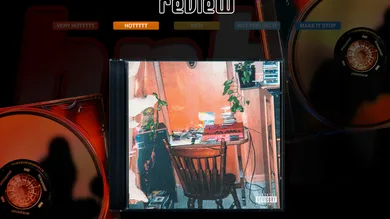
The Fall-Off, initially presented as a final album (supposedly following It’s A Boy, still forthcoming), feels less like a climactic statement and more like a comfortable pivot after years of combating narratives that defined the 2010s. There was a time when hating on J. Cole was as much a personality trait as being a devoted fan. Half-baked consciousness, constant external validation, and quiet internal pressures became the terrain of criticism he faced. The Fall-Off lands somewhere in that space, delivering a body of work that feels like an appropriate reflection of both his listeners’ nostalgia and his own measured ambition.
The album’s two discs—“Disc 29” and “Disc 39”—represent distinct stages of life and career, though not with equal impact. The first half has the essence of classic J. Cole: grounded, introspective, and rooted in the North Carolina upbringing that shaped him. The second half, however, sometimes struggles to reach the depth it aims for, flirting with milestones of the past without fully committing to the meaningful reflection that’s expected from an artist who has spent nearly two decades in the public eye. There is a sense that Cole is both looking backward and forward, attempting to reconcile his younger self with his present persona, yet the album occasionally falters in translating those reflections into music that lands.
Highlights abound. “The Villest,” featuring Erykah Badu, blends jazz-inflected neo-soul with Mobb Deep samples and Outkast interpolations, bridging Cole’s youthful ambition with his present perspective. The track’s plaintive delivery contrasts the motives of his younger self against his current worldview—an artist who has achieved what he set out to do and whose goals have evolved accordingly. In “Poor Thang,” Cole taps into a grittier, battle-ready energy, demonstrating high-intensity aggression reminiscent of the era he grew up in, and the type of boastful smack talk that made Birthday Blizzard ‘26 an effective precursor to this project. Complete with Westside Gunn ad-libs and a Boosie vocal sample, his third verse reads like a precise, battle-rap deconstruction, a reminder of the skill he could have deployed two years ago.
Lyrically, Cole oscillates between precision and overreach. Tracks like “WHO TF IZ U” showcase his scaffolding wordplay, while Memphis-inspired “Two Six” stakes territorial pride with deft craftsmanship. Collaborations, too, feel deliberate: Future’s appearances add intentionality beyond mere cool factor. Tems’ sultry presence on “Bunce Road Blues” builds off Future’s flip of Usher’s classic “Nice And Slow,” creating a streetwise hook over Alchemist production that hints at experimentation beyond the conventional. On “Run A Train,” Future merges hedonism with philosophical reflection over jazzy production.
Yet the album falters in moments where ambition outpaces execution. “What If,” attempting to imagine Tupac and Biggie reconciling, comes off as a forced exercise in perspective-taking; Cole tries to inhabit both legends in an alternate timeline, and the effort, while ambitious, feels unconvincing. “I Love Her Again” feels like a quintessential homage to hip-hop, even if Freddie Gibbs’ earlier approach to the same Common sample on Alfredo 2 was more effective. Worse, the Drake-Kendrick references that frame these tracks often feel extraneous, drawing comparisons that do little to illuminate Cole’s reasoning for backing out. On “Life Sentence,” a DMX sample intended to celebrate married life lands unevenly, while “Safety” grapples with internalized homophobia in ways reminiscent—but less nuanced—than Kendrick’s "Auntie Diaries." These moments underscore a recurring tension in Cole’s career: the pull between ambition, experimentation, and the comfort of his established style.
The Fall-Off is J. Cole attempting to navigate a crossroads he created when he sought reconciliation and closure, particularly in moments of public apology and reflection on past conflicts. The damage, at least in the court of public opinion, has been done, and any claim to be the “best rapper alive” remains debatable. Yet the album succeeds in what it sets out to do: it is unapologetically J. Cole. The back-half of the project does include moments of indulgence—soft guitar strings, introspective musings that don’t always land—but it is this ambition that has always counted for him. What the album demonstrates is a willingness to push outside of his bubble, even if those efforts are occasionally miscalculated. It is indulgent at times, sometimes lacking self-awareness, and hesitant about the very risks that have made Cole compelling over the years.
If The Fall Off is a final album, it closes a career on a measured, safe note—a reminder of why J. Cole has remained relevant and respected, but not a work that fully challenges the artist himself or the audience he has cultivated. Ideally, a final statement should leave fans eager for a return, a body of work that commands reflection and conversation. Here, Cole offers a snapshot of craftsmanship at a high point, a reckoning with his own mythos, and a testament to the fact that even the most dependable voices in rap can surprise, falter, and reflect at once.
User Reviews
Hot New Hip Hop users rated J. Cole's The Fall-Off 4.58 out of 5 stars based on 30 reviews. One user wrote, "While it may or may not have reached the hype, it's still a fire album from top to bottom with 24 songs. Lyrics, concepts, productions, and true hip hop. Happy Black History month." Another added, "Dope album this is a translation of everything Cole in this new era, I loved that he experimented and made it work, intentionality beats anything, this is heat back to back 🔥🔥 modern classic."