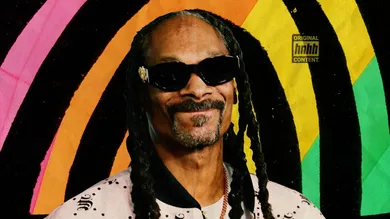


When Snoop Dogg speaks, it carries more weight than the average rapper. He isn’t a hungry newcomer trying to break through. The D-O-Double-G is a Hip Hop G.O.A.T., one of the few who has crossed from Gangsta Rap into a global, mainstream celebrity. His words are folded into a legacy that stretches across decades of music, film, endorsements, and cultural moments. That’s why a passing remark during a visit to the It's Giving podcast about a gay couple in a kid's film reverberated.
The remark came while he was talking about Pixar’s Lightyear, where a gay couple also share a kiss. He admitted he was “scared to go to the movies now,” recounting how his grandson turned to him and asked: “Papa Snoop? How she have a baby with a woman? She’s a woman!” He added, “Oh sh*t, I didn’t come in for this sh*t. I just came to watch the goddamn movie. They just said, she and she had a baby, they’re both women. How does she have a baby? ... I’m like, ‘What part of the movie was this?’ These are kids. We have to show that at this age? They’re going to ask questions. I don’t have the answer.”
Read More: Snoop Dogg's "Moment I Feared" Video Called "Openly Homophobic"
This is a far cry from the rapper who, back in 2004, had a guest appearance on The L Word, a famed series about a circle of friends who are lesbian and bisexual. In that moment, the man who had never flinched at rhyming about shootouts, sex, or gang life confessed he had no words. Gay parents, ordinary, loving queerness between a couple, was where he faltered.
The unease wasn’t surprising, but was familiar in Hip Hop’s long-standing distance from LGBTQIA+ presence. It also revealed the contradictions of an artist who has reinvented himself for the mainstream while still stumbling over a reality his own music has skirted around for decades.
Snoop Dogg Apologizes...Or Not?
What unsettled people wasn’t just the comment itself but the contradiction it exposed. Here was an artist who built his reputation on narrating murder trials, gang wars, partying all night ('til six in the morning), and explicit sex without hesitation, now admitting he had no words for a moment of gay love in a children’s film. That imbalance struck a nerve, but gained support from the masses. The quote spread online because it confirmed something long known that Hip Hop’s elders, among others, are still uncomfortable when queerness refuses to stay in the margins.
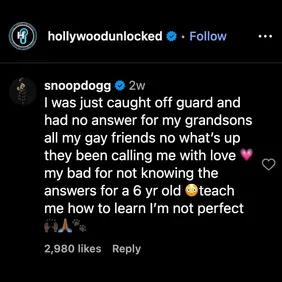
Days later, an “apology” appeared. "I was just caught off guard and had no answer for my grandsons," a comment posted under a Hollywood Unlocked clip of Ts Madison addressing his remarks. It continued, "All my gay friends [know] what’s up. They been calling me with love. My bad for not knowing the answers for a 6-year-old. Teach me how to learn. I'm not perfect."
Read More: KAYTRANADA Thanks Freddie Gibbs For His Early Support After Coming Out
However, according to Entertainment Weekly, Snoop's representatives claimed neither he nor his team wrote the post, though it was never removed. The denial only deepened the sense of evasion. Was it an attempt at humility, or just image control gone wrong? Either way, the words didn’t erase the truth of what he had already said. The moment laid bare how easily Hip Hop can frame violence and misogyny as legible to children, while arguing it's not for minors, but balk at explaining the LGBTQIA+ community.
Legacy Vs. Guarded Identity
The California legend's reservations rang louder because of where it came from. This is the same figure who became the face of Gangsta Rap’s extremes in the 1990s. He was rapping on The Chronic about women as objects in “Bitches Ain’t Sh*t,” about disposable pleasure in “Ain’t No Fun (If the Homies Can’t Have None),” about crime and violence in “Murder Was the Case.” Snoop wasn’t just playing a part but was a Long Beach Crip, eventually tried for murder in a case that turned his music into courtroom evidence. He built his name on saying the things polite society pretended not to hear.
Still, this isn't Snoop Dogg's first run in with being accused of homophobia. In 2014, the rapper caught heat for reportedly telling gay men on Instagram to "go suck ya man n get off my line f. A. G." Then, a few years back, Snoop was criticized once again after dropping the video to "Moment I Feared," where he is seen interviewing a fake rapper named Fonz D-Lo. The fictional artist was allegedly supposed to be a play on Young Thug, and some believed the exchange centered around making fun of the gay community.
Read More: Snoop Dogg's "Moment I Feared" Video Called "Openly Homophobic"
That past sits in tension with his present. Snoop is Martha Stewart’s partner in primetime, a face safe enough for cereal boxes, yet still marketed as authentic enough to keep Hip Hop credibility. Earlier this year, he added another contradiction, performing at Donald Trump’s pro-Crypto Ball, alienating fans while insisting afterward that “love” was his answer to the criticism.
The Hypocrisy Of Moral Discomfort
Read More: Australian Politician Calls On The AFL To "Dump" Snoop Dogg After Homophobic Comment
Defenders of his comments argue that his music was made for adults, while Lightyear is a film for children. The logic goes that explicit Rap lyrics are one thing, but showing a gay couple in a kids’ movie crosses into “pushing an agenda.” It’s a familiar refrain that is one rooted in homophobia, not concern.
The truth is, Hip Hop has never belonged exclusively to adults. Children have always absorbed it. Think about your favorite songs from your childhood. We memorized hooks long before we could understand them. We watched videos that blurred the line between aspiration and exploitation. Snoop himself is proof of that, becoming a household name in the 1990s not just because of The Chronic or Doggystyle, but because his songs filtered into playgrounds, house parties, and school dances. To pretend that his catalog didn’t already shape generations of kids is willful denial.
Further, what did that catalog contain? Songs that normalized calling women “b*tches” and “hoes.” Videos filled with women kissing women, not as expressions of LGBTQIA+ love, but as props for male desire, or the "male gaze." Violence was a backdrop, sex was a performance, and women’s humanity was negotiable. This was the moral universe children were already asked to navigate.
Read More: Pride Month 2025: Artists Who Redefined Visibility In Hip Hop & R&B
As Ts Madison told TMZ, parents have a responsibility to explain difference, not run from it. “We’ve conditioned the world to accept heteronormative activity because that’s all we see,” she said. “As queer people, we’ve always been pushed to the side. It’s time for us to have these uncomfortable conversations.”
Moreover, music icon Boy George also had a few choice words for Snoop Dogg. “So sad to read this from Snoop Dogg. Because you can't turn kids gay by helping them understand that some people are different,” said George. “You are born gay, just like you are born Black or anything else. Kids are a reflection of those who raise them. Come on Snoop, be the legend you are or get some stronger weed! Always your fan. Boy Gay-geous!”
If kids could parse his lyrics about murder, misogyny, and fantasy sex, they can certainly understand love between two women. The fear isn’t about children being confused. It’s about adults being forced to confront their own discomfort.
Read More: NLE Choppa Speaks On His Decision To Perform At LGBTQIA+ Pride Events
Cultural Weight & Queer Presence In Hip Hop
When a figure with his reach hesitates, it lands as a reminder of where hip hop still stumbles. The genre has long framed queerness as punchline or spectacle. Yet, the culture has shifted, with or without his blessing. Frank Ocean reshaped R&B with Channel Orange, making intimacy between men impossible to ignore. Young M.A. claimed space on Rap’s biggest stages while spitting openly about her sexuality. Lil Nas X dismantled the old scripts entirely, turning queerness into a spectacle on his own terms, rather than someone else’s insult. Saucy Santana and Big Freedia have brought joy to clubs and charts, refusing to stay underground.
Even inside Snoop’s orbit, queer voices shape the sound. Gizzle, a queer songwriter who’s penned tracks for him and other Rap giants, has proven that the music he profits from is already infused with queer creativity. That’s the paradox, that Hip Hop has always had queer influence woven into its DNA, even as the culture tried to deny it.
What his remark revealed wasn’t shock, but lag. A generational hesitation that feels increasingly out of step with the world that his grandchildren, and his audience, already live in.