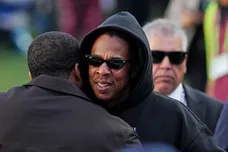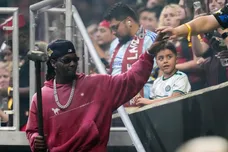


A few days ago, Timothee Chalamet opened up about his experience working with Kendrick Lamar for a promo video for the latter’s Super Bowl performance earlier this year. It was one of the rare moments where we glimpsed how Kendrick was feeling during the time his feud with Drake became a cultural obsession. “My big takeaway from Kendrick. It was during all the huge beef last year. I was so impressed that this man was so calm sitting next to me and I was like, ‘Wow, he’s engaged in a Gladiator sport right now. As much as I love hip-hop… I couldn’t believe that you could be that big at war with somebody that big and go about your life,” Chalamet explained on the 7 PM In Brooklyn podcast.
Chalamet’s comments, although tone-deaf in their complete context, add to a short list of collaborators who’ve shared rare glimpses into Kendrick’s mindset during that period. There’s a pattern in how people recall this era of his career: he exudes the calm, guiding presence of a shaman, a certainty that doesn’t acknowledge failure.
On the other side, Drake and his associates have been far more vocal publicly—media personalities trying to reshape narratives, collaborators angling for verses, friends sending threats to anyone criticizing him. For the casual fan, this can be frustrating: you can’t defend Drake, but you’re not invested in the life-or-death way that others have made it seem. The people championing him now often approach situations with selective reasoning, amplifying skewed stats or TikTok narratives without real verification.
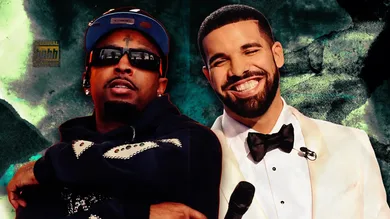
In extreme instances, some declared Drake the victor while clinging to conspiracies—that the machine worked against him, that his ceasefire support in Gaza offended elites. Yet the outcome was predictable. “I told that n**** leave that sh*t alone,” 21 Savage said on Perspektives With Bank. “He felt like he was being challenged lyrically so he wanted to respond.”
It was refreshing to hear 21 Savage, who recently released WHAT HAPPENED TO THE STREETS?, offer honesty to Drake, especially when his framing of a “rigged” job didn’t feel tempered by some politically-charged smear campaign that became central to the infamous lawsuit against UMG. His analysis felt more in tune with those who could distinguish between a rapper and an MC, and a certified hitmaker and a Pulitzer Prize winner. “They want to tear the top n***as down. So how can you win a battle when n***as want you to lose it? Even if you win, you lose! No matter what. Even if Kendrick never responded… [Drake] was already the top n***a,” he said.
Savage explained that the beef gave Kendrick his biggest look, with “Not Like Us” echoing across the world during the Super Bowl Halftime Show; Drake wouldn’t have benefited in the same way had he won. “He would've just been looking like he tearing a good n***a that minds their business down. This s**t rigged, man. Even if Drake won, he would've still been the bad guy for winning. It would've still been like, 'Man, f**k that.' 'Cause Kendrick one of them rapper rappers. He knows how to say different s**t, writing s**t. J. Cole like that. They could consider them MCs. An MC really can't lose. But Drake an MC for real, but he makes hits too. So it's different. Meek an MC, but he wasn't them type MCs, bro."
That balance between making hits and flexing one's lyrical prowess is evident in 21 Savage’s catalog, especially when his introspection takes center stage. Savage’s proximity to real street beef gives him insight into how rap conflicts play out as ego tests, not physical confrontations. While the hypothetical outcomes of Drake’s choices are endless, one thing is clear: 21 Savage wasn’t misguiding his comrade. He gave a clear analysis, refusing to feed a pipedream that would raise the white flag on “The Heart Pt. 6.”
21 Savage has gained from Drake—features, a collaborative album, even his green card—but Drake doesn’t have many people around him willing to remind him that sales, streams, and accolades don’t erase perception. This honesty, often rare in a transactional industry, defines 21’s role as much of a mediator and voice of reason as a collaborator.
In recent weeks, he revealed he helped Drake and Metro Boomin patch up their differences, potentially paving the way for new music. He’s attempted to mediate Lil Durk and NBA Youngboy’s feud, had a role in ending YFN Lucci and Young Thug’s, and even called on Thug and Gunna to end their dispute after the YSL trial. In the case of the latter, Savage acknowledged that they swept Gunna’s previous allegations of snitching under the rug for the greater good of Atlanta’s rap scene. Even his relationship with Future demonstrates this maturity; he offered an apology publicly after a minor Twitter exchange—a display that honesty and reflection extend beyond music. On top of that, he was recently spotted on a FaceTime call with Quavo and Offset, who many have suspected to be on bad terms.
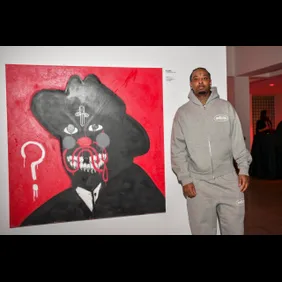
Unfortunately, the industry’s unforgiving nature means minor infractions often turn into life-long grudges. The most striking aspect of 21 Savage's growth is his ability to navigate street politics, industry favors, and online gossip without losing his integrity. That steadiness seeps into his music, his relationships, and the environment he inhabits.
What makes 21 Savage remarkable these days isn’t just the quality of music but the thoughtfulness behind it. He moves through a world built on ego, hype, and performative loyalty without losing himself. In Drake’s corner, in Atlanta’s feuds, in the studio, on the street, his honesty has turned into a philosophy for his existence. But in a time where spectacle is rewarded over substance nine times out of ten, that steadfastness—calm, uncompromising—is the kind of influence that fuels longevity.