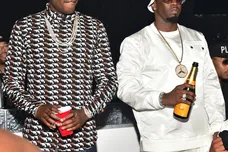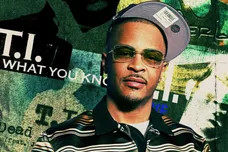
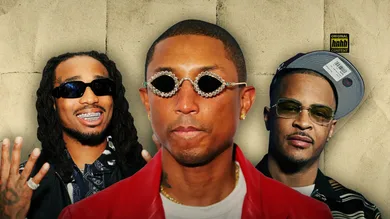


A recent post by @fraim.world on Instagram declared, “In 2026, Pharrell Is Still No. 1 Producer In The Game.” At first glance, it reads like the sort of hyperbole social media throws around every other week. But the receipts are difficult to ignore. His recent run alongside Quavo, Lil Baby, Future and T.I. has quietly yielded one of the year's most fascinating streaks. T.I. earned his first Billboard Hot 100 top 40 appearance since "No Mediocre," while Lil Baby scored one of hip-hop's biggest debuts of the year. Future and Quavo, meanwhile, have found themselves drifting further away from the trap blueprint that built their careers without sacrificing the edge that made them compelling in the first place.
Those chart placements are interesting, but they aren't the story. What's far more compelling is what they reveal about Pharrell's role in hip-hop today. At this stage of his career, it’s impossible to deny that the greatest asset he possesses in his arsenal is his taste.
Pharrell's crisp, clean production has always occupied that fascinating middle ground between the muddy streets and mainstream radio. That's been true since the days of "Southern Hospitality," "I'm Serious," and "Shake Ya Ass." His beats have never diluted Southern rap. Alongside Chad Hugo, they made street records feel expansive without sanding off the personality that made them resonate in the first place. That philosophy remains intact today, only the mission has changed.
It was impossible not to notice on Clipse's return. For years, reunion rumors floated around with little movement beyond the occasional guest appearance. Then Pharrell stepped in as executive producer of Let God Sort Em Out. Rather than chasing Hell Hath No Fury or recreating the chemistry that made them legends, he pushed Pusha T and Malice somewhere neither nostalgia nor reinvention could fully explain. The album didn't sound like it recreated a 2006 run. It fully encompassed what the Clipse should sound like in 2026.
That's become Pharrell's most fascinating quality as a producer. He's no longer operating like someone trying to stack hit records the way he did during the Neptunes' commercial peak. Instead, he's become an all-encompassing creative director, someone capable of identifying where an artist is in their career and understanding where they could go next. Atlanta provides the clearest example.
For the better part of two decades, the city dictated rap's direction. Its ability to produce stars has never really been in question. What's changed over the past few years is the conversation surrounding its veterans. As Playboi Carti, Opium and a younger generation continue pushing rap into stranger and more abrasive territory, artists like Future, T.I., Quavo and even Lil Baby find themselves confronting a different challenge than they have since the turn of the 2020s. They're no longer fighting to become the face of rap, but many have wondered what the next phase of their careers is supposed to look like.
That's where Pharrell's recent run feels remarkably similar to Rick Rubin's philosophy. Rubin famously admitted he possesses "no technical ability" and knows very little about music theory. His value has never been rooted in engineering records or playing instruments. Artists trust his taste. More importantly, they trust the conviction behind it. Throughout his career, Rubin has helped artists escape creative stagnation not by recreating the past but by stripping away everything unnecessary until they rediscover what made them compelling in the first place.
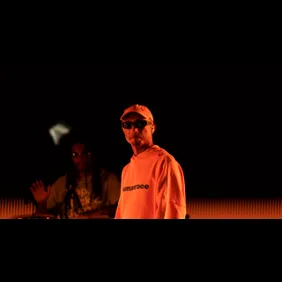
Pharrell arrives at a similar destination through a completely different route. Where Rubin often strips artists back to their essence, Pharrell expands their palette by pushing for evolution. He’s not asking artists to recreate the records that made the stars (we saw how that went when Ye produced Nas’s Nasir), but he’s identifying their strongest qualities and pushing them to explore what they should sound like now.
It’s a philosophy that runs through each of these collaborations. For T.I., it meant respecting his maturity during what he declared would be his final album. "Let 'Em Know" doesn't pretend he's still competing with twenty-somethings. It embraces his perspective as an elder statesman. The result wasn't simply a viral record or a Billboard placement but, more significantly, reminding listeners that T.I. still sounds purposeful when he's given the right framework.
Lil Baby's "Dead Fresh" serves a similar function. Following years of criticism that his music had become increasingly formulaic, Pharrell didn't attempt to reinvent him completely. He simply emphasized the qualities that made Baby compelling in the first place, allowing cleaner production to reposition an artist many had begun questioning creatively.
Future and Quavo might be the strongest examples. "Alice" feels like one of the biggest left turns on The Real Me. Rather than revisiting the sinister bounce of "Move That Dope," Pharrell leans into Future's melodic instincts, steering him toward something dreamier and more atmospheric without losing the emotional weight that's always existed beneath his music.
Quavo appears to be receiving that same treatment. If their upcoming collaborative project is any indication, Pharrell isn't interested in chasing another Culture. He's building around Quavo's greatest strength: melody. Songs like "Haavin" and the previewed "Hit A Lik" suggest a producer less interested in recreating Migos than helping Quavo navigate one of the most transitional periods of his career following Takeoff's death, the group's breakup, and the inevitable challenge of defining himself as a solo artist. That's taste backed by conviction. It's also why Louis Vuitton feels like such an important part of this conversation.
People often separate Pharrell the producer from Pharrell the creative director, but they're increasingly impossible to untangle. Luxury fashion doesn't simply sell clothing. It sells discernment. Its value comes from deciding what's culturally significant before everyone else catches up. That's exactly what Pharrell has been doing with these artists.
Future, Quavo and Lil Baby haven't merely received beats from Pharrell. They've become collaborators within a broader creative ecosystem where runway shows, album rollouts, campaign imagery and music all inform one another. Recording inside Louis Vuitton headquarters or debuting songs alongside fashion collections is another expression of P’s taste, even if it doubles as clever marketing. He's repositioning these artists within spaces that historically celebrated hip-hop from a distance rather than treating it as part of the creative process itself. Virgil Abloh helped build the bridge between luxury fashion and rap more concretely. Pharrell has walked across it and started building rooms on the other side.
In many ways, none of this is new. Whether it was Ludacris, T.I., Usher, or 2 Chainz, Pharrell has spent decades connecting worlds that rarely seemed compatible. He understood how to maximize artists without asking them to become somebody else. The difference today is that he's doing it less as a producer chasing another hit and more as a curator shaping careers.
Pharrell's résumé stopped needing validation years ago. When you're known on a first-name basis, your legacy speaks long before your credits do. What's made his recent run so fascinating isn't simply the quality of the records but what they suggest about his evolution as a creative. He understands how to find the feeling behind an artist, excavate it and build something larger around it. That's the same instinct that made figures like Quincy Jones, Brian Eno and Rick Rubin indispensable across generations.
Atlanta doesn't need saving, and its veterans don't need rescuing. What they need, as every great artist eventually does, is someone capable of recognizing the version of themselves they haven't heard yet. Increasingly, Pharrell looks like the person best equipped to do exactly that. Whether he's assembling a Louis Vuitton collection or executive producing a rap album, his greatest contribution is seeing possibilities before anyone else does—and having the conviction to convince artists to follow him there.