
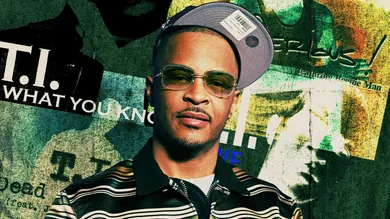


Hip Hop rarely grants longevity without a fight. Even artists who once dominated the charts often fade quietly as the culture shifts around them. T.I. has never been one of those artists. The Atlanta veteran finds himself back in the headlines after trading shots with 50 Cent in a bubbling Rap feud that has pulled his family into the spotlight. His sons, rising artists Domani and King Harris, have also entered the conversation with new music of their own, turning the moment into something larger than a simple back-and-forth between Rap veterans.
For T.I., the clash feels like familiar territory. Competition has followed him since the earliest days of his career, when he was a young Atlanta rapper fighting for recognition in an industry that still looked to New York and Los Angeles as its center of gravity. Over the next two decades, he would become one of the defining figures of Southern Hip Hop, helping push Trap music into the mainstream while navigating taking over the charts, several legal battles, reinvention after incarceration, and staying present in the Rap game.
Read More: T.I. Claims 50 Cent Is Avoiding A Verzuz Battle With Him, 50 Calls Him A Snitch
A catalog as deep as Tip's naturally invites debate. Fans will always argue about which records truly define T.I.’s legacy, and plenty of songs could make a case for inclusion. This list is not meant to be the final word. Instead, it highlights five songs that capture key turning points in his evolution as an artist.
Era One: The Hungry Newcomer
“I’m Serious” (2001)
T.I. was still a young Atlanta rapper trying to break into the industry when "I'm Serious" arrived. Southern Hip Hop was gaining ground, but it had not yet fully taken control of the national conversation. Artists from New Orleans, Atlanta, Houston, and Memphis were building momentum, yet many still had to fight for recognition outside their regions.
“I’m Serious" was the title track from T.I.’s debut album, which introduced the hunger and ambition that would define his early career. Produced by The Neptunes, the record positioned him as a confident new voice coming out of Atlanta. The album itself struggled commercially and eventually led to him being dropped from his label, a setback that forced T.I. to rebuild his career from the ground up.
That rebuilding process would soon lead to the Trap sound that helped define his rise. Songs like “24’s,” “Rubber Band Man,” and “Be Easy” from the Trap Muzik era would later establish T.I. as one of the genre’s most significant voices and influences. Those records helped push Atlanta to the forefront of Hip Hop’s evolving sound.
Read More: Top 25 Best T.I. Songs
Still, “I’m Serious” stands out because it captures the moment before the crown. The record reflects an artist at the beginning of his journey, confident in his potential even before the industry fully recognized it. Long before he would call himself the King of the South, T.I. was already announcing that he belonged in the conversation.
Era Two: The Crown
“What You Know” (2006)
In 2006, T.I. was no longer trying to get the industry’s attention. He had it. The release of King marked the moment when T.I.’s long-standing claim as the “King of the South” moved from bold declaration to cultural reality. Atlanta had already begun asserting itself as one of Hip Hop’s most important cities, and T.I. stood at the center of that movement. Trap music, once considered a regional sound, was now becoming a force in mainstream Rap.
“What You Know” captured that moment perfectly. It was built on a thunderous, cinematic production and sounded like a victory lap. T.I.’s delivery carried the confidence of an artist who had fought for years to reach the top and was finally standing there without question.
This era also produced several defining records in his catalog. “Bring Em Out” became one of the most recognizable club anthems of the decade, while “Top Back” and “ASAP” reinforced his reputation as one of the South’s most commanding artists. Yet, “What You Know” stands above the rest because it crystallized the moment when T.I.’s authority felt undeniable. The song earned a Grammy Award for Best Rap Solo Performance and became one of the most iconic singles of the 2000s. More importantly, it sounded like the coronation of an artist who had spent years building toward that throne.
Read More: T.I.'s Sophomore Album "Trap Muzik" Turns 20
Era Three: Global Superstar
“Live Your Life” (2008)
Two years after claiming the throne with King, T.I. entered a new phase of his career. He was no longer just a Southern Rap heavyweight. In the late 2000s, he had become one of the biggest artists in music, period.
“Live Your Life,” which hosted a major feature from Rihanna, caught that moment of expansion. The record bridged the worlds of Rap and Pop radio without diluting T.I.’s presence as a rapper. The song debuted at No. 1 on the Billboard Hot 100, confirming that his reach had grown far beyond the streets of Atlanta.
Moreover, this season of T.I.'s career was stacked with massive records. “Whatever You Like” became one of the biggest Rap singles of the decade, on repeat on the radio and in clubs while proving T.I. could deliver chart-topping hooks as easily as hard Trap records. “Big Sh*t Poppin’ (Do It)” reinforced his superstar status with the swagger that had defined his earlier work, while “Swagga Like Us” placed him alongside Rap heavyweights in one of the era’s most talked-about collaborations.
Read More: Rihanna's 10 Hardest Hip Hop Tracks
Era Four: Reflection & Consequence
“Dead And Gone” (2009)
Success in Hip Hop often arrives fast. The consequences can arrive just as quickly. T.I. found himself navigating one of the most turbulent periods of his career by the end of the 2000s. Legal troubles had begun to overshadow his chart placements, and the weight of those challenges reshaped the tone of his music.
“Dead and Gone," with Justin Timberlake on the hook, reflected that shift. Instead of the triumphant bravado that defined his earlier hits, the song carried a somber sense of reflection. T.I. rapped about mistakes, personal growth, and the reality that fame does not shield anyone from consequences.
Among his other releases during this era, including "Memories Back Then" and "No Mercy," "Dead and Gone" eclipses the others for its emotional gravity. Released during a time when T.I.’s future in music felt uncertain, the song resonated as both a confession and a turning point. It showed that the artist, who had once built his reputation on confidence and domination, was capable of confronting his own flaws in public.
Read More: Bots & Artificial Streams Are Killing Hip Hop
Era Five: Longevity & Legacy
“Let Em Know” (2026)
More than two decades after his debut, T.I. occupies a rare position in Hip Hop. The industry that once demanded his attention has changed several times over. New stars conquer streaming platforms, younger artists shape the culture's sound, and the Atlanta Rap scene he helped elevate has grown into one of the genre’s most influential hubs.
Yet T.I. remains present.
"Let Em Know" came out this year and reflects that reality. The record arrived at a moment when the veteran rapper finds himself back in the middle of Hip Hop headlines, trading shots with 50 Cent in a feud that has drawn attention across the culture. Instead of retreating into legacy status, T.I. responded the same way he has throughout his career, by stepping into the booth.
For an artist whose career began with the hunger of “I’m Serious,” the willingness to keep engaging the culture decades later speaks to something deeper than longevity. It reflects a mindset that has followed T.I. through every phase of his career in the belief that the crown is something you defend, not something you retire.
Read More: T.I. Punches Back With One More 50 Cent Diss Track
Few rappers remain relevant long enough to see the culture around them change multiple times. T.I. has managed to do exactly that. From the outset, T.I. was still fighting for recognition in an industry ruled by other regions, and, with the authority of “What You Know,” where he fully stepped into the role of the King of the South, his early career mirrored Atlanta’s rise in Hip Hop. The global success of “Live Your Life” expanded his influence far beyond regional Rap, while “Dead and Gone” revealed a more reflective artist grappling with the personal consequences that often accompany fame. Now, with “Let Em Know,” T.I. stands as a veteran who refuses to fade quietly into legacy status.
That full-circle moment says a lot about T.I.’s place in Hip Hop history. His career has never been defined by a single sound or era. Instead, it has been shaped by adaptation and a willingness to evolve alongside the culture. If this latest chapter proves anything, it is that T.I.'s story is still being written.