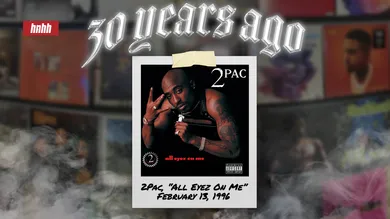


It was October 1995, when 24-year-old Tupac Shakur was released from Clinton Correctional Facility. He had served time on a sexual abuse conviction he consistently disputed. Within hours, he was on a plane to Los Angeles. Suge Knight had posted his bail. A deal with Death Row Records was already in motion. The transition was abrupt. Tupac did not ease back into public life. He went straight to the studio.
Four months later, on February 13, 1996, he released the double album All Eyez on Me. It debuted at No. 1 and expanded Rap’s commercial scale at a time when the genre was still fighting for respect. The project was prolific and unapologetic. It sounded like an artist determined to reclaim control of his narrative after months of confinement and relentless public scrutiny.
Read More: All Eyez On Me - Album By 2Pac
Then, seven months after its release, he was killed in Las Vegas.
That tragedy changed how the album is heard today. All Eyez on Me captures a young Black artist juggling the effects of incarceration, loyalty, rivalry, fame, and the love-hate relationship with the media in real time. It shows both the power Tupac stepped into and the pressure pressing against him. The record reaches far beyond the idea of a comeback.
Death Row's Dominance
When Tupac signed with Death Row Records in late 1995, the label was already dominating the Rap game in the West Coast. Founded by Suge Knight and anchored by Dr. Dre, the company had built its reputation on polished G-funk production and lyrical stories from the streets. While success was ongoing, there were also lawsuits, rivalries, and industry intimidation that were part of its reputation. Tupac’s arrival only intensified that energy.
Fresh out of prison and newly aligned with a label positioned at the center of the East Coast–West Coast feud, he recorded at a relentless pace. Studio accounts from that period describe long sessions and rapid writing. There was no slow reintroduction to the market.
"I only wrote one song [in jail]. But I’ve been in the studio every waking hour since I got out. Me and my producer Johnnie 'J' keep coming up with new songs till people start passing out. Then we come back early in the morning and start over. You’re going to feel the entire 11 months of what I went through on this album. I’m venting my anger."
-Tupac, L.A. Times interview, October 1995
Read More: E.D.I. Mean Of The Outlawz Talks "All Eyez On Me" & The Legacy of Tupac's "Hit 'Em Up"
All Eyez on Me was ambitious. At a time when albums typically ran lean, Tupac delivered a double project that did not feel padded. It moved between aggression and reflection to celebration and paranoia. Commercially, the move was strategic. Death Row understood branding. The album’s rollout reinforced Tupac’s outlaw persona while positioning him as the label’s most visible voice. The project would eventually become one of the best-selling Rap albums of all time. The message to the industry was that Rap could top charts at Rock’s scale without softening its edges.
Yet, with the scale came relentless attention. By early 1996, Tupac was no longer just a rapper. He was a national figure, appearing in films and on magazine covers while navigating active rivalries and media narratives that framed him as dangerous. Death Row’s strength boosted his platform. It also intensified the spotlight.
Read More: French Montana Praises 2Pac's "All Eyez On Me": "I Was Listening To That When I Didn’t Even Know English"
Within that environment, All Eyez on Me also functioned as both product and positioning. It cemented Death Row’s authority and elevated Tupac’s status. It also defined the lines between coasts at a moment when tension was already combustible.
Regional Tension & Public Rivalry
Tupac’s conflict with The Notorious B.I.G. in the mid-'90s had become central to his story. What began as a friendship had deteriorated into accusation and distrust after Tupac was shot in the lobby of Quad Recording Studios in 1994. He believed people within Bad Boy Records had prior knowledge of the attack. Those suspicions hardened during his incarceration. All Eyez on Me pressed into that strain.
Tracks like “Hit ’Em Up,” released shortly after the album as a B-side to "How Do You Want It," left little ambiguity about where Tupac stood. The aggression was direct. The record escalated the Rap beef from competitive rivalry into something deeply personal. In that moment, Hip Hop’s regional split felt less like marketing and more like a fracture.
Read More: Mother & Son Inspiration For 2Pac's "Brenda’s Got A Baby" Reunite After 3 Decades
At the same time, All Eyez on Me affirmed West Coast identity with clarity. “California Love,” produced by Dr. Dre, was celebratory and expansive. It positioned Los Angeles and the Golden State as a cultural capital. The production was polished, built on synthesizers and heavy bass lines that defined G-funk. It was commercially accessible without sacrificing regional pride.
Moreover, Tupac’s geography complicated the binary. Born in New York, raised in Baltimore, and artistically shaped in Oakland, he embodied multiple regions. Yet in 1996, he aligned himself firmly with the West. That choice exposed rifts that were already established.
"The thing that bothers me is that it seems like all the sensitive stuff I write just goes unnoticed . . . the media doesn’t get who I am at all. Or maybe they just can’t accept it. It doesn’t fit into those negative stories they like to write. I’m the kind of guy who is moved by a song like Don McLean’s 'Vincent,' that one about Van Gogh. The lyric on that song is so touching. That’s how I want to make my songs feel. Take 'Dear Mama'—I aimed that one straight for my homies’ heartstrings."
-Tupac, L.A. Times interview, 1995
Read More: Suge Knight Alleges Tupac Begged Suge To Kill Him After Vegas Shooting
Inside The Record: Sound, Collaborators, & Construction
The album's opening track, “Ambitionz Az a Ridah,” does not ease the listener in. It asserts power immediately. The tone is aggressive and confident, and the outlaw persona is heightened. Still, the vulnerability never disappears. It is simply layered beneath the bravado.
Then, the Danny Brown-assisted “I Ain’t Mad at Cha” reflects on fractured friendships and the inevitability of change. “Life Goes On” mourns loss without sensationalism. Even nestled within tracks built for the club, there is an undercurrent of fatalism. Tupac oscillates between celebration and premonition.
As we already stated, Dr. Dre helmed “California Love,” built around a Roger Troutman-assisted hook that felt nostalgic and futuristic. The track’s synth layers and talkbox vocals gave it mainstream appeal without diluting its regional identity. It became one of the defining records of 1996.
Read More: Maino On Tupac: "Nobody Spoke To The Black Male Experience Like He Did"
"If they can stop me, they can stop 30 more rappers before they even born. But there’s something else I understand now: If we really are saying Rap is an art form, then we got to be true to it and be more responsible for our lyrics. If you see everybody dying because of what you saying, it don’t matter that you didn’t make them die, it just matters that you didn’t save them."
-Tupac, Vibe Magazine cover story, 1995
Still, Dre was not the sole architect. Daz Dillinger and Johnny "J" contributed significantly to the album’s sonic backbone. Johnny "J" in particular shaped much of the project’s melodic feel. His production on tracks like “How Do U Want It” and “All Bout U” balanced smooth instrumentation with hard percussion, allowing Tupac’s cadence to cut cleanly through arrangements.
Speaking of “How Do U Want It,” featuring K-Ci & JoJo, it became another commercial high point, topping charts and reinforcing Pac’s crossover presence. The collaboration also bridged Rap and R&B at a moment when that fusion was expanding radio. Moreover, the album's guest list included Snoop Dogg, who appeared on multiple tracks, reinforcing Death Row unity. Nate Dogg added hooks with melodies that softened otherwise hard-edged bars. Further, Tha Dogg Pound’s presence grounded the project firmly in the West Coast ecosystem.
Read More: 2Pac’s Father Admits He Was "Upset" Over "Dear Mama"
The duality of All Eyez on Me was a part of what makes the album endure. It does not present one single version of masculinity. It presents a young Black man steering survival in public view. He embraces excess while speaking openly about incarceration and institutional distrust.
The persona was purposeful. Tupac understood the power of image. He knew controversy extended reach. At Death Row, power was currency. Yet, beneath the performance lay a writer who had studied theater and poetry and had been raised in political thought. That education surfaces in the emotional scope of the record.
The Album, In Hindsight
On September 7, 1996, Tupac Shakur was shot in Las Vegas. He died six days later at 25 years old. The case remained shrouded in rumors and conjecture for decades. Soon, a trial may lay some of the speculation to rest. Pac's death altered the way All Eyez on Me was heard.
It was not built as a farewell. After his murder, however, it became foundational to the mythology surrounding him. Tupac was no longer just an artist figuring out conflict. He became a symbol, a martyr to some and a cautionary tale to others. His posthumous releases followed, and death solidified his status while also accelerating the business of legacy.
Read More: Tupac Shakur BMW He Was Riding In When Shot Is Up For Auction At $1.7Mil
The mid-1990s were not kind to Black male celebrities. Rappers were often depicted as threats rather than artists. Media narratives emphasized criminality and chaos. Pac’s prior legal troubles fed that framing. Rather than retreat, he leaned into it. He exaggerated the outlaw image and forced audiences to confront it on his terms. The same industry that celebrated his sales figures also commodified his volatility. All Eyez on Me sits at that intersection. It is celebratory and defiant, yet also aware. It documents what it meant to be young, Black, famous, and constantly misread.