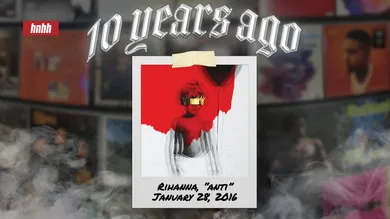


There are albums that arrive that score an era of an artist's career, but ANTI came in and redefined one. The music mood in 2016 was chaotic and club- or festival-centered, and, just like that, Rihanna emerged with a sonic outcry that slowly and deliberately turned away from it. Known for her radio anthems, Rihanna moved away from Pop pageantry with ANTI. A woman sounding entirely uninterested in being understood.
There were already seven albums under Robyn Fenty's belt by that time, and her name was Pop currency. Now, Rihanna had entered a new phase without the pressure of pleasing the machine that helped her grow. Her Def Jam contract was done, and the industry had run her dry. This time, she wasn’t making something simply to please the public. She was building a world she could live in. ANTI was intimate and unconventional. We saw Rihanna's refusal to give Pop the easy hooks and neatly packaged personas it was used to extracting from her.
"I listen to ANTI from top to bottom with no shame, I used to always have shame. I actually don’t like listening to my music, but ANTI—I can listen to the album. It’s not me singing it, if I’m just listening to it. That’s the one album that I can have an out-of-body experience."
-Rihanna, Harper's Bazaar, 2025
Read More: Review: Rihanna's "ANTI"
Ten years later, ANTI still sounds like a line drawn in the sand. It was a departure from the Rihanna who came before it, and a challenge to the industry’s appetite for Black women’s creative labor without their full humanity.
The Style & Sound Of ANTI
After years of an album-a-year pace, Rihanna took a breath. There, she made something uncompromising.
ANTI's creative process stretched over several years and continents. She worked with familiar names, including producers like Jeff Bhasker, Boi-1da, Hit-Boy, Mustard, and No I.D. She also reunited with vocal producer Kuk Harrell, who’d helped polish her biggest hits. On ANTI, the polish wasn’t the point. Tracks like "Same Ol’ Mistakes," a Tame Impala cover that Rih recorded in Paris, leaned heavily on psychedelia. There was a throbbing distortion on "Woo," and "James Joint" was barely more than a minute long, but it lingers. The album moved on more of a feeling, not a formula.
Read More: Rihanna Songwriter Threatens Travis Scott For Delay Of "ANTI"
At its core, ANTI is self-rebellion. Rihanna abandoned the hit-chasing that defined much of her early success. There weren't huge, calculated club bangers. She returned with ballads like “Love on the Brain,” pushed by Doo-Wop influence, and “Higher,” a track that included intentional imperfections that made it human.
Moreover, “Consideration” doesn’t unfold like a traditional opener. It doesn't seem like it's trying to welcome you in. Produced by Boi-1da and featuring SZA, the track carries the tension of an artist declaring her autonomy. “I got to do things my own way,” Rihanna demands.
Read More: Rihanna Claims She's Finally Starting Work On Her New Album Soon
"Needed Me" may be the closest thing ANTI has to a radio record, next to the Drake-assisted "Work," but even that feels accidental. Mustard’s production is haunting, leaving Rihanna’s delivery icy and distant. The track went on to become Rihanna's 28th Top 10 single. Further, throughout ANTI, her vocals take on a new texture. “Didn’t they tell you that I was a savage?” continues to happily torment playlists today.
It was obvious that this wasn't a traditional Pop album. It was experimental R&B with an edge, reflecting where Rihanna was mentally and professionally.
"I was getting tired one night and almost didn’t go to the studio. However, I ended up going, and we came up with ‘Needed Me.’ Rihanna was in the kitchen; it was just like a house full of producers and great artists, spent hours of doing [it]. We have been cool ever since then. She let me be on her tour and stuff like that."
-Mustard, ThatGrapeJuice, 2016
Read More: Rihanna References: The Mogul’s Most Iconic Lyric Name-Drops In Music
ANTI's Initial Impact & Reception
When ANTI dropped, it didn’t immediately get the flowers it deserved. Critics were confused, and Pop radio didn’t know what to do with it. This wasn’t the shiny, cookie-cutter Rihanna they were used to. There was no "We Found Love" or "Where Have You Been," no EDM hooks designed for the summer festival circuit. Instead, she gave them “James Joint" and "Desperado.”
Still, the numbers caught up. ANTI debuted at No. 1 on the Billboard 200 and was certified Platinum within days. This was thanks in part to a Samsung deal that gave away a million copies for free. Soon, critics re-evaluated. What seemed jarring on the first listen revealed layers in songs like “Needed Me” or in the intimacy of “Same Ol’ Mistakes.” There was an ache in “Love on the Brain.” The confusing project was now a classic. Today, the album has spent over 500 weeks on the Billboard 200, becoming one of the longest-charting albums by a Black female artist.
Read More: Rihanna References: The Mogul’s Most Iconic Lyric Name-Drops In Music
Meanwhile, "Work" with Drake also reached No. 1 and stayed there for 9 weeks. An anomaly on the record, its tropical vibe and hypnotic chorus felt almost accidental next to the rest of the album.
In retrospect, ANTI reshaped how fans and the industry understood Rihanna. It freed her from the pressure of the Pop machine and highlighted her artistry outside the singles charts. It also changed the blueprint for what R&B and Pop albums by Black women could sound like in the 2010s. Artists like SZA, Summer Walker, Jorja Smith, and even Beyoncé’s Renaissance era owe something to the sonic risks Rihanna took on ANTI.
Read More: What Is Rihanna's Best-Selling Album?
Compared to albums like Good Girl Gone Bad or Loud, which chased hits and took over the charts, ANTI felt like a refusal. She didn’t want to play that game anymore. Unlike Unapologetic, which still flirted with mainstream, ANTI still stands as her most cohesive, challenging, and complete body of work. The fact that she (STILL) hasn’t released another album since only intensifies its legacy. Truthfully, Rihanna hasn't been silent because ANTI said more than enough.
Read More: Top 25 Best Rihanna Songs
"Just [Rihanna] being more involved creatively was the biggest difference. She’s always involved from her side, as an artist. But musically, creatively, she really wanted to drive the direction of the album. I think that’s why she called the album ANTI—she wanted to do something completely different than everybody else.
"Because we’re in a cookie-cutter time of music. Every record that everybody does is a record that somebody else could’ve done, if that makes sense. It’s so awesome that she just stepped out and was courageous enough to stick to that and be that and do that."
-Kuk Harrell, Chicago Reader, 2016
Where Rihanna Was When ANTI Was Born
At the time, Rihanna was years removed from the glossy blueprint of her early albums. Her previous project, Unapologetic, dropped in 2012 and featured hits like “Diamonds” and “Pour It Up.” That album was built in the aftermath of public scrutiny, heartbreak, and a never-ending public gaze that kept her name in headlines. ANTI didn’t carry that same weight because it wasn’t as reactive.
Read More: Rihanna's 10 Hardest Hip Hop Tracks
Rihanna had just split from Def Jam and moved under Roc Nation management, giving her more creative agency. She was also publicly pivoting with her fashion brand, which was beginning to make waves. Endorsements were everywhere, and after years of being one of Pop’s most dissected stars, often analyzed for everything from her relationships to her body, Rihanna was finally operating on her own terms.
She also wasn’t trying to prove anything. By the time 2016 came around, she’d already sold over 200 million records worldwide. There were more No. 1 singles on her back than most artists rack up in a lifetime. Still, ANTI was about building something that didn’t require approval. For the first time, she let the music come to her instead of chasing what the industry expected.
The Cultural Weight Of Silence
Then, following ANTI, Rihanna left the party with the lights on and the speakers still buzzing. In the years since the album’s release, her silence has become part of its myth of what's on the horizon. Every award show she skips on, every cryptic interview with vague answers, every Fenty launch that’s not a new song feeds into a cultural fixation of pelting Rih with the question, When is the next album coming?
Last year, she told Harper's Bazaar that the direction of her highly anticipated upcoming phantom album is inspired by ANTI. "I think music is my freedom. I just came to that realization," she said, adding that she "just cracked the code on what I really want to do for my next body of work."
Read More: Rihanna Celebrates 20 Years In Music With Touching Tribute
Where most artists cycle through eras, Rihanna let ANTI breathe. While fans begged for new work, the album continued to live on, charting quietly and popping up on “best of the decade” lists. The longer she stayed away, the louder ANTI became.
In a way, Rihanna’s refusal to follow ANTI with another album only deepened its impact and lore. It forced people to return to it and sit with what it was trying to say long before they were ready to hear it. That’s the kind of weight that only a confident artist, one in full control of her narrative, can pull off.