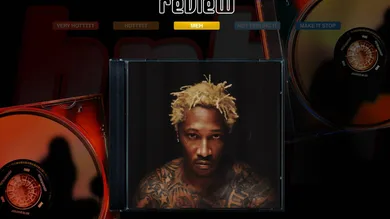


Future has always been misunderstood. From the moment he gained public consciousness with "Tony Montana," listeners struggled to understand what they were hearing. The Auto-Tune, the slurred delivery and lack of traditional enunciation made him easy to dismiss before people realized what Charlamagne Tha God and Gucci Mane recognized early: Future wasn't a traditional rapper, but he was an exceptional songwriter.
Understanding Future the artist was always easier than understanding Future the person. That tension has followed him throughout his career. His music has always lived between contradictions of a superstar’s desire for privacy, a womanizer seeking loyalty, and the drug-fueled nihilist who just can’t escape his emotions. Those contradictions are what made his best work so compelling, but they're also what make The Real Me such a difficult album to fully grasp.
The rollout suggested Future was finally separating the man from the mythology. Instead, the album often feels like he opened every folder on his hard drive, picked one song from each, and turned it into a tracklist. The best moments on The Real Me happen when those different versions of Future collide.
"Fukk An Interview" sets that tone immediately, but not in the explosive way its title suggests. Instead, Future sounds restrained and exhausted. The icy synths and heavy drums create the feeling of someone putting up another wall around himself rather than tearing one down. It's less a rejection of the media in the way Big Banks suggested than it is the sound of someone frustrated with constantly being interpreted outside of the narrative he’s allowed.
That cold atmosphere becomes one of the album's strongest markers of identity. "Money Over Everything" uses spacious pads to create a larger-than-life feeling, matching Future's tendency to make luxury feel almost isolating. "Tank Top Pluto" turns that same energy into a guttural flex where respect matters more than money, while "Weight Up" uses dramatic violin-driven production to give his drug-fueled brags a sense of danger and opulence. Those songs work because the production understands the contradiction behind Future's music. The excess has often functioned as a defense mechanism.
"Konnichiwa" is where that idea comes together best. On paper, it's familiar territory: the nihilistic Future who dismisses competition, relationships and expectations. But the song's arrangement makes that perspective feel more complicated. The layered vocals, distorted textures and contrast between his deeper, detached delivery and higher-pitched ad-libs create the feeling of different versions of Future fighting for control. It's one of the rare moments where the album's idea matches the music itself.
The problem is that The Real Me doesn't always find that same chemistry. Future has always had a natural pop instinct, but his best crossover records never felt like crossover records. The emotion came first. The hit came second. Here, some of those moments feel like Future reaching for familiar formulas.
The Pharrell-produced "Alice" feels like his attempt at the "Please Don't Stop The Music" moment in his catalog, a bright, rave-inspired record built for a bigger audience. "Hollywood" taps into a similar aesthetic, using nostalgic synths and cinematic textures, but the vibe occasionally feels more like a reference point than an identity.
"California Girls" works better because Future sounds genuinely playful. The pitched-up inflections bring out a side of his personality that doesn't appear often. Still, the song carries echoes of "Wait For U," making it feel like an extension of something he's already mastered rather than a new direction. "No Misery" succeeds for the opposite reason. The melancholy gives the experimentation a purpose. "Radio," meanwhile, feels less memorable, especially when contextualized as the song that was supposed to usher in a new era for Future.
"One Two" and "Build A Bitch" introduce a more juvenile side of him, embracing the absurdity that usually gets overshadowed by the darker mythology surrounding him. The most generous interpretation is that Future is tapping into the same stylistic choice that allowed Slick Rick to turn nursery rhymes into something fly. The other possibility is that Future is simply showing listeners a side of himself that has always been there. Maybe underneath the toxic king persona is just a guy who likes being ridiculous.
"2018" pushes that idea too far. The high-pitched vocals are interesting, but the song eventually becomes defined by the effect rather than what Future does with it. Future has always known how to manipulate his voice to create different emotions. Here, the vocal choice never develops beyond the initial idea.
And that's the difference between Future's best experiments and his weaker ones. He has never been afraid to try something different. The question is whether the experimentation reveals another layer of himself or just another aesthetic. The album becomes much more compelling when Future stops trying to showcase every version of himself and focuses on what connects them.
"Snow In Skyami" captures that contradiction better than almost anything else on the album. Future wants abundance without being judged for what that abundance costs him. The money, the women, and the lifestyle provide endless options, but they can't provide the things he actually wants. Loyalty, trust and peace.
"Tryna stay away from that toxic shit, but I can't deny it" feels like the album's thesis because it's a raw admission. Future understands the patterns that keep repeating. He just hasn't figured out how to break them.
That same complexity makes "Build A Bitch" more interesting than it initially appears. On the surface, it's another toxic fantasy about creating the perfect woman. But underneath, it's Future trying to build a solution to problems that can't be solved through access or abundance. He doesn't know exactly what he wants because he might just want too much.
"Big Moment" and "Cast A Spell" are where the album finally finds the emotional specificity that has always separated Future's best songwriting from his imitators. Instead of speaking broadly about pain, these songs focus on the delayed consequences of avoiding it. The soulful production and late-night atmosphere of "Cast A Spell" recall HNDRXX, not because Future is chasing the past, but because that environment allows him to be vulnerable again.
That's the paradox of The Real Me. Future has never struggled to show listeners who he is. That's why he's remained a fixture in our lives: he spent his entire career giving audiences every version of himself. However, access isn't the same as intimacy. The album feels like opening Future's hard drive and finding thousands of songs with incredible individual qualities that never quite form a complete picture. The ideas, melodies and production are there. But too often, they sound like things Future has already mastered rather than places he's trying to go.
The real Future has never been one person, and that complexity is what made him such a fascinating figure, the same complexity that earned him that specific Andre 3000 co-sign you hear at the beginning of "No Misery." The challenge now is that he's spent so long mastering every version of himself that finding the next one might be the hardest part.
User Reviews
HNHH users rated Future's new album, The Real Me, 4.09 stars out of 5 based on 11 reviews. One user wrote, "Future is 1 of the most favorite rappers of all time." In a less favorable review, another added, "Probably won’t listen to it again."