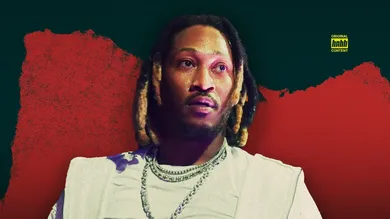


In the leaked song "Ready To Slide," Future raps, "She fakin' a relationship with me, I don't even know her name." On its face, it's another boast from a self-proclaimed Hall of Fame pimp. But like most Future bars about love, the flex feels strangely empty. Behind the bravado is the same emotional detachment he's been selling for over a decade. And somehow, at 42, he's still trying to convince us that being unavailable is the ultimate prize.
Maybe that's because Future didn't just soundtrack emotional detachment. He turned it into a standard to live by. Between numbing the pain and dissociating, his music became a blueprint for treating vulnerability like a weakness instead of a necessity. Eventually, it stopped feeling like an artistic persona. It became his brand, his public identity, and perhaps even the role he struggles to step outside of. The toxic persona wasn't something he shuffled through during periods of heartbreak. He's simply trapped inside of it.
DS2 didn't birth that persona, but it became a testament to its influence. After a highly publicized breakup with Ciara, that heartbreak and anguish fueled what became the most impactful mixtape run of the 2010s. Emotional numbness was rewarded with a second wind of his career through the release of Monster, Beast Mode, and 56 Nights. Each project became a puzzle piece that came together ahead of DS2, the album that punctuated that era.
Rather than publicly processing heartbreak, Future transformed it into an artistic identity built on excess and emotional distance. He weaponized that heartbreak in a way that mirrored the titles of those projects. It arguably became more effective than anything else he had released at the time. Even as a formative piece of Atlanta's soundscape and a critical darling in his own right, the grit was missing from Pluto and Honest, where his frustrations were evident.
"Throw Away" embodies this attitude to a T. A highlight that ranks among the best songs in his catalog, Future captures the contradictions that many people experience after a messy breakup. He's discarding women for personal satisfaction while pleading with the one who got away to return, all while indulging in substances to numb feelings he can't control. Ironically, some of Future's most revealing records tell a completely different story. Songs like "Codeine Crazy," "Hardly," "Sorry," and "Love You Better" aren't records made by someone who is incapable of love but rather, someone overwhelmed by it. Those moments of honesty have almost always been overshadowed by the mythology surrounding Future in the broader discourse of his artistry.
The version of him that has flourished most publicly is the one who is detached, cold, and seemingly unaffected. Social media only accelerated that transformation. Future's lyrics became Instagram captions, memes, and relationship advice stripped of their original context. The vulnerable artist disappeared beneath screenshots celebrating toxicity. Somewhere along the way, the caricature became more recognizable than the artist himself.
That's why his relationship history has become such a crucial part of his mythology. Failed relationships and the fallout with his exes' new partners have all contributed to the lore surrounding him. These stories have defined his music in ways that rival even his Atlanta lineage within Dungeon Family. The headlines become fodder, the women become muses, and their stories become catalog mainstays.
The relationship with Ciara remains the clearest example. More than a decade later, Future has continued to revisit that chapter of his life, whether through lyrics or shots toward Russell Wilson. Meanwhile, Ciara has largely moved on. Even a recent photo of JAY-Z standing alongside Future's son reignited conversations about a feud that Future himself helped keep alive. The same pattern has appeared throughout other relationships. Lori Harvey could've quietly become another celebrity ex, but Future immortalized the relationship on 42 Dugg's "Maybach," directing his frustration toward her stepfather, Steve Harvey, long after Lori had moved on.
Whether those references are calculated or genuine almost doesn't matter. They reveal the same contradiction: Future has spent years convincing listeners that he's emotionally untouchable, yet many of his defining records remain rooted in women he insists he's already left behind. The mythology depends on detachment, but the music often reveals attachment.
That's what makes The Real Me such an interesting title. We've already seen flashes of the "real" Future on songs like "Throw Away," where regret bleeds through the bravado. But his recent album titles have leaned further into emotional distance. I Never Liked You. We Don't Trust You. These projects reinforced the character he's spent years building. On paper, The Real Me sounds less like another chapter of that character and more like an attempt to step outside of it.
Ahead of the album, a snippet of Future speaking about marriage and love surfaced in a promotional video. Ironically, there was a romanticized version of love in his explanation, where he described it as something almost impossible to achieve—something that required the same level of rarity and success as making a hit record. "I love true love. I don't want fake love. True love is like having another life. It's like having another hit record. How many people can get that? Everybody wants true love but how many people get a chance to experience it?" he said.
When asked if he wants to get married, he explained that he does. "Do I want to be married to the wrong person? No. Do I want to be faithful to the wrong girl? No. Every man that marries the right woman, they progress. When you marry and that shit ain't for sure, you lose."
Future's idea of unconditional love, however, comes with a contradiction. He talks about wanting someone who accepts him completely while avoiding the reality that unconditional love still requires accountability. The very behaviors he wants someone to accept are often the same behaviors that have created conflict in his relationships.
And maybe that's because the cycle benefits him regardless. If he falls out of love, it becomes the formula for another classic record. If he stays in love, he gets the stability he claims to want. Heartbreak has become a creative asset. Emotional stability, by comparison, has rarely been rewarded within the mythology he's built around himself.
"Radio" suggests growth sonically, but emotionally, the patterns remain familiar. Future is still motivated by beauty. Distance still functions as protection. Love still sounds transactional, echoing ideas he explored years earlier on "Collection." Even when he gestures toward commitment, it arrives with conditions attached.
That's why The Real Me feels like such a fascinating title. Future has spent more than a decade perfecting one of rap's most enduring characters—a man who mistakes emotional distance for power. The question isn't whether he's still toxic. It's whether there's anything left of Nayvadius Wilburn underneath the mythology. If "Ready To Slide" is any indication, Future is still performing the role that made him famous. The difference is that what once felt like self-preservation increasingly resembles self-parody. The Real Me offers him an opportunity to separate Nayvadius Wilburn from the mythology of Future. Whether he actually wants to, or even knows how to, is another question entirely.