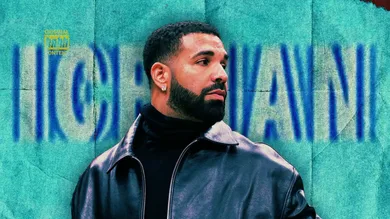


10 years ago, people debated whether Drake actually sat atop the CN Tower for the Views cover. It was Photoshopped, but it didn’t matter. The image still worked. Views was a moment for Toronto. Drake became hip-hop’s de facto Top Boy, having defeated Meek Mill in their feud (rather easily), earning a Grammy nod for a diss song, and then doubling back with “Summer Sixteen.” Views didn’t carry the tension of the Meek Mill feud. That arrived on “Summer Sixteen.” The album itself felt more like a coronation: Drake turning Toronto into mythology at the exact moment he became unavoidable as a pop star.
Ten years later, Drake no longer needs to photoshop himself onto Toronto landmarks. Now, the city itself participates in the mythology. The circumstances today are different from those of a decade ago. It was only last year that Kendrick Lamar returned to Canada for the first time since their battle, selling out two nights at the Rogers Centre to 72,000 people chanting for an encore of “Not Like Us.”
But for as much of a W as it may have been for Kendrick Lamar after already defeating Drake, two nights can’t undo a career of paying homage to a city and uplifting it into a global hub that’s worth paying attention to. If Views captured Drake at the moment he conquered rap’s center, ICEMAN arrives after the center briefly turned against him. Toronto, however, never really did.
The ICEMAN livestream finale treated Toronto less like scenery than infrastructure in its visuals. The city’s landmarks became active participants in Drake’s mythology, beyond serving as a backdrop. In “Make Them Remember,” Drake records inside Mayor Olivia Chow’s office wearing the city’s ceremonial chain. In another scene from the livestream, he sits in City Hall with Chromazz on his lap. Few rappers possess enough civic cachet to turn City Hall into set design.
The CN Tower becomes its own character again. Reports suggested 75 projectors lit it in blue for ICEMAN, and he filmed parts of “2 Hard 4 The Radio” inside the tower’s radome—a space most Torontonians have never seen.
ICEMAN works because it revisits the city that produced him. Aerial shots of the Rogers Centre might be interpreted as some sort of shot at Kendrick, but it’s also a place that builds from his past and explores a pivotal moment in his personal and professional life. The return to Guild Park and the Rogers Centre recalls the “Headlines” video, one of the first moments Drake fully framed himself as Toronto’s defining rap figure.
Places like Sotto Sotto no longer function as simple restaurant references in Drake’s music. They’ve become part of the architecture of his career. Filming “Burning Bridges” inside the restaurant, surrounded by old friends and family, turns it into another node in his personal mythology.
Earlier in his career, Drake often filmed Toronto like an underdog city—somewhere cold, local, and slightly overlooked. The If You’re Reading This It’s Too Late short film, Jungle, turned the streets into cinematic landmarks. That approach becomes harder to replicate once both the artist and the city become global commodities. But ICEMAN still finds pockets of lived-in Toronto: Adonis joyriding in a police cruiser on Lake Shore Boulevard with Shane Gillis, the University of Toronto Scarborough campus reframed in “National Treasures,” and Brass Rail appearing as part of the city’s internal mythology rather than tourist spectacle.
Even the rollout’s scavenger-hunt theatrics reflected that dynamic. The ice-block scavenger hunt near Dundas and Church became a temporary civic event—fans breaking into sculpture to find the release date. When Kishka eventually uncovered it, the moment read like a low-level ritual of participation in Drake’s orbit.
The thing is, ICEMAN can’t be considered a homecoming—he never left in the first place. But the livestream for episode 4 and the music videos that accompanied this album illuminated the city in a way that he hasn’t done since Views. Views sold Toronto as an atmosphere. ICEMAN documents Drake’s ownership over its memories, institutions, and mythology. At a moment when his cultural dominance feels less secure than it once did, ICEMAN uses Toronto to remind the world that his roots there remain immovable.