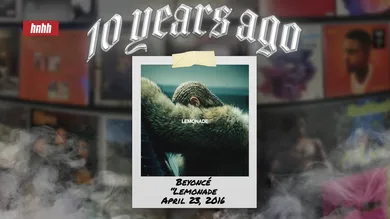


Ten years later, people still remember where they were when Beyoncé released Lemonade. It didn’t arrive like a typical album. It showed up as a film first, one hour on HBO without a warning or buildup, just a full body of work presented to the audience all at once. By the time it ended, the conversation had already started.
People were trying to make sense of what they just watched. The imagery, poetry, anger, and quiet moments in between. Then, the music followed, with twelve tracks that didn’t stay in one place for long. It moved through genres and emotions, giving fans something that felt personal but never fully explained.
Read More: Lemonade - Album by Beyoncé
Very quickly, the focus narrowed in on the story people thought they understood. Songs like “Sorry” and “Don’t Hurt Yourself” had listeners reading the album as a response to infidelity, with one line in particular, “Becky with the good hair,” turning into its own kind of cultural shorthand. The speculation took over, and for a moment, it felt like the album was being reduced to a headline.
Yet, Lemonade was always bigger than that. It held space for anger and betrayal, but also for family and Southern identity. It also spoke to Black womanhood in a way that felt deliberate. A decade later, the music still lands, and the images still hold. Moreover, the conversation around it hasn’t really stopped.
The Rollout That Stopped Everything
Nobody had time to prepare for it. On April 23, 2016, HBO premiered Lemonade (visual album), a one-hour film, produced by Good Company and Jonathan Lia, built around the album before most people had even heard a single track. It wasn’t framed like a typical music special. There weren't any interviews or behind-the-scenes footage. Just a continuous piece that moved through chapters, each one tied to a different emotion. You watched it straight through, or you missed it.
The visuals ranged from Southern landscapes with Black women placed at the center of each frame to poetry layered between songs to family footage woven in without much context. When it reached “Formation,” people were trying to understand what the whole thing meant.
Read More: 7 Times Beyoncé Put Her Texas, Country Roots Into Her Music
Then, the album dropped. Because you had already seen it and felt it, the music landed differently. You weren’t necessarily hearing the songs for the first time, but replaying moments. Social media locked in immediately. People quoted lyrics, gave their guesses as to who “Becky” was, and debated what was real and what wasn’t. Since it was initially tied to Tidal, not everyone could access it right away, which only made it feel bigger.
The Story Everyone Thought They Knew
Once the film aired and the album followed, the conversation narrowed almost immediately. People started building a story around the music. Fans weren't just listening, but decoding. Songs like “Hold Up,” “Don’t Hurt Yourself,” and “Sorry” felt pointed, like pieces of something personal being laid out in real time. Soon, “Becky with the good hair” became a staple, propelling the conversation. Names started circulating. The internet did what it always does: trying to match a lyric to a real person while turning speculation into certainty with little proof to back it up.
Lemonade started getting framed as a public response to infidelity, specifically within Beyoncé’s marriage to Jay-Z. To be fair, the project's emotional arc made that reading easy to follow. You could trace the anger and grief, and what felt like an attempt at repair by the time it reached the end.
Read More: Beyonce Brings Out Kendrick Lamar In Los Angeles On Renaissance World Tour
Still, Beyoncé never confirmed it that cleanly. She gave just enough to guide listeners, then stepped back and let people fill in the rest. Over time, that space between what was said and what was assumed became part of the album’s identity.
What complicated things later was everything that came after. Jay-Z spoke more openly about infidelity in his own work. His album 4:44 seemed to answer some of the questions Lemonade raised without ever directly referencing it. It didn’t rewrite Lemonade, but it changed how people heard it.
The Sound & Range Of Lemonade
Lemonade didn’t sit in one lane. You move from the bounce of “Sorry” into the aggression of “Don’t Hurt Yourself,” then into something like “Daddy Lessons,” which leaned all the way into Southern country without hesitation. It shouldn’t have felt cohesive on paper, but it did. That came down to control.
Beyoncé was doing more than simply performing as she was overseeing a dense, layered project released through Parkwood Entertainment in partnership with Columbia Records, pulling in a wide range of producers and writers without letting the vision drift.
Read More: Jay-Z Explains Why He Cheated On Beyoncé In New York Times Q&A
You had contributions from people, including Mike Will Made-It, Diplo, Mike Dean, James Blake, Just Blaze, and Jack White, all working across different sounds, but nothing feels disconnected. Each track sits where it’s supposed to.
“Don’t Hurt Yourself” hits hard because it doesn’t sound polished. It’s loud, raw, and almost uncomfortable at points, and that’s intentional. “Freedom” featuring Kendrick Lamar carries a different kind of weight, drawing on gospel and protest in a way that stretches the album beyond personal conflict alone. Then something like “Sandcastles” slows everything down, stripping it back to something quieter and more fragile.
None of it felt accidental, and that’s the part that often gets lost when people focus only on the story. The music itself was just as intentional as the visuals, and built with a level of control that made all those moving parts feel like one piece.
The Impact: Culture, Conversation, & Canon
People came to Lemonade through the story, but the project held because it was doing more than narrating betrayal. The film placed Black women at the center without apology and made all of that feel inseparable from the music itself.
It was also dominating in ways that made the conversation impossible to ignore. Lemonade debuted at No. 1 on the Billboard 200 with 653,000 equivalent album units, and all 12 tracks entered the Hot 100 in the same week. Billboard also reported it logged one of the biggest U.S. streaming starts of its time, and IFPI later named it the top-selling album globally in 2016.
Read More: Jay-Z & Beyoncé Relationship Timeline
Further, what added even more weight to Lemonade is where it sits in Beyoncé’s catalog. The album before it, 2013’s self-titled Beyoncé, changed the release model. That project made the surprise drop feel controlled and massive. It was commercially dominant, but Lemonade pushed that blueprint beyond by giving the audience something heavier and more exposed.
Then came Renaissance in 2022, which landed in a completely different emotional register. Put together, the three albums almost read like a progression of command on Beyoncé, rupture on Lemonade, and release on Renaissance. That is part of why Lemonade still feels singular. It sits between two other major Beyoncé statements, but it is the one that cut deepest.
Read More: Beyoncé And Jay Z Are In The Midst Of Shooting A New Music Video
And then there were the Grammys. At the 2017 ceremony, Lemonade won Best Contemporary Urban Album, and “Formation” won Best Music Video, but the loss of Album of the Year became its own cultural argument. Adele’s acceptance speech only intensified that reaction, because even in victory, she was publicly saying what many already felt, that Lemonade had reshaped the year in a way awards did not fully capture.
Ten years later, that part still follows the album. So does its place in the canon. It is remembered as a blockbuster and a visual event, as well as a deeply discussed marital text. It's one of the clearest examples of Beyoncé turning commercial power into a fully authored work.