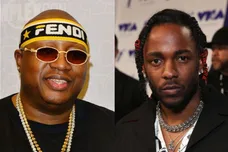
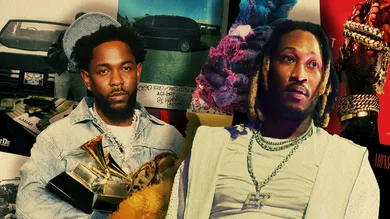


Anything feels possible in discrediting Kendrick Lamar these days. The Grammy favorability, the bots, that deal signed before the release of “Euphoria.” Do I think we’ll eventually reach a point where someone with a growing platform casually dismisses good kid, m.A.A.d city as overrated? Yuuup. That’s just the nature of the internet. When everyone’s opinion is equally accessible—and equally incentivized by an algorithm that rewards outrage—it’s only a matter of time before people collectively decide Kendrick Lamar is corny. Honestly, that’s fine.
Because for those who actually witnessed Kendrick’s ascent—from his days of K.Dot to Section.80 to good kid, m.A.A.d city to projects like To Pimp a Butterfly, and DAMN.—the revisionism will always feel a little hollow. Cultural memory doesn’t evaporate that easily, especially when the work itself continues to hold up.
Of course, the recent feud between Kendrick and Drake has only intensified the urge to re-litigate both artists’ legacies in real time. The two will probably remain tethered to that moment for years, whether through songs like “Not Like Us” echoing through arenas or fans weaponizing the beef in comment sections and concert crowds alike.
And then there are Ebro’s recent comments about Drake’s catalog and how many classics he really has under his belt. If a rap beef didn’t effectively rewrite his narrative, then maybe we wouldn’t be looking at a triumphant run throughout the 2010s as harshly. But that entire saga between Kendrick and Drake, as entertaining as it may be, ultimately has very little to do with the question of catalog. Because when we talk about bodies of work, Kendrick has long operated in rarefied air.
Outside of the Drake and Kendrick beef, a recent conversation across social media comparing Future’s catalog to Kendrick’s makes this all the more bizarre: who has more classics?
Watch The Latest HotNewHipHop Video Essay Below
On the surface, these conversations are random and, oftentimes, nonsensical. At the height of Verzuz, Twitter began debating a hypothetical battle between NBA Youngboy and Jay-Z. It makes for great conversation at the end of the day, but it also urges us to think a bit deeper about what a catalog actually looks like. But in the case of Future and Kendrick Lamar, the comparison of catalogs ultimately doesn’t boil down to preference but approach.
At face value, it might come across as blasphemous. Future is the king of toxicity, a mainstay in strip clubs and on the radio, while Kendrick Lamar is the enigmatic rapper who puts intention behind each word and every appearance. They both play their roles in the landscape of rap differently, yet not entirely in separate universes. We can’t look back at the 2010s—or even the 2020s at this point—without recognizing how important they are, especially since rap fans are the furthest thing from monolithic.
The conversation gets less ridiculous when you start breaking down their respective catalogs and what are considered unanimous classics within them. Let’s examine these more closely: the three-peat mixtape run of Monster, Beast Mode, and 56 Nights led to the release of DS2—that’s four in less than a year. And then let’s throw in both self-titled and HNDRXX, which were released a week apart. In total, that’s six classic projects in Future’s repertoire.
Kendrick, however, never moved at the same pace as Future, and it has resulted in significantly different outcomes. Section.80 is a mainstay for his core audience and a definitive project of the blog era, but whether it’s a classic—as in a quintessential listen for hip-hop heads—is debatable. What isn’t debatable are albums like good kid, m.A.A.d city, To Pimp a Butterfly, and DAMN. It’s too early to include any project either artist has released this decade, but outside of GNX, neither Future nor Kendrick has created projects that have lived up to their respective 2010s runs in quite the same way. Kendrick has four classics, if we’re being generous, but three albums are unanimously revered.
Trying to put either artist against the other will ultimately boil down to a quality-versus-quantity debate, which is the wrong way to frame it. Because at their core, these careers are about quantity versus curation. Future captured lightning in a bottle throughout his career. Even his worst projects contain incredibly strong moments. On the other hand, Kendrick practically vanishes after an album cycle is over—perhaps even more so these days. Yet every album he puts out, even recent ones like Mr. Morale & The Big Steppers, remains in conversation in one way or another.
A Case For Future
But that’s what’s most interesting. It’s not that Future’s success hinged on his celebrity, but that his relationship with Ciara—especially in its aftermath—turned him into a whole different breed of artist, one who reinvented himself emotionally and sonically. Between 2014 and 2017, Future turned trap into the emotional language of mainstream rap, transforming toxicity and nihilism into a pop-level aesthetic. His influence has been pervasive in that sense, from the music that bred countless artists who followed his blueprint to the memes and attitudes that have shaped the modern landscape of dating. He taught detachment on songs like “Real Sisters.” He masked heartbreak through deflection on “Throw Away,” and “Codeine Crazy” is the type of self-medicating that saw him unravel in his own isolation. Alongside producers like Metro Boomin, Zaytoven, and Southside, Future added the emotional depth that made this era particularly inspiring.
The creative avalanche only cemented him as an omnipresent force. If people were surprised that he penned “Drunk in Love,” reuniting with Jay-Z on DJ Khaled’s “I Got the Keys” in 2016 only reinforced that his emotive delivery had become the heartbeat of the moment. It’s the same reason he and Drake locked in together on What A Time To Be Alive in 2015, months after the release of DS2, and If You're Reading This It's Too Late. As much as Drake had the rap game under his thumb at that point, Future was setting the emotional temperature in a way that influenced the streets as much as the mainstream—he was shaping the sound of the moment in real time. An album like DS2 only showcased that he couldn’t miss.
A Case For Kendrick Lamar
The same year Future punctuated the mainstream with DS2 and What A Time To Be Alive, Kendrick Lamar delivered what can easily be considered a definitive body of work in his catalog—To Pimp a Butterfly. Coming off a classic debut that can be viewed in the same vein as Illmatic, we could’ve easily witnessed a rising star succumb to the pressures of a sophomore major-label release. And yet To Pimp a Butterfly underlined Kendrick Lamar as an album artist more than anything else—he could disappear from the public eye and return with something that takes time to digest. In many ways, it fell victim to the same “instant classic” narrative that plagues many albums, but over a decade later, it’s a project that still stands on its own two feet—sonically, lyrically, and thematically.
But that’s the thing about Kendrick’s catalog and the “classics” attached to his name—they simultaneously function as narrative arcs, social commentary, and layered musical compositions. Kendrick operates under an almost entirely different philosophy, where each song isn’t necessarily a standalone but part of a broader concept. good kid, m.A.A.d city brought us through the streets of Compton through his eyes. To Pimp A Butterfly grappled with survivor’s remorse with a politically sharp edge, and DAMN. explored the duality of virtue and vice—faith and doubt, pride and humility. With each of these albums, Kendrick delivered bodies of work that demand time and front-to-back listens. To Pimp A Butterfly often faces flak because it doesn’t necessarily have an obvious “hit record,” even though songs like “King Kunta” and “Alright” remain algorithmic and political mainstays to this day. But a song like “i” truly didn’t receive the credit it deserved until it was contextualized within the album’s tracklist.
Are We Counting Classics The Same Way For Both Artists?
Kendrick’s songs often gain power in sequence, compared to someone like Future, whose model emphasizes individual songs dominating the cultural bloodstream. Where Future’s greatness might be atmospheric, Kendrick’s greatness is architectural. So when we start comparing who has more classics, it gets ridiculous because the models we use to determine them are apples and oranges. Future’s strength was volume—he churned out classics one after another in a way that honestly felt reminiscent of Lil Wayne’s mixtape run in its impact. Quality matched quantity, and the replay value within those bodies of work can’t be contested over a decade later. That era was Future’s era, and those projects—whether mixtapes like Monster or albums like HNDRXX—feel just as fresh in 2026 as they did when they were first released. What makes the “classics” conversation even more muddied is the technicality of mixtape versus album distinctions. But let’s be real—the mixtapes Future dropped functioned like albums.
Frankly, we’re not looking for the same type of instant gratification from Kendrick Lamar. It’s always been a slow burn. Picking bars apart, analyzing samples, spotting Easter eggs that connect back to earlier albums—essentially turning the experience into a puzzle. Each album felt as ambitious as the last without necessarily circling back to old ideas, sounds, or approaches. He pushed his pen as much as he pushed production. Not everyone could close out an album with a makeshift Tupac interview without it feeling completely corny. There was always risk—and reward—in every single one of them.
But ultimately, the question remains: are we counting classics the same way for both artists? We could spend the next decade analyzing every single moment of Kendrick Lamar’s career and elevating them to a point of genius, but Future’s catalog can’t be denied of its genius either—even if it isn’t in the same metrics.
The reality is that Future probably won’t win a Pulitzer Prize or have his work acknowledged by the National Recording Registry. That’s largely because the system that determines artistic greatness often prioritizes intentional artistry over instinctual brilliance. Kendrick’s artistic intentions are partially why he’s been a critical darling for as long as he has—after a Grammy snub for his major-label debut, the Recording Academy has practically overcompensated to the point where he’s now the most-decorated rapper in Grammy history. That isn’t to say Kendrick doesn’t possess instinctual brilliance, but how many reference songs have leaked that show us the evolution of a beloved final product? Sure, the same could be said about Future. But institutions like the Grammys might not fully recognize his level of cultural significance. Future’s relentless output helped define the moods of an era. Through his understanding of melodies and textures, he mastered the art of making music that people live inside of. That’s another form of greatness—one just as rare as Kendrick’s penmanship.
It’s not that there isn’t merit to the Future vs. Kendrick debate, but the more important conversation is what actually determines a classic. Kendrick and Future represent two distinct paths to building both a legacy and a catalog. Future became the architect of sound and emotion, adding a breath of masculinity to a “sad-boy” rap era. In a sense, he approached it with a formula he knew would work—but it never felt formulaic. On the other hand, Kendrick Lamar became the mastermind behind some of rap’s most ambitious albums, and the rewards of that ambition transcended hip-hop entirely. The number of classics, ultimately, doesn’t matter as much as the impact. The debate falls apart the moment you realize they were never playing the same game. Kendrick Lamar documents the psyche of a generation. Future defines its mood. And both forms of greatness are the reason the 2010s sounded the way they did.