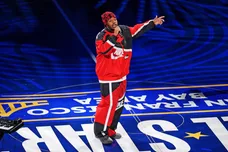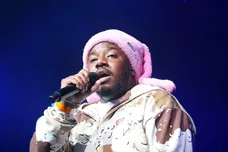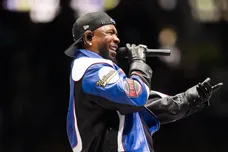
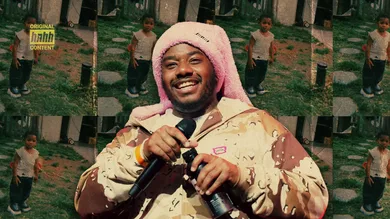


California artist LaRussell built his name on having an intimate relationship with his fans. It was never perceived as the industry kind. It wasn't the manufactured access that comes with a rollout, but something closer to that. He let people into the process. The shows felt, and were, local, almost personal. It was the kind of environment where the distance between artist and audience never fully forms. That closeness is what made his latest controversial moment land the way it did.
At a recent backyard performance, LaRussell introduced a song called “Heaven Sent” with a warning. He told the crowd his engineer didn’t think it should be released, but performed it anyway. In the song, he named himself, Malcolm X, and Martin Luther King Jr. as “heaven-sent.” A few lines later, he said the same about Donald Trump, Jeffrey Epstein, and Adolf Hitler.
"I'm not perfect, and neither is the president / What’s guiltier than a n*gga hiding evidence? / You can't be mad that they heated if you don't let them vent / Even the devil was heaven-sent."
Read More: LaRussell Blasts Critics For “Fake Outrage” Over Epstein, Trump & Hitler Lyrics
The clip didn’t need time to travel. It moved quickly, and so did the response. For a lot of people, the issue wasn’t confusion but recognition. They understood what he was trying to say. They just didn’t agree with how he chose to say it.
What LaRussell Meant Vs What People Heard
LaRussell didn’t leave much ambiguity about his intent. After the clip began circulating, he addressed the backlash directly. He said his point was spiritual. In his view, everyone comes from God. That includes figures people revere, and figures people condemn. From that standpoint, calling someone “heaven-sent” was about origin, not approval.
"Y'all been complicit in supporting serial killers, murderers, drug dealers, pimps, and n*ggas destroying the community for yeeeeaaaars!!!!" he wrote on social media. "But me saying God made me and he also made these sick ass n*ggas is where the line is drawn?"
The pushback wasn’t rooted in confusion. People understood the argument. What they rejected was how it was delivered. Once Malcolm X and Martin Luther King Jr. were placed in the same line as Adolf Hitler and Jeffrey Epstein, the phrase “heaven-sent” stopped reading as abstract and started to feel like a leveling of harm. That distinction mattered to listeners who heard something different than what LaRussell intended.
Read More: LaRussell Deactivates Social Media Amid Backlash To "Heaven Sent" Track
Writers and commentators focused on the language itself. “Heaven-sent” carries an implication. It suggests purpose and even a form of divine placement. Applied to figures responsible for genocide or systemic abuse, it doesn’t land as neutral theology. It lands as a distortion, and still, LaRussell positioned the backlash as "fake outrage."
"The homies briefed me yesterday on all the outrage. My first thought was, 'n****s ain't that slow.' But I go and look, and n****s that slow. Just listen to the music. It's no way n****s hear to that clip, and they like, 'You support Epstein.'"
Rappers and independent artists pushed back in a different way. Some questioned why that comparison needed to exist in the first place. Others pointed out that invoking Malcolm and Martin in the same breath as Hitler and Epstein forces a false proximity that ignores what those names represent historically.
There were also defenses, but they were quieter. A few listeners argued that LaRussell was speaking about creation, not morality. Even then, the same issue kept surfacing. The language made the idea harder to stand behind. That’s where the divide settled.
Why “Heaven Sent” Collapsed The Moment He Made That Comparison
The problem was never just the phrase. It was the company he put inside it. LaRussell didn’t name a random list of public figures. He brought together Malcolm X and Martin Luther King Jr., two men whose names carry the weight of Black struggle, political sacrifice, surveillance, assassination, and an unfinished fight for liberation. Then he placed Trump, Epstein, and Hitler in that same frame. He also included himself. That matters, too.
Because once those names share the same spiritual language, the comparison starts doing work whether the artist intended it or not. Malcolm and Martin are not simply “famous people who came from God.” They are historical figures whose lives have been used, misused, sanitized, and fought over for decades. Their names are tied to Black resistance, moral courage, state violence, and the cost of speaking against power. Hitler’s name is tied to genocide. Epstein’s to the sexual abuse and trafficking of women and children. Trump, for many people, represents cruelty as policy, racial grievance, immigrant scapegoating, and the mainstreaming of open contempt. These are not neutral references.
Read More: LaRussell Responds To Heaven-Sent Controversy In The Worst Way Possible
So, the issue is not that LaRussell believes everyone was created by God. The concern is that he asked the same phrase to hold radically different kinds of human meaning, then seemed surprised when people rejected the collapse. Language cannot flatten history without consequence.
Once Malcolm and Martin are grouped with Hitler and Epstein, the frame no longer reads as philosophical. It reads as moral compression. It suggests that what separates a freedom fighter from a fascist, or a civil rights leader from a sexual predator, can be absorbed into one broad spiritual idea. For many people listening, that did not sound comprehensive. It dinged careless.
Read More: LaRussell Gets Torn Apart Online For New Song Referencing Jeffrey Epstein
Moreover, people weren't rejecting complexity. They were deserting a framework that treated names shaped by very different kinds of consequence as though they could all be made legible through the same spiritual shortcut. Some comparisons don’t deepen a conversation. They empty it out.
A Community Artist Who Misread The Room
That kind of collapse doesn’t happen in a vacuum. It lands differently depending on who’s speaking. In this case, the voice came from someone who built his career on closeness. Backyard shows in Vallejo with fans standing within reach. A model that made the process feel visible and shared instead of packaged. It built trust, and, for a long time, that trust was the point. The music mattered, but so did the transparency. The sense that nothing was being filtered before it reached the people listening. That’s what separated this run from the usual independent grind. It felt direct and honest.
Read More: LaRussell Provides More Context For His Controversial Lil Wayne Comments
Further, the audience isn’t as small as it used to be. The reach has grown. The platform is wider now, with industry alignment entering the picture, including ties to Roc Nation. That changes how moments travel. What might have once stayed local now moves across timelines in minutes, landing in spaces that don’t share the same context or familiarity.
Then, instead of pulling the idea back or clarifying the language, he reinforced it. In follow-up posts, he stood on the same point. Everyone comes from God. That includes people the world sees as evil. The problem, in his view, wasn’t what he said. It was how people chose to hear it. Following the wave of pushback, LaRussell returned to announce that he was taking a hiatus from social media. Quickly, his accounts disappeared.
“I'll be off the grid for a while just working on myself and being in my community. I've been online every single day spreading my message to the masses for the past 5 years! I'm tiiiirrred boss!” he said. "I would still love to have your support during this time offline. I'll still be throwing shows and finding out new ways to push my product. You may see more text and emails from me than usual."
Read More: Kyrie Irving Shows Love To LaRussell By Purchasing His Album For $11,000
The audience LaRussell built his career with doesn’t struggle with nuance. They’ve supported him precisely because he speaks directly, because he doesn’t hide behind abstraction. That’s what made this moment feel off. The clarity that once defined his voice gave way to something looser, something that couldn’t carry the weight of what it was trying to hold.
The idea itself wasn’t new. People have debated questions of good, evil, and everything in between for as long as those words have existed. However, those conversations require precision. They require care and an awareness of what happens when those ideas leave private thought and enter public space. Moreover, his engineer was right about keeping "Heaven Sent" in the drafts, not because they may not have believed in it, but because they sensed that LaRussell's intention may have landed flat to a wider audience. Some ideas don’t fail because they’re too complex. They fall apart because they’re not grounded enough to be said out loud.