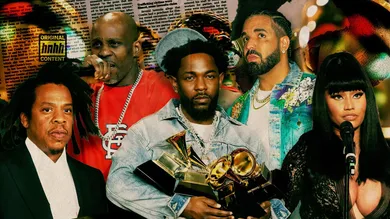


Every February, Hip Hop shows up to the Grammys with its receipts in hand. The talent is undeniable, and the impact is obvious. Yet, the outcome still tastes like confusion or fatigue, and sometimes both. This isn’t about a single snub anymore. Nobody’s upset because one artist lost, yet the question has grown heavier. Does this stage still matter to the culture that’s carried the music industry on its back for decades?
It used to be about recognition. These days, it feels like a performance where the culture shows up, but the institution watches from another room. Artists themselves have said as much. The Weeknd, after one of the biggest commercial and cultural runs in modern music, openly called the Grammys “corrupt” following a year when his work was shut out of nominations entirely. After his massive album and one of the most-streamed singles in history, he declared that the awards meant nothing to him anymore.
Read More: Hip Hop Snubs Have Always Been Grammy Culture
Drake, another artist whose output has defined the past decade, has downplayed the relevance of the trophies altogether, pointing to social impact and fan devotion as the true measures of success. This isn’t isolated to a single moment or artist. It’s long-running.
Nicki Minaj has publicly reminded the world that she was bypassed for Best New Artist even while dominating the charts, Eminem has repeatedly questioned why his critically acclaimed work wasn’t rewarded at the highest levels, and Jay‑Z’s frustrations over how the Academy has treated Beyoncé, one of the most decorated artists ever, have become part of the lore around institutional disconnect. Jay even boycotted the ceremony after they snubbed DMX following a monumental year in Dark Man X's career.
The problem isn’t just annual disappointment; it’s structural. Grammy voters once admitted they steer clear of certain artists simply because they’ve “won too much,” revealing a body that is increasingly defensive and distant from how audiences and creators actually value music.
Read More: Clipse & Pharrell To Take The Stage At The 2026 Grammys
That’s where we are now. Hip Hop hasn’t just evolved. It’s ascended and built its own metrics of success. It's also anchored global culture at every level. This ranges from streaming records and festival stages to the language of pop culture itself. Meanwhile, the Grammys are still chasing songs the culture was done with months ago.
We're not here to complain, but to reflect on whether Hip Hop still needs a validation system that rarely speaks its language, and whether the culture has quietly moved beyond waiting.
A History Of Distance: The Grammys Never Really Got It
The Grammy Awards didn’t formally recognize Rap until 1989. That first award, Best Rap Performance, went to DJ Jazzy Jeff & The Fresh Prince for “Parents Just Don’t Understand.” It wasn’t televised. The Recording Academy didn’t see the need. That snub wasn’t just about airtime but value. Moreover, that moment became the foundation of a long, strained relationship between Hip Hop and the institution.
In the decades since, Hip Hop has evolved, fractured, globalized, and redefined music itself. The Grammys, meanwhile, have often struggled to even classify it. Rap albums that changed the sound of an entire year were left out of major categories. Game-shifting artists were reduced to genre wins, or worse, overlooked entirely. When Kendrick Lamar’s good kid, m.A.A.d city lost Best Rap Album to Macklemore in 2014, it exposed how little the Academy understood about cultural artistic depth, and what a “classic” actually sounds like.
Read More: Kendrick Lamar Leads 2026 Grammys Nominations Among All Artists
Kanye West has addressed this for years. In 2015, he infamously, and jokingly-not-jokingly, walked on stage when Beck beat Beyoncé for Album of the Year. However, he was stone-cold serious in his remarks about the win in a later interview with E!, saying, “The Grammys, if they want real artists to keep coming back, they need to stop playing with us.”
The next year, Frank Ocean declined to even submit Blonde for consideration, calling the awards show “nostalgic” and out of touch with younger Black creatives. In 2021, Tyler, the Creator called out the racism embedded in genre segregation, saying his IGOR win in the Rap category felt like “a backhanded compliment.”
This is all institutional. The Grammys have historically treated Hip Hop like an aesthetic rather than a discipline. Its influence is recognized, but its artistry is underestimated. Further, while R&B has faced similar sidelining, the frequency and scale of Hip Hop’s exclusion have made the strain generational and increasingly unfixable.
Read More: Lil Wayne & Drake Put On Blast For Not Defending Nicki Minaj Amid Grammy Snub
Despite landmark albums from OutKast, Lauryn Hill, and Kendrick Lamar, only The Miseducation of Lauryn Hill and Speakerboxxx/The Love Below have taken home Album of the Year, and even then, the latter wasn’t seen as a pure Hip Hop win. That’s two in over 30 years. It’s not just oversight. It’s misalignment. The Grammys were built to honor commercial polish and critical consensus. Hip Hop was built to challenge both.
The Culture Moved On, The Academy Didn’t
If the Grammys were once seen as the highest stamp of approval, that stamp doesn’t hold the same value anymore. At least, not in Hip Hop, when the culture has redefined what success looks like without waiting for industry applause.
Moreover, the numbers speak loudly. Hip Hop dominates streaming platforms globally. It sets trends across fashion, tech, film, sports, advertising, and fills stadiums. It drives engagement and is the pulse behind the most-watched Super Bowl halftime shows and the backdrop of every major brand campaign. Still, when it comes to the Grammys, Hip Hop remains a genre they recognize but rarely reward.
Read More: Tommy Richman Under Fire For Rap Grammy Submissions After Claiming He’s Not Hip-Hop
That distance suggests that the Academy still seems tethered to outdated ideas of artistry. It's stuck in a framework where Pop-adjacent and legacy-safe often win over anything too Black, too street, or too unbothered.
Artists have noticed and responded. Drake has used his Grammy speeches to remind fans that awards don’t define them. After winning Best Rap Song for “God’s Plan” in 2019, he told the crowd, “You’ve already won if you have people who are singing your songs word for word, if you’re a hero in your hometown.” They cut his mic off.
Read More: Dee Barnes Calls Out Grammys For Honoring Dr. Dre With "Global Impact Award"
When your biggest and most visible artists are either ignoring the awards or outright rejecting them, it stops being rebellion, and it signals something deeper about a system losing its influence. In the past, the Grammys shaped careers. Now, Hip Hop artists are shaping the Grammys by staying away.
Validation On Our Own Terms
For years, when the Grammys refused to see Hip Hop clearly, the culture responded by creating its own. The BET Awards became a centerpiece for Black excellence. The BET Hip Hop Awards specifically celebrated lyricism and creative innovation that the Recording Academy never understood. The Soul Train Awards uplifted R&B and Hip Hop’s more spiritual and sensual sides, praising genres often overlooked unless attached to a white feature or a Pop package.
But now? Even those institutions are being pulled back. In 2024, BET quietly suspended both the Soul Train Awards and BET Hip Hop Awards indefinitely. There wasn't a clear explanation or official replacement. What was once a home base for recognition is now paused. It's become another reminder that even our own platforms are vulnerable to the same systemic erasure we’ve fought to escape.
And still, Hip Hop endures.
Read More: Fat Joe Says Grammys "Jerk" Around Artists "On Purpose"
Artists are no longer waiting for trophies to define them. They build empires off digital metrics and cultural impact. A viral freestyle can launch a career faster than a Grammy. A co-sign on TikTok can reach more ears than a televised performance.
Recognition now also comes in real-time, including playlist placements and how often your bar becomes a caption. It's Lil Nas X spending more energy on creative direction and digital storytelling than on Grammy submissions. It’s independent artists breaking streaming records and skipping label deals altogether.
The old idea that a Grammy win validates your artistry? That’s not the ceiling anymore. Some say it’s not even on the map. So, while the Recording Academy still clings to its authority, Hip Hop has moved into an era of self-definition. The culture knows what it values. It doesn't need a middleman.
Read More: Why Hasn't Nicki Minaj Received A Grammy?
The Grammys were never designed to hold this culture. Hip Hop wasn’t built for ballrooms or polite applause. It didn’t ask to be accepted and demanded to be heard. When it wasn’t? It built its own stages and its own legends.
So, no, Hip Hop didn’t simply outgrow the Grammys. It merely kept moving and evolving while the institution stood still. They are still clinging to outdated metrics and uncomfortable traditions. Hip Hop didn’t lose faith in awards. It just lost patience with being misunderstood. Now, artists don’t need the Grammy to prove they matter. A win might be nice, but it isn’t necessary. Not when the culture already crowned them long ago.