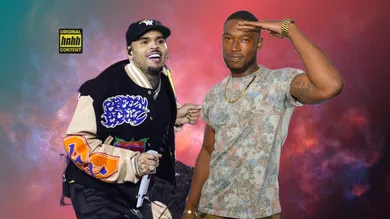


As Kevin McCall sat on a podcast couch, visibly upset, he reached in his pocket and pulled out his EBT card before lamenting about Chris Brown making millions of dollars and owing him money. McCall's plight didn't surprise viewers, as his unraveling has been documented for years. More than a decade ago, McCall was one of the architects of Breezy's comeback. He wrote, produced, and performed on songs that helped reshape Brown's public image after a highly publicized domestic violence assault against his ex-girlfriend, Rihanna.
The music was often undeniably ready for repeat spins at the club. It's commercial appeal was set from the start, and McCall was there for all of it. He took over hooks and dropped verses, and often, if he wasn't in the booth recording, he was in the studio assisting in penning tracks that have climbed the charts or become fan favorites. Now, he's all but been erased from the lore.
Read More: Chris Brown's Sordid, Long History Of Arrests, Violence, & Legal Troubles
Meanwhile, Brown, despite years of public scandal, has managed to hold onto his fame. He’s faced charges of assault, multiple allegations of violence, and well-documented run-ins with the law. Still, he remains praised by fans while continuing to rake in profit from his efforts. Fans are loyal. His tours still sell out. The industry, for all its moral posturing, never really turned away.
McCall was on that same road. He helped pave it, but somewhere along the way, his momentum stalled. What followed was a slow and public fallout of legal disputes, unstable social media posts, accusations of abuse by his ex-girlfriend, Eva Marcille, and a steady slide into financial and professional freefall. However, before that collapse, there was music, and we're taking a look at seven of the several of collaborations that Brown and McCall have under their belts. We recognize that fans will have their favorites, and there are certainly enough songs to choose from, but these hitters remain staples.
Seven Tracks That Captured The Moment
1. "Deuces" (2010)
The success of “Deuces” helped reposition Brown in R&B spaces. There was no avoiding "Deuces" once it arrived on the scene. It wasn't supposed to be a hit, as it debuted on Chris Brown and Tyga's collaborative 2010 mixtape, Fan of a Fan. It would later find a new home on Brown's 2011 F.A.M.E. release, but by that time, it was already making waves. McCall produced the track, co-wrote the lyrics, and opened the song with a verse that framed its entire tone.
Despite its mixtape origin, “Deuces” took on a life of its own. It steadily climbed the charts, eventually hitting No. 1 on Billboard’s Hot R&B/Hip-Hop Songs, where it held the top spot for 10 consecutive weeks. It also rose to No. 14 on the Billboard Hot 100, a rare feat for a track with that kind of nontraditional rollout.
2. "No Bullsh*t" (2010)
It was stripped-down and unapologetically blunt. “No Bullsh*t” was released as part of Fan of a Fan and later folded into Brown’s In My Zone 2. It stood out in a crowded moment of auto-tuned radio bangers because it didn’t chase a trend but leaned into mood.
Again, McCall co-wrote and co-produced the record, giving it its tension and control. The track reached at No. 3 on Billboard’s Hot R&B/Hip-Hop Songs and became one of Brown’s signature bedroom records. It worked because McCall helped build it that way. His background in Gospel, Jazz, and classical piano shows up in the arrangement. Moreover, “No Bullsh*t” never needed a crossover audience. It became a quiet classic in the genre, and proof that McCall was riding a wave and directing the current.
Read More: Chris Brown & Kevin McCall Beef On Twitter & Instagram
3. "Strip" (2011)
It was playful, but it wasn’t lightweight. “Strip” marked a tonal shift in Brown’s catalog as a return to levity without losing the edge he’d developed post-scandal. It arrived in late 2011 as a buzz single ahead of Fortune and came with a simple formula including a teasing hook and just enough bounce to catch on in clubs and on radio.
On this one, McCall co-wrote the track and also appears as a featured artist. The track broke at No. 85 on the Billboard Hot 100 and eventually climbed to No. 37, while also peaking within the Top 10 on the R&B/Hip-Hop charts. The song didn’t dominate like “Deuces,” but it did exactly what it was designed to do as a reintroduction to Brown’s playful side.
Read More: Chris Brown Trolls Kevin McCall After His Emotional Breakdown Over Financial Struggles
4. "Yeah 3x" (2010)
This one moved faster than anything McCall had worked on with Brown up to that point. It was more electronic than R&B, more dance floor than bedroom hits. “Yeah 3x” came in the Fall of 2010 as the lead single from Brown’s F.A.M.E. album, aimed squarely at Top 40 radio. It worked. The song became an international hit, charting in over a dozen countries and reaching No. 15 on the Billboard Hot 100.
McCall once again put his pen to work and co-wrote the track, providing the balance of keeping Brown’s phrasing rooted in Soul even as the production reached for the rave. It wasn’t the kind of track that showcased McCall’s voice, but it showed his adaptability. He understood the assignment, and more importantly, the moment.
Read More: Chris Brown Essential Songs
5. "She Ain’t You" (2011)
It started with a sample and a risk. “She Ain’t You” lifts from two sacred sources. It taps SWV’s “Right Here (Human Nature Remix)” and Michael Jackson’s original “Human Nature.” That kind of interpolation only works if the writing around it holds up. In this case, it did.
Dropped as the fourth single from F.A.M.E., the track slowed everything down. Gone were the club tempos and radio hooks. This was delicate. Emotional without being overwrought. Brown’s vocals hovered above the beat, but the bones of the song owed just as much to the pen behind it.
McCall was in the studio co-writing the track, subtlety making it one of Brown’s more human records. It was a rare moment of softness that landed without apology.
Read More: Kevin McCall Claims He's On EBT And Chris Brown Still Owes Him Money
6. "Ballin’" (2010)
There’s a particular energy in early-career mixtape tracks. “Ballin’” carried that charge. Another one pulled from Fan of a Fan, the track brought Chris Brown, Tyga, and Kevin McCall into the same space with no need for pretense. Moreover, McCall didn’t fade into the background here. He jumped in as a full participant and delivered a verse that matched Brown’s charisma and Tyga’s flow without sounding imitative. His voice had texture and he carried himself like someone who knew the mic might not always come back around.
There’s no chart placement for “Ballin’.” No award nominations. In hindsight, “Ballin’” arguably marked the tail end of an era when McCall still had access and momentum. The industry wouldn’t follow through, but the tape tells the truth.
Read More: Kevin McCall Dedicates New Song To "Baerucche" Amid Chris Brown Beef
7. "Life Itself" (2012)
This was the pivot point. “Life Itself” was introspective, stripped of swagger, and aimed inward. Released in 2012 as part of Kevin McCall’s solo mixtape Uninvited Guest, the track still featured Chris Brown, but the roles had shifted. This was McCall’s record. Brown was the guest.
The song unfolds slowly as McCall sings about the quiet exhaustion that creeps in when the spotlight starts to dim. There are no punchlines or stunting. However, there is reflection and the weight of an artist who saw the machine from the inside and started asking questions. Further, “Life Itself” never charted. It didn’t go viral. Still, it’s arguably one of the most honest pieces of music in McCall’s catalog.
The Fallout: Silence, Scandal, & Self-Sabotage
There was no press release of an official split. We didn't receive a final track to mark the end. Kevin McCall’s name just stopped showing up. The collaborations with Chris Brown slowed, then stopped entirely. The rooms McCall used to be in no longer opened for him. Soon, he and Brown were beefing online. The strain is still haunting, as Brown decided to troll McCall after the latter's EBT admission.
Within the last decade or so, McCall became known less for the music and more for the chaos surrounding him. He was arrested multiple times, including for a courthouse altercation in 2019 during a custody hearing with his ex Eva Marcille, with whom he shares a daughter. He’s posted erratically on social media, spiraling out of control, veering between demands for recognition and attacks on those he once worked with. In interviews, his pain has often spilled over into paranoia. At times, he’s made credible claims about being musically erased. In other instances, he’s unraveled in ways that some suggest point to a deeper instability.
Read More: Kevin McCall Goes Off, Admits He Hit A Woman "'Cause She Hit Me"
The allegations and red flags aren’t minor. There have been accusations of domestic violence and mental health crises made public through court documents and livestreams. Each new headline chipped away at what little industry goodwill remained. Whatever momentum he once had, especially with his long run alongside Breezy, has long been replaced by a reputation for volatility.
Yet, the frustration he voices about being written out of profits and legacy, isn’t entirely imagined. The music industry has a long history of ghosting the laborers behind the sound. Writers, producers, and hook singers get buried under marketing plans and label politics. When McCall says he was cut out, it echoes what many unprotected creatives have whispered for decades. Still, the truth is layered and the erasure is real. So is the self-sabotage.