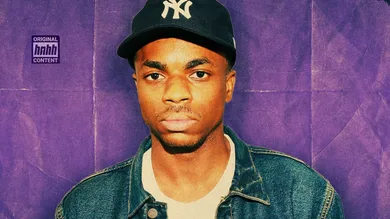


The more Vince Staples explains himself, the more people seem determined to rewrite him. Spend enough time reading reactions to his interviews, and you'll find no shortage of people convinced they know exactly what he should be doing. He should be angrier and more political. Rap harder and chase hits. He should become a mogul or compete with Kendrick Lamar. He should be making another Summertime '06.
The expectations are often contradictory, but they share a common thread. People keep measuring Vince Staples against goals he never set for himself.
These conversations have resurfaced following the release of Cry Baby, Staples' first independent album and arguably his most polarizing project to date. Built on Punk, Alternative Rock, and live instrumentation, the record has divided listeners who expected another typical Rap album from one of the genre's most respected voices. Don't get me wrong, overall, many have praised Staples' creative leap. However, others have questioned whether Staples has drifted too far from the artist they first embraced more than a decade ago. That's when things get weird.
Read More: Cry Baby— Album By Vince Staples
The debate surrounding Cry Baby says less about Vince and more about the expectations people place on rappers, particularly Black artists who refuse to stay in one lane. Staples has spent his career challenging assumptions about race, class, violence, celebrity, and the music industry itself. The latest controversy suggests he's now challenging another the belief that artistic growth should only happen within boundaries that audiences find familiar.
Rewriting Vince Staples
Much of the criticism surrounding Cry Baby begins with a version of Vince Staples that exists more in public memory than in his actual catalog. Throughout his career, Vince has been treated as though he emerged solely as a gangsta rapper, a chronicler of Long Beach street life whose greatest artistic value lies in his ability to document violence. That ignores much of what made his music compelling in the first place. Even when Vince rapped about gangs, death, and survival, he was rarely interested in those subjects as purely entertainment. His attention was often fixed on the systems surrounding them and the poverty that shaped communities. He shed light on the institutions that abandoned them and the ways Black suffering could be consumed as entertainment.
The distinction matters because many of the conversations surrounding Cry Baby assume Staples has abandoned something essential to his artistry. The criticism takes different forms as critics argue he should make a hardcore Rap album. Some insist his interviews have become more compelling than his music. A few frame his recent work as a retreat from the hunger that once defined him. Yet, those arguments often reduce Staples to a setting rather than a perspective. Long Beach becomes the story. The social commentary becomes secondary.
Read More: Vince Staples' New Album "Dark Times" Is Sobering And Soulful
However, his music catalog tells a different story. Big Fish Theory embraced Electronic and Club influences at a time when many Rap fans weren't sure what to make of them. FM! transformed Los Angeles radio culture into a concept album. Vince Staples became more introspective, while Ramona Park Broke My Heart looked back at the people and places that shaped him. Dark Times confronted the emotional weight of carrying those experiences into adulthood. The sounds changed but Staples' questions in maturation did not.
Critics still want Staples to occupy a role he may have outgrown years ago, if he was ever fully interested in it at all. The streets were never the entire story; they were the backdrop. Vince's real subject has always been the world that produced them.
Moreover, criticisms that Staples somehow shrank himself on this project and failed to step into a broader lane that would bring more fame and fortune have surfaced. This is strange, considering becoming a billionaire hasn't seemed to be Staples' goal. Placing those Rap star expectations on an artist who has spent the better part of their career challenging those systems is more of a reflection of the listener, and what they believe success in Hip Hop looks like.
Black Music Never Stayed In One Lane
Shortly after Cry Baby arrived, a clip from Vince Staples' album release show began circulating online. Reflecting on the release of Big Fish Theory, he recalled asking industry executives whether the project could be categorized alongside Electronic music. The response, according to Staples, was, "You don't belong there."
The comment may have been aimed at Vince, but the sentiment is familiar. As we enter Juneteenth Week, it's difficult not to reflect on the Black artists who have spent generations being told where they belong, often by industries that profit from their creativity while narrowing the ways that creativity can be expressed. Entire genres have been built on Black innovation only to become culturally detached from the people who helped create them.
Read More: Vince Staples Explains How 50 Cent And GTA: San Andreas Inspired Him And His Music
Rock music remains one of the clearest examples. Before the genre became associated with white rebellion and counterculture, Sister Rosetta Tharpe was blending Gospel with distorted electric guitar. Chuck Berry helped establish the language of Rock and Roll. Little Richard transformed performance itself. Punk would eventually emerge from that lineage, and Black artists remained there, even as popular memory attempted to write them out of the story. Detroit's Death was making Punk music before many listeners knew what to call it. Washington D.C.'s Bad Brains became one of the most influential Hardcore bands of all time, influencing generations of musicians who followed.
That history feels particularly relevant to the conversation surrounding Cry Baby. Too often, Rock and its adjacent genres are reduced to aesthetics, but it has always been about something larger. There's the distrust of authority and rejection of social expectations. We can't forget the resistance to institutions that demand conformity and refusal to remain where someone else put you. Those ideas are hardly foreign to Black music or Black history. In many ways, they define it.
The Blues challenged the conditions imposed upon Black Americans after emancipation as Jazz rejected convention and rewrote the rules of American music. Soul became intertwined with the Civil Rights Movement. Hip Hop emerged from communities abandoned by political and economic systems, transforming frustration into art, language, and identity across regions. Rebellion is one of its longest-running traditions in Black music.
Read More: Vince Staples Explains How Mac Miller "Changed My Life"
Further, Staples is hardly alone in challenging expectations. Rico Nasty spent years blending Punk energy with Rap, only to face constant questions about where she belonged. Denzel Curry has incorporated elements of Punk, Metal, Jazz, and Alternative music throughout his career, despite being widely regarded as a rapper. Lil Uzi Vert's embrace of Rock influences and Alternative aesthetics was often treated as a departure from Rap rather than an evolution. André 3000 faced similar criticism long before he picked up a flute. Every generation seems to produce Black artists willing to test the boundaries of genre and an audience eager to pull them back.
Why Do We Want Artists To Stay The Same?
Staples has always been preoccupied with systems. Violence appears throughout his catalog, but rarely as an end in itself. His attention tends to settle on the conditions that produce it. That perspective remained remarkably consistent, and that consistency is easy to overlook because Vince has never been an artist who repeats himself sonically. What ties his catalog together isn't genre but inquiry. Staples has spent more than a decade asking variations of the same questions. Who benefits from violence? What happens when survival becomes identity? How do people navigate systems designed without them in mind? What does success actually solve?
Simply reducing him to a gangster rapper is an irresponsible assessment of his music, if we really need to scrutinize it to that degree at all. Still, Staples is hardly the first artist to encounter this dilemma.
Jay-Z addressed it years ago when he famously rapped, "Hov' on that new sh*t, n*ggas like 'How come?' N*ggas want my old sh*t, buy my old albums." The line defines what has followed musicians for generations. Audiences often celebrate growth in theory but resist it in practice. The albums that first connect with listeners become benchmarks, and every project that follows is measured against a version of the artist that no longer exists.
Read More: Vince Staples' New Album Gets Co-Signed By Rock Legend Flea
Hip Hop is filled with examples. Fans wanted Nas to recreate Illmatic. They wanted Lil Wayne to remain in the Tha Carter III era. Tyler, The Creator built an entire second act from refusing to be confined by the version of himself that first gained attention in Odd Future. Yet, many of those same artistic risks are now viewed as essential parts of their legacies.
Jay-Z was never going to make Reasonable Doubt twice. Janelle Monáe was never going to spend her career repeating The ArchAndroid. The history of Black music has never been written by artists who stayed put. It has been crafted by those willing to risk misunderstanding in pursuit of something new. Cry Baby belongs to that tradition, whether listeners embrace it or not.