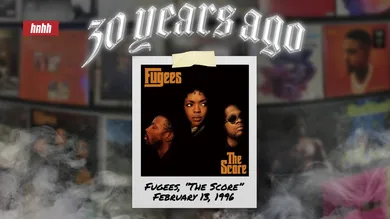


One of the undeniable highlights from the 2026 Grammy Awards was seeing Lauryn Hill and company pay tribute to D'Angelo and Roberta Flack, a moment of celebration and remembrance amid a show that often pointed to the United States' present reality of ICE-led fear, political division, and seemingly insurmountable compromise... On a compromised stage. Despite this grey cloud, L-Boogie spearheaded a wonderful performance, with Wyclef Jean among its many guests. They turned their rendition of Flack's "Killing Me Softly With His Song" cover into a cathartic performance of their mega-hit "Killing Me Softly." If it weren't for Pras's absence due to his federal corruption case, we might have gotten a massive Fugees reunion. But we did get a highlight from their classic album The Score, which turns 30 years old today.
So many things serve to undermine that reunion in a vacuum. There's the group's continuous struggle to reunite, marked by tour disagreements, multiple falling-outs, lateness controversies, and scrapped concert treks. Pras' foreign influence conviction, Wyclef's alleged misappropriation of Haitian charity funds, and accusations against Ms. Hill's alleged ego-driven bridge-burnings all undercut the community-based and collaborative spirit that the trio so passionately championed in the 1990s. And for a group celebrated for its revolutionary spirit, the legend status held up by institutions like the Recording Academy rings as an ironic stifling.
But in the face of all these contradictions and contextual retcons, The Score stands unshakably tall as a resonant and powerful standard of "art-ivism," especially in today's terrors against refugees and subjugated populations across the globe. It's an indelibly influential hip-hop text, one of the genre's greatest flashes in the pan, and a rally against systems that still haven't changed for the better.
The Score's Splash In Hip-Hop
Hip-hop before The Score was finding its way: the genre was finding its commercial formula at the time of its release, and the culture's contributions post-1996 split into increasingly incompatible directions. But listening back to this album in 2026, it's not hard to hear why folks credit it for bringing alternative hip-hop to the mainstream, both in messaging and in sound. Its influence would continue to flower bountifully as rap music further embraced melody and genre fusion.
But its most enduring impact is on the people that this album celebrates, and its condemnation of the societal mechanisms that abuse them. Police become "The Beast" via sharp critiques of forced conflict, a "No Woman, No Cry" cover provides hopeful respite, and current Newark mayor and New Jersey governor candidate Ras Baraka attacks big record companies and much more on the "Red Intro." While the Fugees often speak to the inner violence distracting their peers from a common enemy, their venom rests overwhelmingly on the "dogs" they want their fellow "cats" to kill on the outro.
You could find similarly indignant messaging on, say, 2Pac's All Eyez On Me, which came out the same day as The Score. The difference (regardless of which masterpiece you prefer) is not just in sound, as cuts like "Family Business" and the title track lend beautiful guitar work to somber but nonetheless striking cuts. Rather, it's mostly in how the group subverts and unpacks bravado in hip-hop at the time and morphs it into something more nuanced and humanist.
"The Mask" is a perfect example of this, and some lines admitting to internal friction or competition within the group let the "kayfabe" slide off on repeat listens. So what's under the mask?
What Are The Fugees About?
Wyclef Jean and Pras's Haitian identity shines throughout this record, which still inspires pride after the malign treatment of Haitians during the 2024 U.S. election. Lauryn Hill stakes her claim as one of the best MCs to ever do it, and certainly the best rapper-singer by a few miles. With charisma, skill, introspection, and self-awareness, the trio deftly commemorates their colleagues through standout collaborations. Skits, DJ drops, and thematic through-lines heighten the feeling of 30 friends all being in the same room. It's incredible that The Score pulled off this intimacy and free-flowing creative spirit, especially after a relative flop with 1994's Blunted On Reality that executives at Ruffhouse Records wanted to reward with a pricey second chance.
Also, the Fugees' relentless crusade against artistic biting ("Zealots" is still a classic), commercial exploitation, and anti-Black sentiments across the U.S. and the diaspora has no mask to obfuscate it. Their tangles with mortality on "Manifest" anchor the LP in an early battle for Black art's soul and the acknowledgement of the heavy weight no artist can fully carry.
Via these values, The Score's gargantuan commercial success was still able to retain a sense of anti-establishment veneer, much in the same way people might look at an artist like Kendrick Lamar today. They rooted their approach to the art in these resistances to "selling out," which means audiences today can still find their original intent intact.
Yet it's impossible to reckon with the history of this album without acknowledging the historical progression of the themes it tackled. Or more accurately, the reality that there hasn't been enough of that progression. But the Fugees' history after The Score is a similarly consequential factor.
Lauryn Hill, Wyclef Jean & Pras' Controversies
Without trivializing personal obstacles, the group fell out and broke down in ways that countered their north stars in '96. After Miseducation, Lauryn Hill became a global icon. But controversies around her collaborative process, label drama, constant romantic gossip, the more recent criticisms of her performance lateness, and her general elusion from the mainstream have tainted her legacy in ways she can’t fully control.
As for Pras Michel and Wyclef Jean, their career asterisks land closer to The Score's sociopolitical leanings than they do to its artistic pillars. Wyclef allegedly misappropriated funds from his charity for Haitian relief efforts amid various disasters and injustices, whereas Michel faces 14 years in prison for illegally funneling stolen foreign money into an Obama presidential campaign and lobbying to end the Trump administration's investigation into his purported co-conspirator.
Frictions, tensions, and disagreements between the trio continued even when things got better for a brief period of time. They had successful live reunions since The Score dropped. But at press time, things seem quite bleak, as they have often been for the trio.
As such, the public perception (or reevaluation) of this album today can’t untangle what recent events suggest. Artistic sovereignty and collectivist unity crumbled under accusations of stealing from collaborators and clashes of ego. The sociopolitical messaging hits differently amid rat-races and vulture circles… Allegedly.
There's one big shadow hanging over this. Are the Fugees to blame for their complicated legacy, or is it the system they fought? Did they fall out of love with art, refuse to engage with it as commerce, or fail to live up to their young and lofty goals? Was this inevitable, or did they miss the mark? Are we demanding too much?
Ready Or Not, The Score Is Here To Stay
Back to that Kendrick comparison and that Grammys performance from Lauryn Hill, Wyclef Jean, and many others–it feels like these are questions the world is asking about all its favorite artists right now. If anything, it proves that The Score is timeless, not just in its overwhelming quality, but in its legacy as an anti-establishment record that the establishment loved to celebrate. That doesn't mean its themes haven't inspired its successors to take things a step further.
Now more than ever, it's futile to try to separate ICE horrors, commercialization, xenophobic sentiments, and the dilution of art from the U.S.A. and all of its entertainment industries. It's also increasingly harder to hold artists accountable, and for them to manifest the ideas they express on wax. But despite these contradictions and compromises, "Cowboys" is as playful as ever, "How Many Mics" is still a head-bobber, "Fu-Gee-La" is an all-timer, and this LP finds balance between hip-hop's diverging paths to promote togetherness.
The Score's current history and perception may contradict its values in a vacuum, especially on a Grammys stage. Political messaging turns artists into brands now more than ever. But for listeners old and new, these themes are a spark of hope, not a zero-sum game whose life cycle is defined by the powers that be.
Overall, it's as relevant and compelling as ever 30 years later. While Lauryn Hill, Wyclef Jean, and Pras have all gone in very different directions, their controversies haven't erased their words. Rather, their words have grown beyond them. If we're lucky, they will grow past the artists today who face similar challenges of compromise and commercialization in their art. Hopefully, they will be the ones to settle the score.