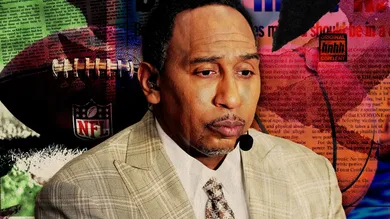


The footage was already circulating when Stephen A. Smith weighed in. An ICE agent in Minnesota had shot Renee Good, an American citizen and poet, in the head during a neighborhood operation that residents say escalated without warning. Good was seated behind the wheel of her car. Her final words, captured and repeated in the aftermath, were simple when she said, “I’m not mad at you.” The agent fired anyway and immediately after called her a "f*ckin' b*tch." ICE later claimed Good used her vehicle as a weapon. Videos show otherwise.
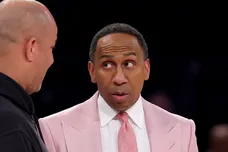
As protests spread and questions mounted, Smith chose a familiar lane. From his national platform, he described the shooting as “completely justified” from a legal standpoint. He acknowledged alternatives, disabling the vehicle, de-escalation, and restraint, but ultimately sided with the authority that pulled the trigger. The comment landed hard, not because it was provocative, but because it fit so neatly into a routine viewers have learned to expect.
Read More: Stephen A Smith's Beef With LeBron James Is His Final Step To Becoming A Right-Wing Grifter
This was not Stephen A. Smith misspeaking. It was Stephen A. Smith doing what he has increasingly done over the last decade by aligning himself with institutional power at moments when communities are demanding accountability and care. Again and again, when history pauses and asks a question, Smith answers from the safest possible distance, often cloaked in the language of realism, legality, or “both sides.” While the effect seems balanced, it’s erosion.
Kaepernick, Crockett, Kamala: The Respectability Lane
When Colin Kaepernick knelt during the national anthem in 2016, the backlash arrived fast. The pushback came from fans and owners, as well as politicians. Of course, it also came from Stephen A. Smith.
Rather than frame the protest as a response to police violence and systemic racism, which Kaepernick had plainly stated, Smith turned his attention to Kaepernick’s methods. He questioned the quarterback’s decision to kneel and later questioned his decision to opt out of a contract. He called Kaepernick a “flaming hypocrite” for not voting in the 2016 presidential election. At nearly every turn, Smith redirected the conversation away from the protest’s purpose and toward its packaging. Rather than ask why a Black man might kneel in protest of the state, he asked why that same man wouldn’t adjust his tactics to make power more comfortable.
He did the same when Congresswoman Jasmine Crockett responded bluntly to Republican attacks during a televised committee hearing. Her comments, which many Black viewers applauded, were dismissed by Smith as “for the streets.” The phrase was condescending and coded. Crockett is a Black woman from Texas, legally trained and politically sharp, and Smith’s assessment carried the weight of respectability politics dressed as critique. He apologized days later, but the sting had already registered.
Read More: Stephen A Smith Slams Those Celebrating Charlie Kirk’s “Horrific” Murder
Vice President Kamala Harris has received similar treatment. When she released a memoir detailing her first 107 days as president, Smith didn’t engage with its content. He simply shrugged it off. “Who cares what she has to say?” he asked, rhetorically. What gets lost in these dismissals is not just the role she holds, but the historical and symbolic weight of her presence as the first Black, South Asian, and woman vice president in U.S. history. Her politics are fair game, but her existence shouldn’t be.
Siding With The System
After the world watched security footage of Ray Rice knocking his then-fiancée unconscious in an elevator back in 2014, the conversation turned toward domestic violence in professional sports. Smith went in a different direction. On air, he suggested that women should “make sure we don’t do anything to provoke wrong actions.” Reactions were swift, and ESPN suspended him. Michelle Beadle called him out publicly. Viewers condemned his framing. Once again, an apology arrived days later, with Smith calling it “the most egregious error” of his career. Even then, the focus of his commentary was not the violence itself but the response to it. It wasn't about the harm, but how it might be avoided.
Read More: Stephen A Smith Claims LeBron James Tried To Sabotage His Career
Years later, when Serena Williams made a surprise appearance at the Super Bowl halftime show with Kendrick Lamar, Smith offered a critique so loaded it barely needed translation. He questioned her timing and challenged her presence. "If I'm married and my wife is going to join trolling her ex, go back to his ass," Smith said of Serena, mentioning her previous romance with Drake. “Cause clearly you don't belong with me. What you worried about him for and you're with me? Bye. Bye.”
The same tone surfaced when he criticized NBA player J.R. Smith for wearing a hoodie on the bench. “I don’t know why the hell Nike made these damn uniforms that had hoods attached to it, by the way," Stephen said at the time. "You got a lot of white folks in the audience that are gonna think this is Trayvon Martin being revisited, and I’m not joking about it. The bench is no place for someone to be wearing hoodies." J.R. responded by calling Smith an “Uncle Tom.” Smith's commentary seemed more interested in how Blackness is perceived than in the systems that punish it.
Read More: Joy Reid Claims Stephen A. Smith Is Paid To Criticize Black People
Even outside Black American culture, Smith has found ways to amplify power through analysis. In 2021, he commented on baseball star Shohei Ohtani’s use of an interpreter. “I understand that baseball is an international sport itself in terms of participation, but when you talk about an audience gravitating to the tube or to the ballpark, to actually watch you, I don’t think it helps that the number one face is a dude that needs an interpreter, so you can understand what the hell he’s saying in this country," said Smith. The response was immediate, and he was accused of being xenophobic and outdated. Smith apologized, but his larger point, that language difference was a barrier to leadership in a sport, revealed a narrow view of who gets to be celebrated, and why.
Click Culture Over Community
He's always been loud, but Stephen A. Smith's volume isn’t the problem. The issue is what happens when performance overtakes principle, and when the currency of a take becomes its virality rather than its value.
In recent years, Smith has expanded far beyond ESPN. He hosts a podcast, books high-profile guests, trends weekly on social media, and reportedly earns an eight-figure salary as the most recognizable voice in sports media. He knows what controversy generates attention. Over time, his commentary has leaned into that equation.
This change became especially observable in his political commentary. On Real Time with Bill Maher, Smith criticized Democrats for being too “woke,” a term increasingly weaponized by far-right politicians to dismiss progressive ideals. He praised Donald Trump’s communication style as “closer to normal than what we’re seeing on the left.” These aren’t casual observations but cultural cues, the kind conservative media uses to signal alignment without fully committing to the politics behind them.
Read More: Stephen A Smith Admits He Was "Misinformed" When He Voted Against Donald Trump
Smith has said he’s not a fan of Trump. Yet, when he speaks the language of the right, even in jest or frustration, he gives weight to narratives that harm the very communities he claims to represent. In the current climate, where words are weaponized and language travels faster than truth, this matters. His comments don’t exist in a vacuum. They get clipped, shared, and used to validate systems that are actively working against marginalized groups.
This is where the argument about diversity of thought within Black communities enters the frame. Because yes, Black people are not a monolith. We do not owe ideological loyalty to any party or movement. We are allowed to span the full political spectrum. There are Black conservatives, nationalists, abolitionists, centrists, moderates, and anarchists. That complexity is part of our power, but it also comes with a cost.
Read More: Stephen A. Smith Claps Back At Monica McNutt, Takes Credit For Her Success
The Consequences Of Being Loud & Wrong
There is a difference between being controversial and being careless. Over time, Stephen A. Smith has blurred that line so thoroughly that it’s hard to tell where the takes end, and the harm begins. His words don’t stay on set. They give cover to policies and institutions already built on control.
When Smith calls the ICE shooting of Renee Good “justified,” it’s not just an opinion. It’s a signal to viewers who already believe that force against civilians is acceptable. When he questions Kamala Harris’s legitimacy, minimizes Jasmine Crockett’s voice, or mocks Serena Williams’s visibility, it lands differently because of who he is and who they are.
Read More: Terrell Owens To Stephen A Smith: "Max Kellerman Seems Blacker Than You"
History has receipts for this. The voices who policed protest in real time have rarely aged well. Those who questioned the tone of civil rights leaders, who dismissed Black resistance as too radical, too emotional, or too disruptive, are not remembered as truth-tellers. They are remembered as distractions.
Smith doesn’t have to agree with every movement. He doesn’t have to support every figure. However, he does have a responsibility to understand the weight of his voice. That responsibility doesn’t vanish just because he yells or because he’s good at his job or because he gets laughs. Being a cultural commentator, especially one who occupies this much space, is more than just speaking one's mind.
The Wrong Side Of History Is A Choice
Saying what others won’t is not the same as saying what needs to be said. In moments that require moral clarity, Smith has too often chosen volume over vision.
He is not alone in this. Plenty of media figures shift with the wind, build careers on controversy, or mistake platform for insight. Few sit at the intersection Smith occupies as a Black man with a national platform. Smith doesn’t need to be an activist. He doesn’t have to lead movements or write manifestos. Yet, if he’s going to keep speaking, he should at least consider the historical company he’s keeping, because history will remember who stood with the people when power came knocking. It will remember who questioned authority, and who reinforced it. Moreover, it will remember who simply made noise while others put their voices to use for the betterment of their communities.