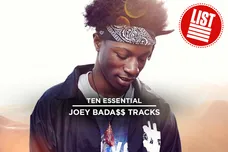
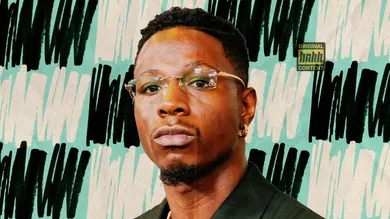


There’s something stubbornly refreshing about the way Joey Bada$$ has approached his new album. We’ve seen some pretty great rollouts this year compared to some of the more lab-engineered TikTok experiments since the pandemic that have done little except craft a few hit records that would otherwise be forgotten about. But the thing about the more “traditional” routes, as we saw with the Clipse this year, is that it’s a long game that rewards the listener by the time the album drops. For Joey, this has been the play that sets up Lonely At The Top as one of the most anticipated releases of the year. He’s doubled down on craft for an audience he knows actually cares. Competing for playlist placement or algorithmic supremacy was never where he thrived—and while the moments where he did achieve this felt organic, it didn’t necessarily feel like a sustainable path for such an anomaly. He came into the game as a teenage prodigy, reviving the industry boom-bap aesthetic as a frontrunner in the East Coast renaissance of the early 2010s.
That initial niche—built on 1999’s sample-heavy raps and Pro Era’s collective energy—gave him both a cult and a curse. He carved out a lane early, but when the industry tried to squeeze him into its larger machine, he didn’t quite fit. His commercial high point with ALL-AMERIKKKAN BADA$$ proved he could move units and plant himself in mainstream conversations, but when he drifted toward the underground after a five-year hiatus, he found himself alongside a wave of like-minded rappers who were mining the same ’90s nostalgia. Suddenly, Joey had peers everywhere, and the singularity of his come-up seemed blurred.
Fast forward to 2025, and his current strategy looks less like chasing validation and more like solidifying his lane. Earlier this year, he set the tone with “The Ruler’s Back” on New Year’s Day—a track that instantly raised the stakes, laced with sly shots at the West Coast in the spirit of hip-hop’s competitive nature. Some may have dismissed it, since it came on the heels of one of the biggest showdowns in hip-hop history, while others felt it was an effort for attention. However, it was Joey Bada$$ in his natural element, tapping into the oldest rap tradition: sparring with something to prove. That gauntlet sparked a regional flare-up, but instead of folding or looking corny, Joey doubled down with “Crash Dummy.” The song’s brilliance was in the details: adopting a West Coast flow over a sample of “Hit ’Em Up,” while still keeping his Brooklyn DNA intact. A provocation and a flex in the same breath, he proved that he could beat you at your own cadence.
What’s more impressive is that it clearly didn’t impact his relationships with his West Coast comrades, especially since it was primarily Joey Bada$$ facing off against TDE signee Ray Vaughn and label associate Daylyt. Ahead of his new album, he announced that Ab-Soul would be joining him on tour (along with Rapsody), and all three of them connected on Joey’s latest single, “STILL”—proof that Joey’s not burning bridges for headlines. He can spar and still shake hands after. That duality—competitive yet cooperative—is part of why his rollout feels singular. At a time when rappers are hyper-sensitive to even the slightest allusion to them, Joey made space where you could throw shots without it escalating beyond a point of no return.
Then there’s the larger ecosystem he’s orbiting. Take the recent Red Bull freestyle alongside Ab-Soul and Big Sean: three rappers who came up at the same time but now stand at different inflection points in their careers. Soulo is entrenched as a hermit genius, Sean is caught in the awkward post-G.O.O.D. Music comedown (opening for Russ rather than proving why he was often mentioned alongside Drake, Kendrick, and Cole for cultural supremacy), and Joey is an Emmy winner who has remained one of the sharpest wordsmiths of his era. The freestyle showed how sharp he looks when he’s not trying to force a mainstream moment. His verses sounded hungrier, looser, and more comfortable—a pocket where he’s performing at high levels without the pressure.
The singles leading up to Lonely At The Top have mapped out his strategy with surgical precision. “ABK (Anybody Killa)”—his first official lead single of the year—sounded like a mission statement, doubling as a televised flex when he performed it on Kimmel. “My Town,” with Loaded Lux, reaffirmed his New York roots and reconnected him with the battle-rap spirit. And with “Dark Aura,” Joey finally articulated the frustration behind the strategy: a scathing critique of Columbia and the label machinery that slowed his output. Over Chuck Strangers’ stark boom-bap, he delivered lines like “Independent mindset, we ain’t f***in’ with the majors.” It encapsulates this sense of renewal and defiance.
Lonely At The Top isn’t a bid for the King of New York title, nor is it a subtle flex of grandiose success that some of his contemporaries haven’t seen themselves. It’s a testament to the value of underground reverence—remaining compelling enough to avoid redundancy while evolving within the confines of your niche. There’s no contrived effort to dominate the charts or retreat to obscurity. It’s a precise walk that Joey’ Bada$$ embarked on, yet each step is deliberate, intentional, and unwilling to be rushed. Ultimately, it’s a blueprint that proves Joey never needed a throne to validate his reign.