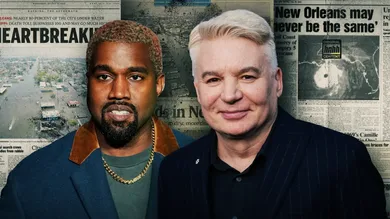


A live television fundraiser for Hurricane Katrina became one of the defining political moments of Kanye West’s career when he abandoned NBC’s prepared remarks and said what the network clearly was not expecting to hear. Standing beside Mike Myers during A Concert for Hurricane Relief on September 2, 2005, Kanye criticized the way Black survivors were being portrayed in news coverage and questioned how race and poverty were shaping the response to the catastrophe. Then came the seven words that would follow him for years: “George Bush doesn’t care about Black people.” The remark aired live on the East Coast. Because the telethon was broadcast on a delay in other parts of the country, NBC had time to remove Kanye’s statement before those later broadcasts, according to CNN.
Twenty-one years later to the date, the clip is striking for reasons that stretch beyond its original controversy. This was Kanye using the unpredictability that had already become part of his public persona to challenge a sitting president over the treatment of Black Americans. He was confrontational and willing to make a nationally televised celebrity fundraiser uncomfortable. Those characteristics never disappeared. However, what eventually changed was where much of that defiance was directed and what many of the Black fans who first embraced him believed it represented.
Read More: Mike Myers & SNL Recreate The Infamous Kanye West Hurricane Katrina Statement On 20th Anniversary
Katrina was not the first indication that race and inequality occupied a serious place in Kanye’s work. The College Dropout had already examined Black consumerism and the limits of education as protection against racism. A 2004 review in The Guardian called him an “intelligent social commentator” and specifically recognized the album’s interest in materialism and the obstacles facing Black graduates. Late Registration, released only days before the telethon, pushed further into government policy and the damage inflicted on Black communities.
That history makes the anniversary more complicated than a nostalgic look at an outrageous television moment. The Kanye who confronted George W. Bush did not suddenly discover politics because a camera was live. He was amplifying concerns already present in his music and, increasingly, in his public statements. Over the next two decades, the artist who once used his platform to challenge how America treated Black people would embrace Donald Trump, declare that 400 years of slavery “sounds like a choice,” and eventually alienate large portions of the same Black audience that once saw his refusal to stay quiet as one of his greatest strengths. Kanye never stopped disrupting the room. The meaning of that disruption changed.
The George Bush Moment Didn’t Come Out Of Nowhere
The records make Ye's earlier politics easier to see. On “All Falls Down,” Kanye tied status and consumption to insecurity while questioning what success was supposed to look like for Black Americans. “Spaceship” turned his own retail experience into something less celebratory, focusing on low wages and racial discrimination in the workplace. In a review of The College Dropout in 2004, The Guardian recognized that social commentary as part of what separated him from many of his peers.
Late Registration sharpened some of those ideas. “Crack Music” reached directly into the political history of the crack epidemic, invoking Ronald Reagan while framing drugs as something that devastated Black communities rather than simply another piece of street mythology. Kanye later told XXL that after concerns that “Jesus Walks” was too Black for Pop radio, “Crack Music” was his answer. He described it as “real Black music.”
His willingness to push those conversations beyond the records was becoming visible, too. Weeks before Katrina, Kanye used an MTV interview to condemn homophobia in Hip Hop and urged rappers to stop discriminating against gay people. The Los Angeles Times reported on the comments at the time. What mattered was not only the position he took, but his growing willingness to use promotional spaces for arguments that had nothing to do with selling an album.
That was the version of Kanye who walked onto NBC’s Katrina telethon.
Katrina Turned Kanye’s Politics Into A National Moment
The reaction to Kanye’s accusation exposed a racial divide that spread far beyond one celebrity. In a survey conducted days after the telethon, the Pew Research Center found that two-thirds of Black respondents believed the government would have responded faster if most Katrina victims had been white. Seventy percent said they were angry about the aftermath. Kanye had given unusually blunt language to distrust that was already widespread.
Moreover, he did not retreat once the comment became national news. A week later, Kanye appeared during BET’s S.O.S. (Saving Ourselves) fundraiser and again criticized the coverage of Black survivors. He said the media had “really tried to make the Black people seem like animals” and told viewers that he felt “the world needed to hear what was going on,” according to the Los Angeles Times. Two days later, during an MTV-sponsored concert, he mocked suggestions that he should worry about professional retaliation while people in New Orleans had gone days without food or contact with their families.
The controversy pushed Kanye into a role larger than the socially conscious rapper critics had identified on his records. He had challenged the president during a humanitarian crisis, then continued pressing the racial argument after NBC cut his statement from later broadcasts. Many in the Black community understood that, as they operated under the same refusal to soften themselves for mainstream audiences, this now carried political weight.
The Politics Didn’t Disappear Overnight
That association between Kanye’s defiance and Black political critique survived well beyond the Bush years. On 2013’s Yeezus, “New Slaves” attacked the surveillance of Black shoppers and the private-prison system, while his interview with Zane Lowe that same year widened the argument to Black creative ownership. Kanye described repeatedly reaching a “glass ceiling” as he tried to move beyond music into fashion, telling Lowe that Black artists could achieve enormous visibility without gaining comparable power inside the industries profiting from their influence.
Read More: Kanye West Remains Loyal To Trump: "I Still Got A Red Hat On Today"
His framing of those barriers began to shift over the next few years. In a 2015 interview with Clique TV, Kanye called racism a “dated concept” and argued that class had become the more important dividing line. He was not denying that racial discrimination existed, but the emphasis had moved away from the structural language heard on records like “Crack Music” and “New Slaves.” Increasingly, his public complaints about exclusion also centered on his own battles for access to corporate power.
The first major political rupture arrived after Donald Trump won the 2016 election. During a Saint Pablo Tour stop in San Jose, Kanye told the crowd that he had not voted but would have supported Trump if he had. He praised Trump’s campaign style and told Black people to “stop focusing on racism,” even as he acknowledged that the country itself was racist, according to The Washington Post. The reaction inside the arena included boos.
Weeks later, Kanye met with Trump at Trump Tower. He said afterward that they discussed issues including education and violence in Chicago, but the image carried its own significance. The artist who had once become nationally famous for accusing a Republican president of indifference toward Black people was now publicly aligning himself with another. That tension would become much harder to explain away once MAGA became part of Kanye’s identity.
Read More: Nipsey Hussle On Kanye West Wearing The MAGA Hat: “It Was A Kick In The Gut”
When Kanye’s Politics Took A Different Turn
MAGA made the political shift inseparable from Kanye’s broader identity. In 2018, he posted a photo of himself wearing a hat signed by Trump and continued to defend the president even as longtime fans questioned the alliance. Months later, he wore the hat into the Oval Office. The Washington Post documented how firmly Trump support had become part of Kanye’s politics that year. The artist who once used national television to accuse a Republican president of failing Black Americans was now embracing another as a symbol of independent thought.
The break with much of his Black audience deepened during his appearance at TMZ that May. While discussing free thought, Kanye said 400 years of slavery “sounds like a choice,” prompting staffer Van Lathan to confront him in the newsroom. Kanye later explained that he was referring to mental imprisonment rather than suggesting enslaved people had willingly accepted bondage, but the damage was substantial. The distance from the artist who had once invoked the Black Panthers and the crack epidemic in his music was becoming difficult to overlook.
Read More: Rare Times Kanye West Said He Was Sorry
His public rhetoric eventually moved far beyond Trump. Antisemitic remarks beginning in 2022 cost Kanye major business relationships, and his later statements included praise for Hitler and the use of Nazi imagery. He created "White Lives Matter" merchandise to combat the BLM movement. The escalation pushed his politics into territory that could no longer be framed simply as conservative rebellion or a refusal to follow Black political expectations. In January 2026, Reuters reported that Ye took out a full-page Wall Street Journal advertisement apologizing for his antisemitic behavior and stating that he was neither a Nazi nor an antisemite.
He addressed Black people directly in that apology, saying, “To the Black community, I am sorry to have let you down. I love us.” Twenty-one years after Hurricane Katrina, that acknowledgment gives a new meaning to the footage of Kanye standing beside Mike Myers. The man on that stage was already confrontational and unwilling to follow a script. Those qualities never left him. That 2005 moment now makes the distance between Kanye’s early politics and where he eventually landed impossible to ignore.