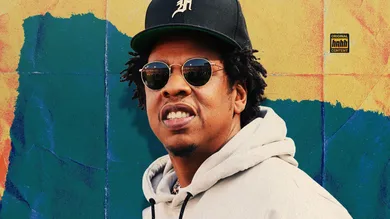


"You can't knock the hustle." It was the first lesson JAŸ-Z taught listeners on Reasonable Doubt, a double entendre that challenged the hustlers who downplayed the importance of money in rap, the system that punished the hustler, and the society that created the circumstances behind both.
Thirty years later, that same mantra exists in a different light. The Lexus that appeared in the "Dead Presidents" video was once a symbol of aspiration, proof that someone from Marcy Projects could dream beyond his circumstances. It represents the evolution of a street hustler into a rap savant, entrepreneur, and hip-hop's first billionaire. It's also the key to understanding why the criticism surrounding JAŸ-Z feels louder than ever.
The past weekend at Yankee Stadium celebrated the unlikely journey that turned Shawn Carter into one of the most influential figures in music history. The first night, celebrating Reasonable Doubt's 30th anniversary, featured a crowd larger than the number of people who purchased the album during its opening week. It was a reminder that one of rap's definitive debut albums has only grown more influential with time.
Reasonable Doubt established the foundation for everything JAŸ-Z would eventually become: Roc-A-Fella's defiance as an independent alternative to the major labels that rejected him, the dissolution of that empire, and the creation of Roc Nation as a corporate powerhouse. From corner boys in Marcy Projects to billionaire boardrooms and corner offices, JAŸ-Z's career has become the clearest example of what happens when the hustle evolves into something much bigger than its original surroundings.
But revisiting Reasonable Doubt today reveals something else. The album wasn't simply documenting the psychology of a hustler. It was laying out a philosophy that JAŸ-Z has remained remarkably faithful to, even when that philosophy has become increasingly uncomfortable to defend. From the beginning, Reasonable Doubt wasn't interested in separating right from wrong. It was interested in explaining why those distinctions often became blurred for people born into circumstances where survival came before morality. "D'Evils" explores how childhood relationships can become corrupted by competition and greed. "Politics As Usual" frames territorial conquest through the lens of something almost sinister, while "Can I Live" wrestles with the benefits that come from morally complicated decisions.
Across the album, JAŸ-Z never glorified greed as much as he examined the compromises that accompany the pursuit of money. Every accomplishment came with an understanding that success could carry consequences, even when the rewards outweighed them.
"Most of us had choices, but the choices were bleak. The street life was tough and morally compromised, but a dead-end nine-to-five job at permanent entry level wasn't all that attractive either," JAŸ-Z later explained in Decoded. Few sentences explain his entire career better.
JAŸ-Z was never keen in presenting himself as a revolutionary in the mold of Tupac Shakur or Public Enemy. He might believe that he’s as complex as Che Guevara with bling on or feel as though there’s significance that his birthday lands on the same day that Fred Hampton died. The reality is that neither of them would’ve f*cked with JAŸ’s politics.
Yet in Hov’s mind, his approach to revolutionary efforts was different. He acknowledged that capitalism was flawed, but he never expressed a desire to dismantle it. His approach was less about challenging capitalism and more about understanding how to navigate it successfully. In the music, he argued that the system was broken long before he became one of its biggest beneficiaries. Wealth wasn't portrayed as inherently virtuous. It was portrayed as necessary. JAŸ's portrayal of the hustle was always complicated. He understood the appeal of money and power while acknowledging the moral compromises that often came with pursuing them.
"The only thing I heard coming up was the American dream. You could make it if you pull yourself up by the bootstraps," JAŸ-Z told GQ earlier this year. "I heard that my entire life—until we started being successful. Then it was like: You're selling out because you're making money."
That perspective has always defined him. JAŸ-Z has consistently viewed the world through the lens of reality rather than idealism. His belief has always been that systems exist regardless of whether they are fair, and success comes from understanding how those systems operate.
That's why Reasonable Doubt has always resembled The Sopranos more than a political manifesto. Like Tony Soprano, JAŸ invites listeners into the mind of someone navigating an environment where survival and dominance become inseparable. The appeal wasn't necessarily in excusing those decisions, but in understanding the logic behind them. Reasonable Doubt functioned less like a morality play and more like a psychological study of someone trying to justify the compromises required to reach a better life.
That honesty is why people connected with JAŸ-Z for decades. He wasn’t the poster child of moral purity. He was embraced because he admitted that success often requires compromises that many people would rather ignore. Perhaps that's why the Illuminati rumors followed him long before he became a billionaire. JAŸ always understood the appeal of power, and he never pretended otherwise.
But those compromises look different when the stakes change. The hustler trying to escape poverty and the billionaire protecting an empire might operate under the same philosophy, but they do not occupy the same moral landscape. We've seen that evolution throughout JAŸ-Z's career, especially when he transitioned from rapper to executive. The resurfacing of DMX discussing his frustrations with JAY-Z's time as Def Jam president highlighted one of the more complicated parts of his evolution. The instincts that helped JAŸ survive the politics of the rap industry followed him into executive spaces, where the competition simply took a different form. The hunger that made him successful as an artist also influenced how he approached business, and that transition has always created complicated conversations about where ambition ends and accountability begins.
This evolution is what makes the recent criticism surrounding JAŸ-Z more complicated. His Roots Picnic freestyle was aimed at familiar targets: former friends, business partners, and artists who have questioned his integrity and business decisions. Given the history between JAŸ and many of those figures, responding to those criticisms was not surprising.
But when he returned with his Yankee Stadium acapella celebrating Reasonable Doubt while addressing online criticism, the target shifted. The conversation was no longer about industry rivals but ordinary consumers questioning the ethics behind the institutions JAŸ-Z now represents. The people questioning his partnership with Target, his relationship with the NFL, or the broader role of billionaire capitalism were no longer just critics from within his industry. They were everyday listeners trying to reconcile the person they saw in the music with the businessman he had become. He was pushing back against the same working-class audience willing to spend hundreds of dollars celebrating Reasonable Doubt. That disconnect is what made the moment feel off-key.
That’s the crossroads of where the expectations placed on Hov collide with the reality of who he has always been. His contributions to culture and philanthropy cannot be ignored. He has created opportunities for artists, invested in communities, and used his platform in meaningful ways. His philanthropy also helped establish him as more than a businessman. It positioned him as someone whose wealth and influence could be used in the service of broader social causes. But becoming a symbol of the American Dream also means inheriting the responsibility that comes with representing what that dream should look like. The Target criticism reflects that tension.
JAŸ-Z's response suggested that critics were being unrealistic, arguing that capitalism is capitalism and that nearly every major corporation operates within the same economic framework. JAŸ wasn't wrong to point out that most major corporations operate under the same profit-driven incentives. That observation, however, doesn't really address why Target became the focus of a boycott in the first place. The criticism came from consumers who felt those structures still deserved scrutiny when they impacted communities that already carry the burden of those decisions. To criticize the same people spending money to celebrate such a milestone is tone-deaf, especially when the disappointment comes from putting him on the same pedestal that helped him accumulate such wealth.
For many consumers, especially within marginalized communities, boycotts are not symbolic gestures. They are sacrifices. Choosing where to spend money carries consequences when affordability and accessibility matter. Treating those concerns as though everyone occupies the same marketplace ignores the difference between navigating capitalism as a consumer and navigating it as someone who profits from it. It's a perspective that feels far removed from the JAŸ-Z, who once rapped about having limited choices, even if it follows the same philosophy that guided him from the beginning.
His relationship with the NFL presents an even more complicated example. The debate was never simply about Colin Kaepernick’s re-entry into the league. Kaepernick's decision carried weight because he accepted the possibility that speaking out could cost him his career. JAY-Z's decision reflected what he described as a different calculation: that influence could be gained by entering those spaces and attempting to create change from within them. Through Roc Nation's partnership with the NFL and initiatives like Inspire Change, investments have been made in areas including education, criminal justice reform, economic advancement, and community programs. Those accomplishments deserve acknowledgment as much as the questions. Kaepernick's influence came from accepting the possibility that his stance could cost him his career. JAŸ-Z 's approach was rooted in the perception that access could become another form of leverage. And yet, the real issue surrounds whether he threw Kaep under the bus in order to push himself into the NFL's sphere. "I think we have moved past kneeling. I think it's time for action," he said during a press conference announcing the partnership. "We forget that Colin's whole thing was to bring attention to social injustice. In that case, this is a success."
The same tension appears throughout JAŸ-Z's career. His proximity to figures like Harvey Weinstein, R. Kelly, Diddy, the Kushners, and the Bronfmans isn't evidence of guilt by association. It does, however, reinforce a pattern that has followed him throughout his career. Access has often mattered enough to justify occupying rooms where ethical lines become increasingly blurred.
Ironically, those questions become an extension of Reasonable Doubt. The album understood that money complicates morality. It warned that ambition does not eliminate ethical dilemmas, it often magnifies them. Thirty years ago, those compromises revolved around surviving the streets. Today, they revolve around maintaining corporate influence. The psychology has remained consistent.
That's why accusations that JAŸ-Z "sold out" have always felt slightly misplaced. Selling out was never the nightmare his music warned against. His songs repeatedly suggested that every opportunity comes with a price tag, and every form of success requires deciding which compromises you're willing to accept. The hustle wasn’t a righteous one but part of an inevitable cycle.
Perhaps that's why one line from his recent freestyle landed differently than intended. "They say I sold out. Yeah, I did sell out. Three nights. I sold Yankee Stadium the hell out." Nevermind that the freestyle itself was rather subpar, and that punchline hardly cracks among his most clever bars, it’s a revealing line. JAŸ-Z has never been offended by accusations of selling out because commercial success has always been the metric through which he measured victory. That has been true since Reasonable Doubt. What's changed isn't his philosophy, but the position from which he now applies it.
Over the course of three decades, JAŸ-Z went from documenting what it meant to survive within a flawed system to becoming someone with the influence to shape parts of it. JAŸ-Z's greatest contradiction has always been rooted in that evolution. The worldview that made him such a compelling figure has followed him through every stage of his career, even as his circumstances have become almost unrecognizable from where he started. That's why the contradictions surrounding Hov aren't new. They've simply become harder to overlook.