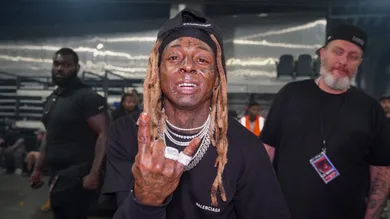


Now, it’s not often that we could use DJ Khaled’s catalog as a point of reference for anything, but there are serious gems to be found there. More than anything, Khaled’s catalog documents Lil Wayne’s progression over the years, especially when he was both the feature and mixtape king, not yet the gargantuan American icon he became. “We Taking Over” probably isn’t Wayne’s best verse at this point, but it was one of those cultural moments where denying his greatness would earn backlash in high school cafeterias, barbershops, and locker rooms. Today, it’s worth looking at Wayne’s contribution to “God Did” alongside Jay-Z and Rick Ross. The verse felt overshadowed by Hov’s lengthy performance, which summarized a career of hustling from street corners to corner offices, but it is particularly important when discussing Lil Wayne’s contribution to culture.
“But I’m so cultivating, everybody replicate me, n***a face facts
Dreadlocks, face tats, I’m the apex
I made the culture, what up twin? Never laid back”
If you saw the video of Lil Baby’s reaction after hearing Wayne’s verse, it captured the moment the New Orleans rapper bypassed his own humility to claim his influence. His description is certainly more shallow than it should be, but it’s evident across the board, especially during the SoundCloud and mumble rap era, where the Wayne aesthetic became the norm. Tupac gave us martyrdom, Biggie provided storytelling polish, Kanye delivered reinvention, and Jay, as his verse on “God Did” summarizes, provided corporate ascension. But Lil Wayne created a blueprint for rappers in the internet era. The direct line between Wayne’s auto-tuned croons and Drake’s sing-rap style is clear. The elasticity in Wayne’s flow echoes in Young Thug’s warping of syllables. Even Future’s drug-coded bravado built a mythology out of Wayne’s double cup. Wayne altered the DNA of hip-hop indefinitely.
But that influence is a double-edged sword for those who never had the same success stories. Most recently, LaRussell shared what many interpreted as a hot take on Wayne’s influence.
“Just because I started listening to everything [and] I started maturing as a human, and I'm like, 'Damn, this n***a wasn't talking about nothing for a long time,'" LaRussell said. "As someone who grew up in these communities and grew up with homies who I seen want to be Bloods 'cause they following Wayne, and want to be gangsters, and want to shoot. All the gun bars. I've seen the negative that he contributed to the community. And I have to look like, 'Man, what are the songs where he really talked about something and gave?'"
The internet spun it into “LaRussell Doesn’t Think Lil Wayne Has Substance,” but his comments, at large, speak to broader problems in hip-hop rooted in capitalism, mass consumption, and what is marketed to whom. That is where Lil Wayne’s influence becomes a double-edged sword.
“Out of a thousand-song catalog, it's minute on this end," LaRussell continued. "Man, 'Tie My Hands.' One of the greatest records ever. If I hug you once, but I slap the s**t out you a thousand times, your affinity for me, you're probably gon' remember me for this. As I mature, a lot of my old favorite artists, I'm now like, damn. I love you, 'cause I learned how to rap to you. But when you look at the contributions, it's like, man."
For an artist of Wayne’s stature, asking for something beyond witty wordplay and technical proficiency may be excessive. But what does Lil Wayne know about the struggles of the average person? He has been a superstar for most of his life. That said, his catalog still contains moments worth diving into. Wayne’s best work often came when he freestyled off the top of the dome across mixtapes and leaks scattered online, moments in the vein of greats who created music without restrictions.
Still, he also delivered substance that was sometimes buried in his prolific output. “Tie My Hands” and “Georgia Bush” addressed political grief. “I Feel Like Dying” became a template for existential addiction, underscoring the lean culture that would later become branding. Early cuts like “Miss My Dawg” and “Hustler Muzik” layered mourning and intention behind the grind. Even recent outings like “Let It All Work Out” and his verse on Solange’s “Mad” offered introspection, humanizing Wayne beyond the superhero persona he created, because he never aimed to be a healer, only untouchable. That is precisely why we tuned into him.
This is also where the duality of his influence becomes apparent. When you are the biggest rapper alive, every action is scrutinized. Waving a red flag carried weight beyond the streets. Yet Wayne isn't the first nor last to wave it loudly. Gang culture in music predates Lil Wayne and has not been confined to hip-hop, with R&B artists like Ray J and Chris Brown claiming association with Blood gangs. They weren't as flagrant in how they represented gang culture as Lil Wayne, but the reality is that gang culture has long been embedded within hip-hop.
At the same time, Wayne normalized the double cup as an accessory. He never sought to humanize himself. In a hyperbolic art form, Wayne remained larger than life. His ability to consume lean and other substances while maintaining functionality became a kind of superpower, even after multiple health scares. Few could endure as much and maintain the same workflow. Wayne normalized excess because, for a long time, he survived it.
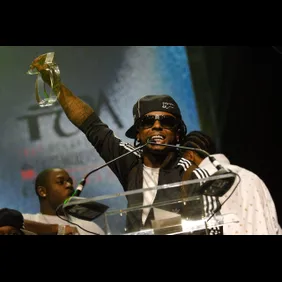
The lifestyle associated with Wayne—money, jewelry, women, success—became aspirational. Yet the core of his influence should be measured in achievement and work ethic. Even in “God Did,” he seems aware that his influence is surface-level, despite acknowledging that he never "laid back." For every pint of lean, every blunt, Wayne maintained a relentless work ethic comparable to Kobe Bryant. Those who came after him wanted the lifestyle his work afforded them without replicating the work itself. Even if the quality of Wayne’s music has declined over the past decade and a half, he remains a machine, and his commitment surpasses his shortcomings.
Wayne recorded from sunup to sundown without writing lyrics down, producing output unmatched in scale and quality. Artists like NBA YoungBoy release similar volumes, but much of it fails to land. Wayne’s greatest asset was the music he released and the catalog he built. How one interprets that catalog is part of the duality LaRussell highlighted.
The backlash LaRussell faced points to broader issues in how Wayne’s career is received. Conversations resurfaced during the 2025 Super Bowl when Kendrick Lamar headlined in New Orleans, highlighting the revisionist tendencies surrounding Wayne’s legacy. Yet the truth is simple: we never needed Lil Wayne to give us moral guidance. His endorsements of Donald Trump and comments on Black Lives Matter indicate his detachment from everyday experience. Wayne was never a moral compass; he was a machine, a glitch in the system, and an apex predator of an art form whose shadow stretched far and wide. Influence multiplies, and how it is wielded is often beyond the control of those who wield it.