

The freaks really do come out at night on Halloween. And whether you celebrate the holiday or not, it’s hard to deny the festivities in whatever form they take. In hip-hop, Halloween feels almost ingrained in its DNA in a way that no other genre can claim. Horror cinema’s chilling soundtracks and menacing atmospheres have seeped into hip-hop’s bloodstream, from its underground origins to its mainstream domination—through samples, music videos, and shared aesthetics.
You could point directly to the horrorcore subgenre as the clearest example. Although some might dismiss it as a niche lane dominated by Insane Clown Posse and Tech N9ne, horror elements have been woven into hip-hop’s most integral moments over time. Prince Paul, Gravediggaz, and Big L intertwined those spooky motifs into their music, while in the South, groups like Geto Boys and Three 6 Mafia drew direct parallels between horror movies and their realities through lyrics and production that felt both hypnotic and eerie.
In that way, hip-hop’s essence lurks through the holiday itself. Halloween marketing doesn’t quite hit without the week-long photo dumps from artists unveiling their most elaborate costumes. For others, it’s the perfect excuse to drop new music—Offset, 21 Savage, and Metro Boomin’s Without Warning stands as a modern Halloween classic. Metro’s cinematic, haunting production perfectly complements the macabre flyness of Savage and Offset’s pairing.
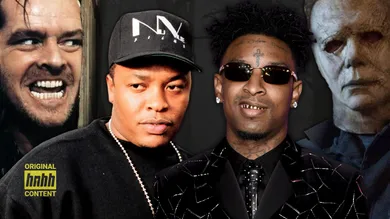
But horror’s place in rap isn’t just seasonal. Its sonic and thematic DNA has been absorbed by rappers and producers alike: the minimalist, eerie piano of Halloween (1978); the brooding synths of The Shining (1980); the screeching strings of Psycho (1960); the unsettling choral “Tubular Bells” motif from The Exorcist (1973); the prog-horror rock of Suspiria (1977); the twisted motif of Saw (2004); and the cult midnight-movie aura of The Omen (1976). From 21 Savage to Dr. Dre, horror’s influence in hip-hop has proven to be multigenerational and cross-regional, transcending the gimmick of the “spooky beat.”
Read More: Dr. Dre's Top 10 Most Haunting Beats
1. Halloween (1978)
John Carpenter’s original Halloween theme—with its cold, gliding piano melody and whisper of dread—has etched itself into hip-hop history. Dr. Dre turned that piano motif into the backbone of “Murder Ink,” looping it and layering heavy drums to create a confrontational G-funk moment. Three 6 Mafia transformed that same theme into the foundation of “Lolli Lolli (Pop That Body),” converting Carpenter’s haunting score into a trunk-rattling club anthem. DJ Paul and Juicy J have revisited the theme multiple times, proving how its simplicity makes it irresistible for beat-makers: the melody is sparse, iconic, and endlessly adaptable.
The film creeps through scenes with sound but never floods them—and producers mirror that restraint. J Dilla, under his Jay Dee alias, flipped the Halloween motif on “Featuring Phat Kat,” while the posthumous Biggie track “I’m With Whateva” (featuring Lil Wayne, Juelz Santana, and Jim Jones) stretched it into another dimension. Few cinematic compositions have lent themselves so seamlessly to rap’s darker moods.
2. The Shining (1980)
The Shining is one of Stanley Kubrick’s most enduring works, and Wendy Carlos’s eerie synth score amplifies its psychological dread. While the film’s music has rarely been looped directly, its mood has been mined repeatedly. 21 Savage’s 2024 single “Redrum” channels the film’s claustrophobic energy, sampling Jack Nicholson’s “Here’s Johnny!” line to drive home the horror connection in its title. Onyx used the same clip on “Stacking” (featuring Dope D.O.D.), while JPEGMAFIA pulled dialogue from Wendy and Danny’s conversation for “💯.” Even Big Daddy Kane and Project Pat have shouted “Redrum!” in lyrical homage.
Kubrick’s visual and tonal fingerprints appear in hip-hop cinematography too. Aesop Rock’s The Impossible Kid was accompanied by a short film that recreated The Shining with miniature figurines. Beyond samples and references, what hip-hop borrows from The Shining is its pacing: slow-burn tension, paranoia, and cabin-fever energy, an emotional register that perfectly mirrors isolation in urban life.
3. Psycho (1960)
Alfred Hitchcock’s Psycho laid the blueprint for cinematic horror, and Bernard Herrmann’s stabbing-string motif remains one of the most recognizable sounds in film history. Producers recognize that tension—the musical signal that “something’s about to happen”—and translate it into some of rap’s greatest moments.
Busta Rhymes’ “Gimme Some More” famously flips Herrmann’s “Prelude,” pairing the frantic strings with Busta’s rapid-fire flow. Dave East and Wiz Khalifa tackled the same sample on “Phone Jumpin,” while RXKNephew’s “Please May I Stab Everyone” pushes it toward absurdist horrorcore. The brilliance of that motif is its built-in suspense—listeners might not consciously recognize the source, but they feel its tension instantly. And of course, countless rappers have nodded to Norman Bates in punchlines, cementing Psycho as part of hip-hop’s psychological lexicon.
4. The Exorcist (1973)
William Friedkin’s The Exorcist pulled horror into the mainstream, and Mike Oldfield’s “Tubular Bells” became the genre’s sonic shorthand for evil. Hip-hop producers, captivated by its eerie bells and choral drones, recontextualized them as reflections of real-world horror.
Ice-T opened his debut Rhyme Pays with it; Cam’ron and Juelz Santana used the motif on “Losing Weight”; Freddie Gibbs echoed its mood on “Forever and a Day.” Cypress Hill even wove dialogue from the film into “Stoned Raiders,” while $uicideboy$ have sampled the movie throughout their catalog. The motif’s haunting spirituality mirrors themes of possession and salvation that rappers recast as metaphors for addiction, faith, and street survival.
5. Suspiria (1977)
Dario Argento’s Suspiria may be an art-house deep cut, but Goblin’s psychedelic-prog score has been a secret weapon for hip-hop producers obsessed with texture. Its lush, unsettling instrumentation and layered percussion offer a palette rather than a loop.
Cage sampled it on “Weather People,” while A$AP Mob’s “Telephone Calls” (featuring Playboi Carti, Tyler, The Creator, and Yung Gleesh) borrowed its vibe wholesale. Raekwon and Bankroll Fresh have also dipped into Goblin’s catalog, drawn to the score’s otherworldly dissonance. Unlike most horror themes, Suspiria’s score evolves constantly—it breathes, twitches, and bleeds color. That complexity makes it irresistible to producers chasing something beyond the typical “dark piano loop.”
Read More: 7 Rappers Who Starred in Horror Movies
6. Saw (2004)
The Saw franchise ushered in a new era of horror sound design—mechanical, suspense-driven, and inherently rhythmic. Charlie Clouser’s main theme, “Hello Zepp,” has been re-appropriated in hip-hop multiple times, its grinding suspense and metallic melody tailor-made for trap production.
The most notable example is 21 Savage’s “Spiral,” from the Saw spinoff of the same name, which directly samples Clouser’s original. The result is seamless: Savage’s steely calm against the theme’s cinematic tension. Elsewhere, Skepta and Trigga flipped it on “Dark,” and Giggs reworked it for “Saw.” The franchise’s aesthetic—stylized violence, psychological gamesmanship—feels inherently compatible with hip-hop’s own fascination with control, strategy, and survival.
7. Candyman (1992)
Candyman remains one of the most significant horror films of the 1990s, and much of its power lies in Philip Glass’s hauntingly beautiful score. Often referred to as “Music Box," the composition builds around repetition, cathedral-like reverb, and ghostly choral textures that sound both sacred and sinister.
That duality has made it catnip for hip-hop producers. The theme’s crystalline piano lines have been flipped across the genre—from the cinematic tension of Travis Scott’s “Days Before Rodeo: The Prayer” to Big Sean’s “1st Quarter Freestyle.” Lil Jon sampled it on “Da Blow,” while Fat Money reworked it for “400 Degrees.” Its minimalist structure leaves room for heavy drums and 808s, turning Glass’s fragile melody into something both chilling and propulsive.The connection runs deeper than aesthetics. Candyman’s story—an urban legend born from systemic neglect—mirrors hip-hop’s instinct to mythologize its own environments. Sampling “Music Box” isn’t just about mood; it’s about reclaiming space, turning horror’s portrayal of Black trauma into something that moves, that bangs. Glass gave the film its haunted grace; hip-hop gave that grace a pulse.