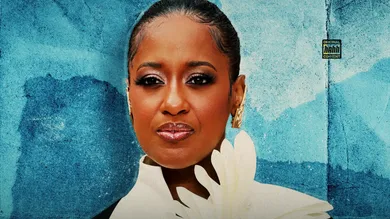


Calling Rapsody a great lyricist has always been accurate, but it has also become an easy way to flatten a career that kept changing. When Return of the B-Girl arrived in December 2010, she was already a precise emcee working within the Jamla Records circle and alongside producers from The Soul Council. “1983,” the second track on that first solo mixtape, introduced a rapper who understood exactly how much the craft mattered to her.
More than 15 years later, the pen is still there. What surrounds it is different. Rapsody gradually made more room for Marlanna Evans in the music, allowing listeners closer to the woman behind an artist who was often discussed almost exclusively in terms of technical ability. That shift became especially clear on 2024’s Please Don’t Cry. Her next album, God Gotta Afro & Gold Hoops, arrives Friday (August 21), with its focus again moving outward toward Black identity and the communities she wants her work to speak to.
Read More: Rapsody Albums & Mixtapes, Ranked
That evolution is easier to hear than explain through awards or career milestones. So, this is not a ranking of Rapsody’s 10 best songs. Instead, these records move chronologically through her catalog, beginning with the early Jamla years and ending at the doorstep of her newest album. Each captures something that changed in the way she approached the music or in what she was willing to reveal through it. Taken together, they show why understanding Rapsody requires looking beyond the reputation she earned for simply being able to outrap almost anybody.
1. “1983” — Return of the B-Girl (2010)
The title alone tells you where Rapsody wanted to begin. This entry appeared as the second track on Return of the B-Girl, Rapsody’s first solo mixtape, released in December 2010. “1983” takes her back to her birth year and uses autobiography as the entry point, giving listeners an early sketch of the person behind a solo career that was only beginning to take shape.
There is plenty of hunger in the record, but young Rapsody does not present becoming an emcee as if destiny were simply waiting for her. She raps about education and having something to fall back on while still making clear where her ambition sits. Even this early, the writing has some of the qualities that would remain throughout her career. She's always had an attachment to Hip Hop history and a refusal to separate what she learned from what she lived.
2. “Believe Me” — The Idea Of Beautiful (2012)
Two years after her first solo mixtape, Rapsody sounded less interested in introducing herself than in showing what it had taken to get there. “Believe Me,” the first single from her debut album The Idea of Beautiful, carries that difference. The hunger is still obvious, but there is more weight behind it. She is rapping about the uncertainty that comes with trying to turn skill into an actual career, opening one passage with, “Mountains and peaks, valleys I been through.”
That perspective fits an album built around a much broader idea than proving she could rap. Rapsody described beauty at the time as something that could take many forms, and the record gave her enough room to move between ambition and relationships without losing the lyrical foundation established on her mixtapes. Musically, The Idea of Beautiful also strengthened the connection between her writing and the soulful production that would remain important throughout her catalog. Rapsody has said that the sound she absorbed from artists like The Fugees and Little Brother deeply influenced her, particularly because soulful beats inspired her as a writer.
3. “Kingship” — She Got Game (2013)
By the time we get to She Got Game, there was less interest in asking for permission. “Kingship” is Rapsody alone over a DJ Premier production, and that pairing matters because the mixtape itself was crowded with respected names. Phonte, Jay Electronica, Nipsey Hussle, and Raekwon all appeared elsewhere on the project, but this song strips the equation back to one emcee and one legendary producer.
Premier’s beat is unusually spacious, giving her plenty of room to determine the pace. Rapsody responds with the kind of densely written verse that had already become part of her identity, but “Kingship” feels more assured than the earlier records. “Washed all my demons in the dark where the fiends trip” is buried inside a run of imagery that moves without stopping to underline every reference. The question was no longer whether she could hold her own beside established rappers. She was increasingly showing that she did not need them there at all.
Read More: Big Daddy Kane Calls J. Cole His "Hero," Praises Migos, Rapsody, & More
4. “Hard To Choose” — Beauty And The Beast (2014)
“Hard to Choose” finds Rapsody turning some of her attention toward the culture around her. The confidence is still there, but the record is less concerned with demonstrating skill for its own sake. She questions what Hip Hop rewards and how easily substance can be overlooked when louder personalities dominate the conversation. Critics at the time singled the song out for its frustration with where the genre was headed.
There is also a line that fits Rapsody particularly well: “The quietest in the room is the baddest one.” It speaks to the position she occupied then. Rapsody was rarely the artist demanding the most attention, even as her reputation among other emcees continued to grow. “Hard to Choose” turns that restraint into part of the point. She did not need to become louder to make the writing hit harder.
Released in October 2014, Beauty and the Beast arrived between She Got Game and the much wider exposure Rapsody would receive after appearing on Kendrick Lamar’s “Complexion (A Zulu Love)” the following year. That placement in her catalog is important. “Hard to Choose” makes clear that the perspective millions of listeners would later encounter alongside Kendrick was already firmly established.
5. “Crown” — Crown (2016)
A new Roc Nation partnership gave Rapsody a larger platform in 2016, but it did not suddenly give her a sense of worth she had been waiting to find. That distinction is all over the title track from Crown, where she treats confidence as something carried internally rather than granted by a label, an audience, or industry approval.
The song opens with the question, “You didn’t leave the house without your crown, did you?” From there, the crown becomes a stand-in for self-possession. Rapsody is not celebrating arrival so much as reminding herself that recognition means very little if it changes the way she sees her own value.
She announced her Roc Nation partnership in July 2016 after years of building through Jamla, then released Crown that November. The timing could have encouraged an easy victory lap. Instead, the project sounds more grounded than triumphant. Rapsody had already spent years earning respect as an emcee, and the deal expanded the machinery around her career without rewriting the work that got her there.
6. “Sassy” — Laila’s Wisdom (2017)
Swagger had always been part of Rapsody’s music, but Laila’s Wisdom gave it more room to breathe. “Sassy” is playful without being lightweight, and its bounce lets her loosen the delivery without giving up the writing that had already defined her career. The song pulls directly from Maya Angelou’s “Still I Rise,” including the question, “Does my sassiness upset you?” Rapsody has said Angelou’s poetry was part of her writing foundation, which makes the reference feel less like a literary flourish than an extension of something she had carried with her for years.
Here, Rapsody is not straining to sound intimidating. That ease helped separate Laila’s Wisdom from the projects that came before it. The album was nominated for Best Rap Album at the 2018 Grammys, while “Sassy” earned a Best Rap Song nomination of its own. Those nominations widened the audience around Rapsody, but the bigger change was already audible in the music. She no longer sounded as though every song needed to function as proof of concept.
Read More: The Top 50 Best Female Rap Albums Of All-Time
7. “Nina” — Eve (2019)
Black womanhood had appeared throughout Rapsody’s music before Eve, but the 2019 album placed it at the center of the entire concept. Each track takes its name from an influential Black woman, with figures including Nina Simone, Aaliyah, Oprah Winfrey, and Michelle Obama providing different entry points into conversations about identity and legacy. Rapsody said she wanted the album to celebrate those women while encouraging listeners to learn more about them.
Opening with “Nina” makes that purpose immediately clear. The song draws from Nina Simone’s recording of “Strange Fruit,” connecting Rapsody’s own writing to an artist whose work regularly confronted racism in America. Rapsody also places herself within that lineage rather than treating Simone as a distant historical figure. “I am Nina and Roberta,” she raps, linking herself to Simone and fellow North Carolina musician Roberta Flack.
That relationship between past and present runs throughout Eve. The women named in the tracklist are not simply subjects for tribute songs. Rapsody uses what they represent to speak about her own experiences and the lives of Black women around her. The concept gave her a way to discuss history without separating it from the world she was writing about in 2019. Critics recognized the album for doing exactly that, placing Rapsody’s perspective inside a much longer cultural lineage.
8. “Marlanna” — Please Don’t Cry (2024)
Technical skill had become such a dominant part of the conversation around Rapsody that it sometimes obscured the person doing the writing. Please Don’t Cry pushed against that distance. The album gave more space to Marlanna Evans, including parts of her life she had previously been hesitant to make public. Rapsody later admitted that although she had always considered herself authentic, she eventually recognized a fear of allowing herself to be completely seen.
Naming the album’s first full song “Marlanna” makes that shift impossible to miss. She introduces herself outside the stage name while acknowledging some of the perceptions that have followed her career. Rapsody has explained that the persona itself once served as protection for Marlanna, the woman she was still learning how to understand.
That separation had become harder to maintain. Please Don’t Cry grew out of a period that included heartbreak and a great deal of self-examination. The musical environment changed with her. It was her first album without production from longtime mentor 9th Wonder, giving her room to work with a different group of collaborators as the sound expanded beyond the familiar Jamla foundation.
9. “Daddy’s Girl” — MadRaps (2025)
A two-song release with Madlib gave Rapsody room to get back to something simpler in 2025, by rapping because the beat demanded it. MadRaps paired her with the veteran producer for their first official collaboration, with “Daddy’s Girl” arriving alongside “Avon Thru the Wire.” There is no sprawling concept to carry and no pressure to make another deeply personal statement after Please Don’t Cry. The appeal is hearing two artists with very distinct instincts meet in the middle.
Madlib’s production gives her an appropriately crooked backdrop, and Rapsody treats it like an invitation to play. The opening, “Beethoven was Black, truth is a key,” immediately kicks into wordplay before she moves through observations about recognition and where she stands among her peers. The writing remains dense, but the record feels loose in a way that matters after an album where so much of the material required her to look inward.
The title also leaves room for something more personal underneath the flexing. When promoting the track, Rapsody connected “Daddy’s Girl” to lessons from her father, including the practical skills and independence he taught her growing up. That combination feels true to where her writing had landed. The rapper who spent Please Don’t Cry letting Marlanna further into the frame did not disappear when she returned to straight bars.
The Pen Was Never The Whole Story
The throughline across these 10 records is not reinvention. Rapsody never needed to abandon the technical skill that made people pay attention in the first place. What changed was how much she asked that skill to carry. Early records were rooted in proving what she could do with a microphone. Later albums made more space for family and self-examination. Her writing also became a place to wrestle with history and the responsibility she feels toward Black culture.
That progression makes God Gotta Afro & Gold Hoops, arriving August 21, feel less like another reset than the next point on a line that has been moving for more than 15 years. Rapsody has already settled the question of whether she belongs among Rap’s strongest writers. The more interesting part of following her now is hearing what she chooses to do with the pen once proving that is no longer the point.