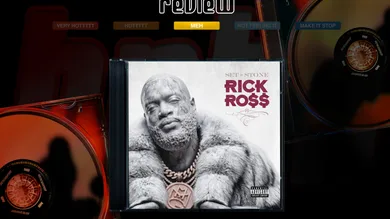


In the middle of the Drake-Kendrick Lamar feud in 2024, Rick Ross inserted himself into a battle that nobody necessarily expected him to join. What started as a few social media jabs between Ross and Drake eventually turned into a public debate over wealth, success, and whose lifestyle represented the ultimate version of success. Drake mocked Ross with the “Miami starter pack” line, suggesting his sprawling estate was closer to a content creator mansion than the palace of a rap mogul.
The irony is that Ross’s entire career has been built around that exact contradiction. Whether it was fair or not, excess has always been the foundation of his mythology. When he first arrived with Port of Miami, he embodied the image of a larger-than-life Miami kingpin who transformed street aspirations into luxury fantasies. As his career progressed, that fantasy expanded beyond music. Maybach Music Group became his corporate empire. Wingstop franchises became proof that the boss mentality extended beyond rap. His mansion, cars, and business ventures became visual representations of what financial freedom could look like. The strength of Ross’s brand is that it became the manifestation of attaining the type of luxury he sold
That’s what makes the current era of his career so complicated. Rick Ross has already accomplished the things he once rapped about. He became the executive. He became the businessman. He became the person younger artists could look at as proof that the transition from rapper to entrepreneur was possible. But now that he has reached the destination, the question becomes: what does he have left to say?
That is the biggest issue with Set In Stone. The album captures everything that has made Rick Ross recognizable for nearly two decades, but it rarely reveals a new dimension of the artist behind the persona. It is full of the same extravagant imagery, the same luxurious production, and the same larger-than-life confidence. The problem is that Ross’s greatest strength has also become his biggest limitation. With 19 tracks and more than an hour of music, the album feels like a continuation of a brand that has already been fully established without a new statement to offer.
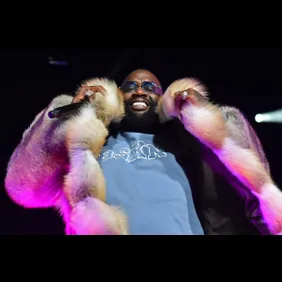
Ross still knows how to make wealth sound appealing. Few rappers have ever delivered luxury better. His deep, commanding voice remains one of the most distinctive instruments in hip-hop, capable of making a dinner reservation sound like a business acquisition. But the issue is not whether Ross can sell the lifestyle anymore because the lifestyle that he once sold hardly feels new.
“Caviar Bumps” is one of the better examples of where Ross is most interesting. The production moves away from the overwhelming orchestral arrangements that have defined much of his career and creates something more grounded, leaning into jazz influences and a more reflective atmosphere. But even there, Ross finds himself revisiting familiar themes, like wealth, paranoia, loyalty, and the cost of maintaining his position. The execution remains strong. The perspective, however, feels familiar.
The strongest moments on Set In Stone often come when Ross allows other artists to challenge his formula. “Mahogany Caskets” with T.I. feels like a reunion between two veterans who understand the difficulty of maintaining relevance after reaching the top. The song’s energy feels natural, with both artists reflecting the tension of aging in a genre obsessed with youth. The record almost feels like it is missing a Wale feature, considering how well his style has historically complemented Ross’s luxury rap aesthetic. “Maybach Music VI” continues that tradition with Don Toliver and Jeezy. Don handles much of the melodic weight, while Jeezy delivers one of the album’s more effective verses by stepping away from corporate language and returning to the hunger that defined his early career. The record works because it connects multiple generations of Southern rap. It feels like a continuation of the Maybach legacy rather than just another expensive-sounding track.
That same energy carries into “Diamonds Never Die,” featuring Kodak Black and Ball Greezy. The song succeeds because it balances Ross’s polished executive image with artists who represent different corners of Florida’s street culture. Kodak’s melodic approach feels slightly disconnected from the production, but the contrast is interesting because it highlights the gap between Ross’s established luxury and the younger generation’s more unpredictable sound.
The album struggles when Ross tries too hard to prove he is still connected to the streets. “Purple Fentanyl” feels like one of the weakest moments because it leans into chaotic trap production and a darker street aesthetic that feels more like an attempt to fit into the current landscape than a natural extension of Ross’s artistry. The title itself feels like a forced attempt to capture modern street language rather than something rooted in his own perspective.
“Big Fish” with Gucci Mane has a similar problem. The collaboration makes sense historically, but musically it feels like a recreation of a sound Ross perfected years ago. It is also an interesting moment because Gucci spends the record reinforcing his reputation for loyalty after recently facing criticism over accusations of snitching on Pooh Shiesty. Regardless of the outside conversation, the song itself feels stuck in a familiar era rather than pushing either artist forward.
One of the more enjoyable surprises comes from “Do It One Time,” where Ross taps back into his Miami roots. The record feels closer to the rapper who once wrote for Trina before becoming the Maybach executive. It has bounce, personality and regional identity. It is a reminder that Ross does not always need extravagant production to command attention. Sometimes the simplest version of Ross is the most effective.
Unfortunately, those moments feel isolated. The Yung Miami-assisted “She’s My Star” attempts to merge two different versions of Miami luxury, but the chemistry never fully develops. Yung Miami has always represented a certain lifestyle-driven confidence. However, her delivery feels slightly disconnected from the brighter, more polished production surrounding her. Later in the album, Ross returns to the motivational territory that once separated him from his peers. “Remarkable Hussle” featuring Leon Thomas serves as another tribute to Nipsey Hussle and focuses on legacy, perseverance and building something bigger than yourself. It is one of the moments where Ross feels closest to the artist he became rather than simply the image he created.
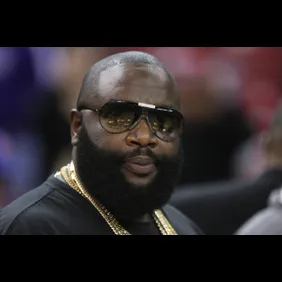
“Chain Of Command” might be the most revealing song on the project because it places Ross alongside underground voices like Big Tony and Nino Breeze. Their street credibility feels more immediate, creating an interesting contrast with Ross’s veteran perspective. Nino Breeze’s technical ability and Big Tony’s Houston-influenced delivery give the record an energy that Ross often lacks when surrounded by established stars.
That contrast exposes the album’s biggest disconnect. Rick Ross built his career on elevation. He represented the journey from nothing to something. But Set In Stone spends too much time reminding listeners that he has already arrived. The hunger that fueled his best music has been replaced by the maintenance of a lifestyle he already achieved.
Production-wise, the album attempts to balance the luxurious Maybach sound with harder trap influences. But neither side feels completely natural anymore. The orchestral production that once made Ross sound like a king can now feel predictable, while the darker trap moments often feel like an attempt to chase a landscape that has moved beyond him.
Rick Ross is living the life he spent years rapping about. That is both his greatest accomplishment and his greatest creative obstacle. He went from being the aspirational boss, to becoming the boss, to teaching others how to become bosses. Now he is figuring out what a boss represents in an industry that changes faster than ever. Set In Stone is not a disastrous album, and it is not a stain on Ross’s legacy. It is simply the work of an artist whose mythology has become almost impossible to expand.
User Reviews:
HNHH users rated Rick Ross' new album 4.08 out of 5 stars based on 6 reviews. One commenter wrote, "Ross has a nice vibe with his music."