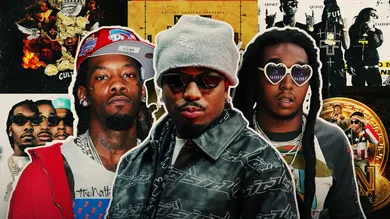


The circumstances that made Rocket Power proved that Quavo’s strongest attributes haven’t faded. The hollow croons of “Mama Told Me,” vivid images of Atlanta’s Norf Side, the grief of Takeoff’s loss, and his back against the wall made him deliver a project that probably would’ve been a more notable debut album had he not dropped Quavo Huncho four years prior. By that point, Migos Mania began fading away; the group was fresh off of the gargantuan release of Culture II, and his solo success made him pop music’s latest fixation.
In a space of mourning, Quavo put his grief, pain, and grit into a body of work like Rocket Power that captured exactly what made him an anchor of the Migos from its onset. Quavo brought the melodies, Takeoff brought the flows and lyricism, and Offset brought the charisma and wordplay. But those melodies in particular became critical to their appeal from their mixtape runs to the Billboard charts. Eventually, his solo career increasingly depended on these harmonies without the counterbalance that his groupmates provided.
On his latest solo effort, Quavo attempts to harness that creativity under Pharrell’s tutelage. Working alongside one of hip-hop’s most imaginative minds is typically a safe bet for innovation and progression, yet that’s not the case. The main criticism of QRÖMELIFE surrounds the production. Quavo's performance is often compelling, but the production and creative direction don't consistently support it.
Huncho sounds seasoned in several moments. There’s a smoky husk to his tone and funky ad-libs on “Hit-A-Lik” and “Backwards” ft. T.I. He rips through the beat on “Baby Breath” alongside Tyler, The Creator, Pharrell, and A$AP Rocky. Offset and Quavo’s reunion on “Away” allows an organic level of collaboration to build off of church organs and decades-long chemistry. It’s no “Bad & Boujee,” but it’s evidence of a chemistry that’s been sorely missing.
The production, however, gets stale on this project, and that doesn’t happen in isolation of Quavo’s performance. For an album executive produced by Pharrell Williams, it doesn’t have that same freshness that’s historically been connected with P. That’s partially due to the fact that the beats have predictable rhythmic patterns and an overly standardized pop structure. Within that, Pharrell is trying to force a pop framework that doesn’t necessarily suit Quavo.
That leverage is apparent on the tracklist’s guest stars outside of Quavo’s more expected wheelhouse of collaborators (i.e., Lil Baby and Yung Miami). Quavo and Justin Timberlake connect on “House Music,” a record that calls back to Jimmy Iovine’s career-changing advice to Pharrell. It’s one of those songs that’s truly worth the meme-inducing criticisms online, especially when Quavo’s dishing out recycled flexes over pop-washed house production and a cameo from the former N*SYNC frontman. It captures one of Quavo’s biggest flaws: delivering lacklustre, uninspired, and formulaic performances when pulled way outside of his comfort zone.
Unfortunately, Pharrell’s history with Migos probably could’ve predicted this outcome. “Stir Fry” proved that the Migos working formula paired well with Pharrell’s eccentric production style. Still, it was also a record that felt too sanitized for what we knew Migos for. Pharrell brought whistles and bongos together to build a proper crossover that was commercially accessible and recognizably Migos all at once. But the polish still felt like a compromise. Culture II already had problems with cohesion, and that wasn’t the result of Pharrell’s production. Part of it related to the fact that Quavo sounded phoned-in, despite having such a large presence on the project, and that issue ultimately extended to the execution of Quavo Huncho.
That pop spree began well before “Stir Fry” or Culture II. He was bound to be a household name by the time he worked with Post Malone on “Congratulations,” cementing the appeal of his trap to pop audiences. Along with the numerous Migos records that had already gone viral, Quavo’s magic touch on “Congratulations” gave Post Malone a triumphant diamond-certified record. However, it also created this template that Quavo tried to replicate when people like DJ Khaled needed him. Did it prove successful? Yes. But did it create any curiosity outside of his radio-friendly outings? Not necessarily. That type of approach hinders a body of work like QRÖMELIFE. It’s reflected in the album’s poor first-week sales and abysmal debut on the Billboard 200 at #103.
According to Quavo, QRÖMELIFE is just the beginning. He’s already confirmed that another solo album is on the way, along with a new Migos album, another Unc & Phew tape, and the release of Takeoff’s posthumous album. He responded to the criticism he faced on QRÖMELIFE with defiance, stating that these next projects will have a more apparent impact. Naturally, there’s an undercurrent of anxiety that lingers across what we’re supposed to expect, especially when considering the emotional weight involved due to Takeoff’s passing. “Away” revisits Quavo and Offset’s emotional history for the first time in four years on Kanye’s “We Did It Kid” and five years after Culture III marked a natural endpoint for Migos. The final installment in the Culture trilogy, though not their best, sounded like they were in a revitalized form, even though there were moments across the project that lacked their synergy as a group.
Maybe that’s because there were already plays in motion. Only Built 4 Infinity Links saw Quavo and Takeoff hone in on a compelling partnership that was already evident during the Migos early days. The legacy between the Uncle and Nephew duo has been a consistent presence on the timeline lately. The AI-generated recreations of their “HOTEL LOBBY” performance on COLORS demonstrate the enduring cultural resonance of Quavo and Takeoff's chemistry. The staying power of “HOTEL LOBBY” embodies exactly why Quavo’s pop-centric efforts have felt far more contrived, especially when he and Takeoff’s back-and-forth had a hit record without stripping away the muddiness that allowed their rawness to co-exist with their infectious tendencies.
But when left to his own devices, Quavo can create something that feels meaningful, compelling, and inspired, as seen on Rocket Power. The circumstances surrounding the project turned it into a much bigger win than any Billboard placement could afford him, especially when it served as a therapeutic outlet, a legacy to uphold, and a definitive return to form at one of the most trying times in his personal and professional life. The stakes were just as personal, if not more, because none of it depended on recreating commercial appeal or trying to reconcile past successes. Frankly, honoring Takeoff became a far more significant mission statement. Quavo’s strongest work emerges when commercial calculation and predictability don’t dictate his creative process.