

The Kendrick Lamar-Drake beef continues to occupy conversation today, but one of the most overlooked shots didn’t have anything to do with Drake. On “Like That,” Kendrick Lamar issued a brief yet relatively respectful warning shot to Melle Mel in the midst of asserting himself at the top of hip-hop’s food chain. Months earlier, the hip-hop trailblazer and pioneer downplayed the influence of Kendrick Lamar. The comments were part of a broader string of hot takes he dished out in the aftermath of hip-hop’s 50th anniversary, and yet, when it comes to K. Dot, Jay-Z, Nas, or even Biggie Smalls, their success meant very little to the purity of the culture in Melle Mel’s eyes.
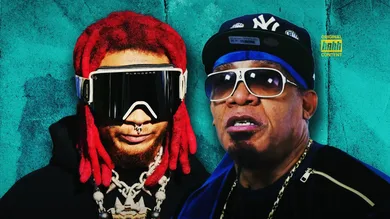
Kendrick's triumphant 2024 run, which culminated in a Super Bowl halftime performance and the record-breaking Grand National tour, also prompted Melle Mel to change his tune in August 2026. But his initial attitude carries from generation to generation. We haven’t heard Melle Mel’s analysis of Trippie Redd just yet, but perhaps their views of hip-hop’s transformation share a few parallels. Melle Mel created a foundation for hip-hop that has continued on for over 40 years.
By the time Trippie Redd’s generation emerged, the critics of Mumble Rap made their case clear: this wasn’t hip-hop. Or, at the very least, it wasn’t rap as we knew it. A few rappers of that ilk proved otherwise, but for the most part, the DIY movement that emerged from SoundCloud changed the fundamentals of rap indefinitely. It’s something that persists today, even if a lot of rappers were unfairly categorized as being part of the problem. It’s not that they didn’t rap–they just chose not to do it in the traditional sense.
Trippie Redd, however, has proven to be a sonic chameleon of sorts, though not necessarily one that succeeds in every style he pursues. But he is part of a generation whose genre-bending efforts have opened the doors for budding artists to explore sounds outside of the norm.
A recent comment attempted to relitigate his space among the Mount Rushmore of SoundCloud rappers as part of a broader argument surrounding the state of the music industry and the artists getting signed.
“The industry is weird right now. A bunch of wannabes doing the same music. I’m actually sorry for contributing to this fast food hipster music… We might have looked the same, but the music is not the same. You can’t play me a ‘F*ck Love’ or a ‘Taking a Walk’ by any of these new jits. It’s all turn up, drink, pop a pill, no meaning,” he wrote.
The sheer irony is that his generation was accused of doing the exact same thing: doing drugs, partying, and failing to deliver anything of substance. Maybe it’s true for some, but you can’t really act as though artists like XXXTENTACION, Juice WRLD, and Lil Uzi Vert–the three other artists Trippie Redd named–also didn’t wear their hearts on their sleeves. The drugs and partying simply worked as coping mechanism. Hip-hop often reflects the social conditions that the youth exist in. Their generation also came of age amid the opioid epidemic. Name-dropping Xanax, lean, Percocet, and other substances was escapism at work. The SoundCloud generation, and even those that arrived prior, became the antithesis of the message behind a song like “White Lines (Don’t Do It)” but not necessarily a far cry from the cautionary message behind a song like “The Message.”
Each generation becomes a case study in the consequences of the one that came before it. But that also introduces somewhat of a contrary approach that, in a sense, keeps the anti-authoritarian spirit of hip-hop alive. Sometimes, it’s bred through misunderstandings, like when Jeezy seemingly took Nas’s “Hip Hop Is Dead” as a slight toward the South’s dominance. Nas’s issue was rooted in the corporate exploitation of hip-hop and how business people and executives steered the genre in the wrong direction while leaving artists with less and less creative control. Artists like Jeezy likely benefited from it more at the time, even if Nas later clarified he was largely targeting New York, but the reality is that record labels have constantly made artists feel dispensable.
That’s partially why most rappers can’t escape being defined by an era, and longevity often feels like a rarity in a genre that celebrates commercial dominance. Truly, it’s not exclusive to hip-hop, but it is something that plagues conversations of artistic merit. Artists like NBA YoungBoy and Playboi Carti developed devoted followings by disrupting hip-hop's conventions, often before their success could be measured by Billboard placements. Drake went from hip-hop’s outlier to its gold standard. This cycle continues forever, and hip-hop needs it to a degree. If it’s going to see its 100th birthday, then its evolution must continue, even if it starts looking unrecognizable.
That tension hasn’t gone unnoticed, especially as the economy of nostalgia has turned more pervasive in pop culture. The independent rap scene harkens back to the 90s, when the pillars of lyricism reigned supreme over the dusty samples of crate-digging. Even more mainstream releases, like MUSIC by Playboi Carti, were distinctly shaped by the sound and sequencing of 2010s mixtapes. That era also represented a time when artists took control of their careers and circumvented label restrictions. It laid the groundwork for the SoundCloud era, which further lowered the barriers to distribution and paved the way for artists like Playboi Carti to prosper. That influence extended into the creator economy, where a pre-existing fan base can lead to an RIAA certification if a song is catchy—or cringy—enough. There are fewer traditional intermediaries between artists and their audiences.
This framework has also made cultural standards increasingly difficult to establish. A new artist making weird music isn't necessarily the problem. They may simply be experimenting. Meanwhile, a YouTuber or streamer with studio-quality microphones and a camera can garner millions of views after releasing a song when they never made music to begin with. That doesn’t really help evolve the genre in any way, especially since in most cases, they’re merely replicating whatever’s hot at the moment. It shows what audience portability can get you. Views and pre-existing fame alone don’t demonstrate artistic contribution or cultural investment into said genre.
Trippie Redd’s commentary echoes a legitimate anxiety about a genre whose boundaries have become increasingly porous. He would be wrong to think that he or his peers are exempt from the same criticism, but he isn’t wrong that things changed. Hip-hop needs people to disrupt its conventions to grow. It evolves by rejecting the conventions of the previous generation. Then, once that new form becomes established, its practitioners can become protective of the very boundaries they once helped break. The next generation breaks those boundaries again.
Maybe its gatekeepers need to be overthrown–the tastemaking torch has gone from DJs at radio stations who broke records to blogs that premiered unreleased music to personalities like Akademiks and other streamers who get their hands on snippets and leaks. And frankly, it’s an ecosystem that’s kept hip-hop alive beyond the lifespan it was assigned by the old guard who always considered it a fad until it wasn’t. However, after 50 years of constantly dismantling its own boundaries, we’re now confronting the strange possibility that the thing preserving the genre’s identity may be the very gatekeeping that each generation has spent decades trying to destroy.