

Hip-hop has always been an extension of the American civil rights tradition—a genre rooted in grassroots community building that eventually became a global phenomenon. It carries forward the political theory and moral urgency developed by Black leaders during the civil rights movement, transforming that blueprint into rhythm and verse. That impact has been felt globally. Not just in America, but across Europe, Africa, Asia, and Latin America, hip-hop has become the voice of communities fighting marginalization. It empowers those who have been minimized and discarded, translating protest into culture.
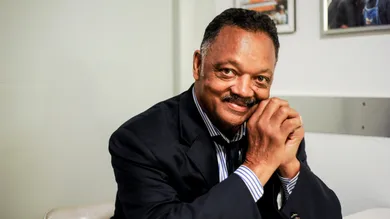
Very few people recognized hip-hop’s long-term impact in its early days, but Jesse Jackson did. When news broke that Jackson passed away on February 17, 2026, at 84, it marked the loss of one of the few civil rights leaders who consistently saw rap not as a threat, but as a potential. His work began in the 1960s—marching alongside Martin Luther King Jr.—and stretched into every decade that followed. He criticized presidential administrations, confronted systemic racism, and remained attentive to hip-hop’s cultural reach.
Jackson treated rap as an extension of the Black freedom struggle rather than a cultural liability. That distinction mattered during the late 1980s and 1990s, when politicians and media outlets targeted the genre as corrosive. Even as hip-hop’s political lens narrowed over time, Jackson remained committed to its higher possibilities. He defended its legitimacy while challenging its excesses. He could critique misogyny and violence while insisting that rap deserved space as political speech.
In many ways, Jackson became a bridge between hip-hop’s cultural force and its political conscience. His voice appeared in the orbit of groups like Public Enemy, and artists such as Nas referenced him as part of a broader tradition of Black leadership. Jackson was never a mogul or producer, but his influence seeped into rap through language and moral framing.
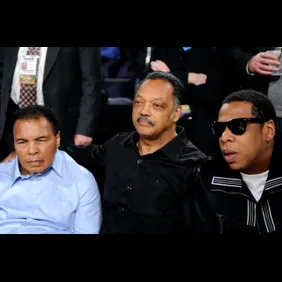
The most famous convergence of Jackson-style rhetoric and hip-hop spectacle came in 2005, when Kanye West interrupted a Hurricane Katrina telethon and declared, “George Bush doesn’t care about Black people.” The backlash was swift, but the moment echoed the tradition of prophetic protest speech that Jackson had long embodied. Jackson didn’t amplify Kanye’s exact words, but he affirmed the broader truth behind them, arguing that the suffering of Black residents in New Orleans reflected “a historical indifference to the pain of poor people and Black people.” The cadence was a familiar moral indictment delivered without apology.
In Chicago, where Jackson built much of his career, that influence was felt long before Kanye stepped onto a national stage. During an interview on The Breakfast Club, Kurtis Blow recalled how Jackson viewed hip-hop artists as the next generation of civil rights heroes. Blow passed that message along to pioneers like The Sugarhill Gang, Grandmaster Flash, and The Furious Five. According to Blow, early artists even adopted a code of ethics—no cursing, no dissing, keep it clean—as a form of discipline and respectability that could help the culture gain mainstream acceptance.
Jackson folded hip-hop’s community-driven spirit into his own outreach through the Rainbow PUSH Coalition, recognizing its ability to mobilize young people. One of the most visible intersections between Jackson and hip-hop politics came in 1992, in the aftermath of the Los Angeles uprising. When rapper and activist Sister Souljah made controversial remarks that sparked outrage from then-presidential candidate Bill Clinton, Jackson defended her right to express the anger of her generation. Clinton’s rebuke became known as the “Sister Souljah moment,” but Jackson countered that she represented “the feelings and hopes of a whole generation of people.” That statement represented hip-hop’s broader emotional reality.
Still, Jackson’s support was not blind. As rap grew more commercial and corporate, he became more critical of its excesses—violence, misogyny, and the normalization of harmful language. He believed hip-hop could be transformative, but he also believed it carried responsibility. His stance reflected tension rather than contradiction: hope mixed with accountability.
Jackson wasn’t a mogul who elevated hip-hop in boardrooms, nor a producer who defined a sonic era. But his spirit lives in artists who fuse sermon and studio. On Michael, Killer Mike channels that preacherly cadence, turning confession and critique into performance. Whether mainstream rap still carries the urgency Jackson championed is debatable. In an era of corporate caution, fewer artists are willing to rattle political cages. Yet hip-hop remains, at its core, a grassroots movement. As long as it continues to articulate the frustrations and hopes of marginalized communities, it will carry echoes of Jesse Jackson’s voice.