
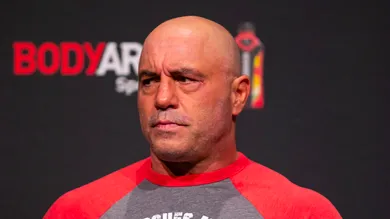


Hip Hop’s weaker showing near the top of the Billboard charts now has an unlikely explanation from Joe Rogan. He claims cuts to American foreign aid are responsible for the decline. During an episode of The Joe Rogan Experience with Shane Gillis, Ari Shaffir, and Mark Normand, the podcast host argued that Rap’s recent commercial slowdown was connected to the Trump administration's dismantling of much of the U.S. Agency for International Development.
“The weird thing is how Rap’s fallen off the charts. It’s because USAID got defunded,” Rogan said. He claimed the agency had funded “radical, anti-government rappers overseas” as part of efforts aimed at political change. His comments arrive during a genuine shift in the charts, where country music has enjoyed an unusually strong crossover run and Hip Hop has not occupied the same space it did at its commercial peak.
Read More: Hip-Hop Artists We Need On The Joe Rogan Experience
More About USAID
The agency Rogan referenced was dramatically reduced under President Donald Trump. Secretary of State Marco Rubio announced in March 2025 that more than 80 percent of USAID programs had been canceled after an administration review. The government later moved to fold much of the agency’s remaining work into the State Department. Those cuts affected foreign-assistance programs around the world, but no evidence has emerged linking them to Hip Hop’s performance on the Billboard charts.
However, Rap’s commercial position has been changing for reasons the industry has been tracking for several years. In October 2025, the Billboard Hot 100 went without a Rap song in its Top 40 for the first time since 1990. That milestone was partly affected by Billboard’s recurrent chart rules, but it also reflected a broader decline in the genre’s market share relative to its late-2010s and early-2020s dominance.
Country’s current Hot 100 strength has made that shift especially visible. Ella Langley’s “Choosin’ Texas” has spent much of 2026 at No. 1, while country and Western-influenced records have occupied an unusually large portion of the chart’s upper ranks. That success gives Rogan a real trend to point toward. What remains unsupported is his explanation for it—USAID’s documented involvement with foreign artists does not show that the agency was propping up American Hip Hop, much less that its dismantling caused Rap records to lose ground.