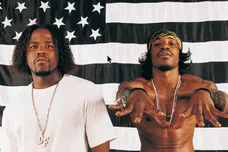


The South has something to say. Those infamous words were echoed throughout the Paramount Theater in New York City in 1995 during one of the most contentious nights in hip-hop history. In the midst of a bubbling feud between Bad Boy and Death Row that turned territorial, OutKast planted a flag for the South that undoubtedly felt prophetic of the cultural dominance we’d see from the South in the years that followed. Ironically, despite being booed by a New York-dominant crowd, the influence of the South eventually seeped into the fabric of the East Coast and beyond.
That’s not necessarily due to OutKast alone, but their influence can’t be denied. Arguments surrounding the best rap duos/groups often see them at #1, while André 3000, without releasing a solo album, is your favorite rapper’s favorite rapper. Mind you, it’s been 20 years since the release of their last album.
Three decades later, André 3000’s contentious speech at the 1995 Source Awards has come to be regarded as a turning point, both in OutKast’s career and in the dynamics of regionalism in hip-hop. Their legacy doesn’t need another reunion tour or a comeback album to revalidate. The cultural currency developed around their name is invaluable. Aquemini celebrated its 28th anniversary on September 29th. Even the albums that preceded the massive commercial success of Speakerboxx/The Love Below carry as much acclaim without a song like “Hey Ya!”
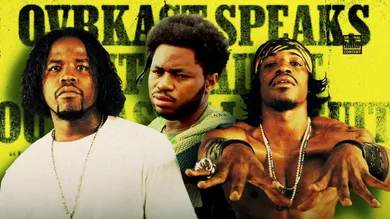
But when a legacy of such magnitude becomes just as much of a valuable piece of intellectual property, it starts to collide with the culture it belongs to. OutKast’s recent lawsuit against Ovrkast. sits at the crux of the dilemma between capital and art. High Schoolers LLC (the holding company owned by Big Boi and André 3000) filed a lawsuit against Ovrkast. for trademark infringement, unfair competition, and breach of contract. The lawsuit filed in federal court alleges that a cease-and-desist letter was sent to Ovrkast. in June 2025, and that they eventually reached an agreement where the Bay Area rapper would change his name. However, High Schoolers LLC claims that Ovrkast. didn’t hold up his end of the bargain. Apparently, he agreed to change his name to “OVERKXST,” though the up-and-coming rapper-producer argued that he never signed an agreement.
All of this has left Ovrkast. in an awkward position, forced to defend a name that he insists was never intended to capitalize on OutKast’s legacy. Yes, he’s had plenty of people leap to his defense, but there have also been countless users on X, Instagram, and elsewhere who’ve been going at his throat as if OutKast is their family name. Ovrkast. explained his position–he told Rolling Stone that he never “had any intention of trying to copy, misrepresent or confuse fans with the name of such a legendary act.” He also explained that he started a collective online called weathrboyz and a few members had “-kast” as part of their meteorological-inspired names. “In 2015, I created an online collective called ‘weathrboyz’ a few of us had different names that were related to weather and had ‘kast’ at the end,” he wrote. “I say this to say, my name was never ever inspired by them.”
Not only does High Schoolers LLC want a court order preventing him from using Ovrkast. as a moniker, but they also want him to hand over all profits made from “unlawful activities alleged herein.” Additionally, they’re asking that he “deliver for destruction” all merchandising that involves the Ovrkast. brand. For a budding artist who is far from a household name, the scope of those demands makes the dispute feel considerably larger than the alleged overlap itself.
Yet, this isn’t the first time that OutKast has gone after a musical entity for infringing on their intellectual property. They sued the EDM duo ATLiens for trademark infringement. In that lawsuit, OutKast accused them of using ATLiens, the name of their sophomore album, without their permission while also trademarking the name without their awareness. Similarly, they were seeking damages and a court order preventing them from using their name.
“The album’s title is a portmanteau of ‘ATL’ —an abbreviation for Atlanta, Georgia — and the word ‘aliens,'” the lawsuit explains. “The word ATLiens was invented by Outkast. Before Outkast created it, it was not used in the cultural lexicon and did not exist.”
OutKast’s lawyers argued that it was a basic brand protection issue, and eventually, they reached an agreement. The terms weren’t publicly disclosed. But the ATLiens case presents a more intuitive question of potential consumer confusion: an EDM duo was using the exact title of one of OutKast’s most recognizable albums.
In the case of Ovrkast., that confusion doesn’t seem as clear-cut, outside of the fact that they both share seven-letter names that differ by only two letters. The similarities are obvious enough that the court filing cites an interview where he acknowledged that there is confusion among fans who read Ovrkast. as OutKast. But the cultural controversy seems to center more on OutKast’s enormous name recognition than on evidence that consumers are actually mistaking Ovrkast. for OutKast.
Ultimately, there’s an irony in what’s playing out in front of our eyes. Similar to the lawsuit against ATLiens, this lawsuit wouldn’t exist without the cultural influence of OutKast. And frankly, if they weren’t as influential, no one would have batted an eye at the fact that Ovrkast.’s name ends with “kast.”
The legacy that paved the way to the Rock & Roll Hall of Fame became the intellectual property they’re now fighting for. But what’s wild is that this intellectual property feels like it’s being used to draw boundaries around a culture that always thrived on borrowing and pulling inspiration from what came before it. We’re witnessing a situation where the underdogs who fought to get their voices heard have turned into an institution in and of themselves. To some, they’re the old heads whose influence has become so valuable that even the young bulls have to account for it. Yet, OutKast doesn’t have to act maliciously for this contradiction to exist, even if they argue that Ovrkast. "knowingly, wilfully, intentionally and maliciously adopted and uses the Ovrkast mark and demonstrate an intentional, wilful and malicious intent to trade on the goodwill associated with plaintiff and the Outkast mark" in their court filing.
Their success isn’t the issue, but their success also changes what their influence means. It’s quite the 180 from demanding respect 30+ years ago, and the uncomfortable part is that protecting their legacy can feel at odds with the culture that made the legacy possible in the first place. At the center of it all is the fact that we’ve watched something as culturally fluid as hip-hop become increasingly divided into privately owned intellectual property.